
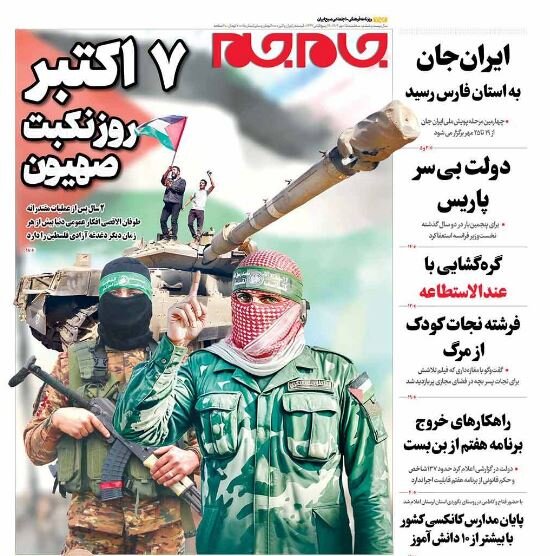
TEHRAN – In an article, Jam-e-Jam addressed the West’s endless violations of commitments, including the nuclear inspection agreement signed between Iran and the International Atomic Energy Agency (IAEA) on September 10 in Cairo, Egypt.
It reads: Iran’s history with the West in recent years is full of deceptions and breaches of commitments, from the betrayal of the JCPOA to the burial of the Cairo accords. The massive Israeli and American airstrike on Iran, two days before the fifth round of indirect talks between Tehran and Washington, was a fatal blow to diplomacy. More than 120 countries condemned these attacks, considering them clear attacks. However, in accordance with the post-war atmosphere and the demands of European countries, Iran pursued the path of dialogue with the IAEA and achieved a new framework of limited but targeted inspections, resulting in the Cairo Agreement. In an official statement, IAEA Director-General Rafael Grossi called it a practical step to restore trust and said the agreement demonstrates Iran’s goodwill. But the West deceived it. The Cairo Agreement was designed on the principle of cooperation, but it lasted only two weeks. The activation of snapback was the peak of killing diplomacy.
Siasat-e-Rooz: The enemy is always the loser
Siasat-e-Rooz argued in an editorial that Zionist enemies ultimately remain losers. Israel claims it has achieved tactical gains against resistance groups and temporarily shifted the balance in the region, but has not secured a decisive victory in Gaza. The resistance the editorial maintains continues across the region. The piece adds that efforts by hostile states and groups to disarm Hezbollah have failed, Iran won the June 12 war, and Yemen continues to break away from Israel. Taken together, these developments demonstrate that Israel is in a critical position. Considering the events in Palestine, the editors conclude that countries must strengthen themselves, because negotiations and compromises do not bring results. As evidence, it cites attacks on Iran by Israel and the United States during ongoing talks between Iranian and American diplomats. Ultimately, it calls for a new world order. This abandons capitalist-led unilateralism in favor of fair multilateralism to overcome the current crisis.
Ettelaat: After snapback sanctions, will China remain a customer of Iranian oil?
Ettelaat investigated Iranian oil sales after activation of snapback sanctions in an interview with energy expert Mahmoud Khaghani. He said: The return of international sanctions against Iran has raised a lot of questions about the country’s income, since the amount of trade with other countries will decrease by the same amount, and as a result, financial irregularities will increase. Today, most of Iran’s oil is purchased by private refineries in China. In fact, so far these refineries have not been directly affected by the White House’s (secondary) sanctions, as they do not have extensive ties with the United States. China always defends its national interests, so if Washington puts pressure on Beijing or offers greater benefits in the form of a Chinese contract, China may abandon oil imports from Iran. Therefore, the ruling system needs to seriously revise its oil policy so that developments in the international system’s foreign policy or changes in the equation cannot easily affect our oil revenues.
Arman-e-Melli: The Cairo Agreement in Ambiguous Situations
In a commentary, Armand Emery addressed the ambiguity of the Cairo Agreement and wrote: During the negotiations between our country’s Foreign Minister Araghchi and Grossi, hosted by Egypt, the Cairo Agreement was reached to resume cooperation. After the Cairo Agreement, Araghchi said that this agreement aims to prevent the activation of a snapback, and if the Europeans do not take into account this goodwill by Iran, the Cairo Agreement with the institution will indeed lose its meaning. However, the Europeans, despite Iran’s good intentions, continued on their own course and witnessed a shift towards activation of snapback sanctions due to the lack of permission from their “big brother” the United States. In such a situation, where the West is making exaggerated claims instead of a constructive approach, Iran seems to be saying that the agreement with the institution is not effective, and the only way to change the terms is to restart negotiations, and there is no other way. The Europeans themselves realize that pressure on Iran is not effective and, ultimately, they must sit at the negotiating table with Iran.