
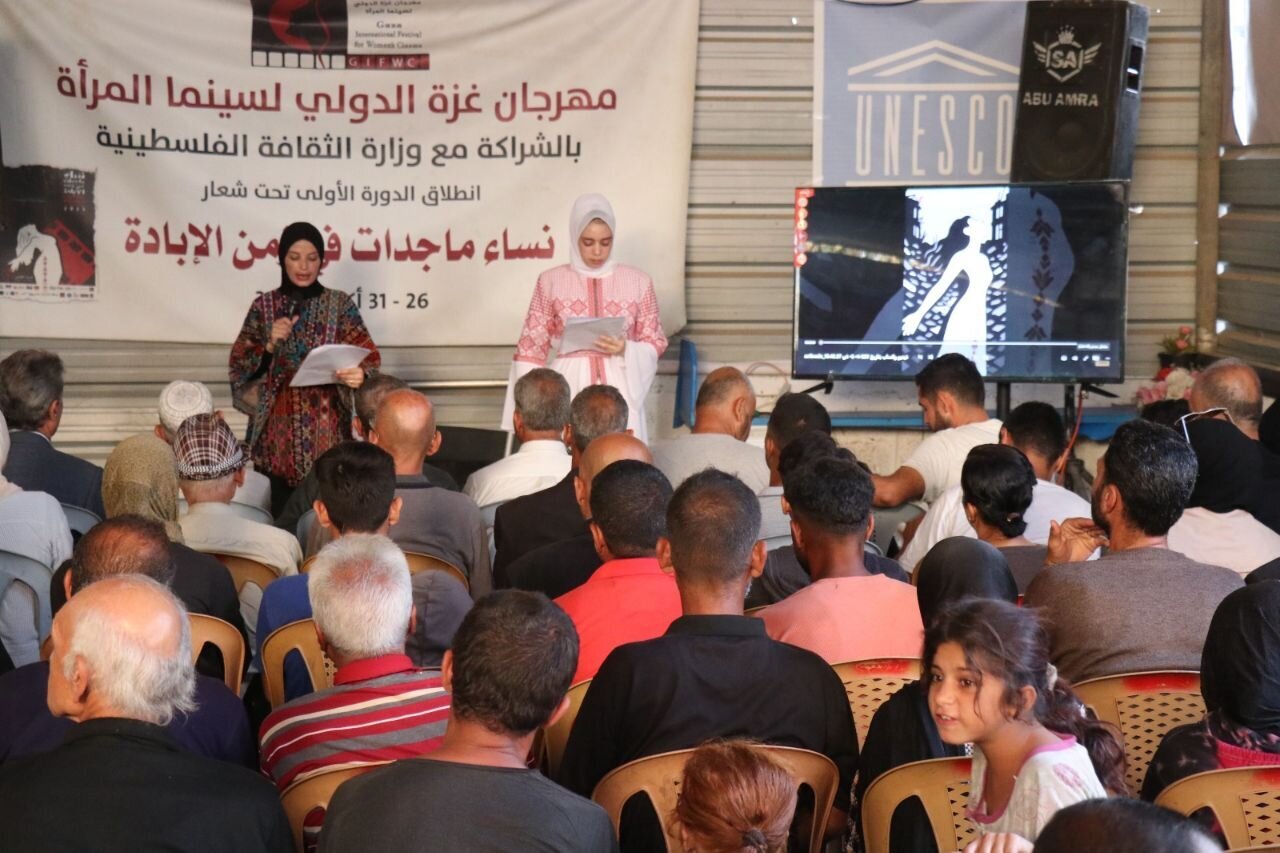
TEHRAN – Amid the devastation of war and displacement, Gaza has produced an extraordinary act of cultural resilience: the first Gaza International Women’s Film Festival. Founded by Palestinian filmmaker and researcher Ezzedine Shaller, the festival brings together 79 films from 28 countries to celebrate women’s voices through film, even as bombs fall and cities crumble.
Held in a displacement camp using small home televisions and generators, the event symbolizes Gaza’s unwavering commitment to art and life. In this exclusive interview, Shaller speaks to Tehran Times about founding the festival under siege, women’s cinematic resistance, and the power of storytelling amidst destruction.
The text of the interview is below.
What inspired the creation of the Gaza International Women’s Film Festival, especially in such a dire humanitarian situation?
We are living in the midst of a genocide in Gaza, and I myself am a refugee in a refugee camp. There I met many women who had lost their husbands, sons, or their only caregivers – women who suddenly had to leave their homes and face life alone. Their stories gave rise to the idea of empowering women through film and helping them become filmmakers who tell women’s stories through their own eyes.
This film festival, the Gaza International Women’s Film Festival, was born directly from the pain, displacement, and destruction that surrounds us. These harsh realities gave rise to this idea. Palestinian novelist Ghassan Kanafani once said: “It is not important to die before realizing your ideas, but it is important to have noble ideas before you die.”
Lockdown didn’t stop us. In fact, that was the very reason we created this space. As the world approaches, art becomes the only window through which we can speak and survive.
Many describe art and film as forms of resistance. What do you think about the contribution of Palestinian women filmmakers to cultural resistance through this festival?
Art and film are powerful forms of soft resistance. They allow us to reach a global audience in a way that weapons and politics never could.
In Gaza, in the midst of genocide, thousands of untold stories are waiting to be captured on film. We are currently training 20 young women from Gaza to be film directors. Each training cycle will produce five films that will be premiered at festivals and then participate in international festivals.
Through these films, the world learns about the reality faced by Palestinian women: their pain, resilience, and humanity. These stories serve as living testimonies that reveal the truth that the occupation inflicted on our people. In this sense, film is both a cultural act and a form of resistance.
What logistical and psychological challenges did your team face in organizing a film festival in Gaza under shelling, forced displacement, and communication breakdowns? How did you overcome them?
The challenges were immense, both logically and emotionally. There was no electricity and the movie theater screens weren’t working. The large screens we used in the past were destroyed when the Israeli military bombed a center for the disabled that housed them.
After searching endlessly, I finally had no choice but to use a small 55-inch home TV. It was difficult for people sitting far away to see it, but I managed to do it. We didn’t have electricity so we rented a generator, but we needed fuel and it was almost impossible to find. After some trouble, I managed to get a diesel.
Imagine the noise of a generator mixing with the sound of a movie. Still, the refugees in the camp continued to watch, as if the story on the screen was bigger than the machine.
All the cultural institutions in Gaza had been destroyed, including the Rashad al-Shawa Cultural Center where we were holding the festival, so we screened the film in an evacuation camp among the tents and rubble.
They considered holding the opening of the festival on the site of the former shower center, but by the next morning the area was filled with tents for displaced families. So we laid out a red carpet between the tent and the rubble.
Our opening film was The Voice of Hind Rajab, which won the Silver Lion at the Venice Film Festival. The first screening of this film in the Arab world took place at our film festival, right in a refugee camp.
How do participatory films depict the everyday realities of Palestinian women: not only their suffering, but also their creativity, resilience, and influence?
From the beginning of the Palestinian struggle, women have been steadfast, patient, creative and active participants. They tell their stories with depth and symbolism, revealing truth through artistry rather than direct reportage.
Movies are not breaking news. It’s a poetic, emotional, and very human form of storytelling.
How are the cinematic stories of women in Gaza different from those told by men and outsiders documenting the conflict?
There is a big difference between the perspectives of Palestinian female filmmakers and other women. When a woman tells a woman’s story, she captures invisible emotional layers and realities.
Palestinian female directors approach their subject matter with boldness and creativity, offering a sensitivity and insight that lends authenticity to their work.
Has the festival received any support, recognition or solidarity from international filmmakers and cultural institutions?
Yes, this festival has had great solidarity and support from international filmmakers and organizations. Among them are German director Monica Maurer, French director Celine Sciamma, and Italian actress Celine Trinca.
It also received support from several international and Arab institutions, some of which participated in the founding committee and contributed directly. These include the European Women’s Audiovisual Network, the Florence Film Festival, and many others.
Their participation greatly encouraged us and strengthened our belief that film can build bridges even in the midst of destruction.
What does it mean to hold a film festival under these circumstances, when so much of Gaza’s cultural infrastructure has been destroyed? Can cinema survive and thrive under siege?
When cultural life is destroyed, we are faced with two choices: surrender to death or resist death.
Movies mean life, and life has to face death.
Holding a festival here is an act of defiance, a declaration that creativity cannot be killed.
Do you think Western media and the global film industry fail to reflect the real lives of Palestinian women? How can your festival help change that narrative?
Yes, Western media and movies have long misrepresented not only Palestinians but Arabs in general, often portraying us in unrealistic and dehumanizing ways.
We aim to reveal the truth through the Gaza International Women’s Film Festival. Over time, this will have an impact. The festival is part of a broader cultural movement with Palestinian filmmakers, artists and musicians, all telling the Palestinian story in their own unique ways.
Together, we can form a collective voice and slowly change the way the world sees us.
What message do you want to send through this festival to audiences around the world who may only see Gaza through the lens of destruction and despair?
We are a people who love life and believe that life always triumphs over death.
For our people, this festival brings a glimmer of hope amidst the rubble, a reminder that beauty and art still exist and that tomorrow can be brighter.
We say this to the world: Despite the killing, destruction and siege, we are still here.
Through film, we proclaim our presence and resilience.
We are here, and we are staying on this land.