
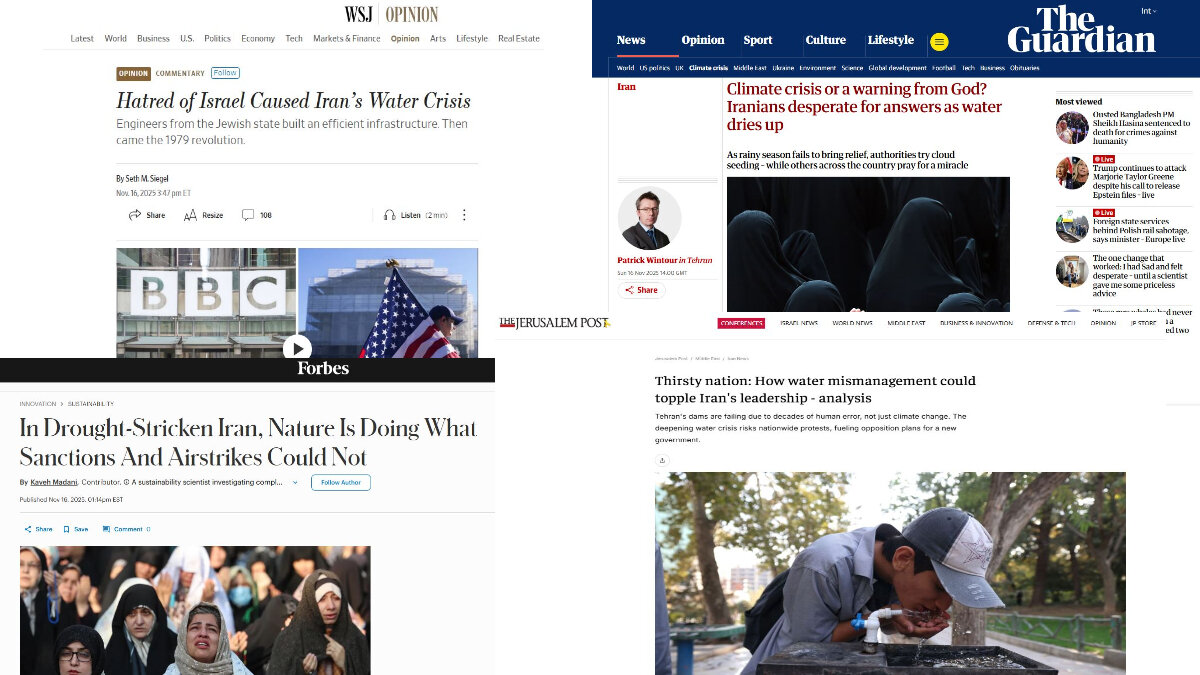
TEHRAN – Iran is facing one of its most serious water crises in decades. But much of the Western and Israeli press is treating the crisis as a political morality play. Headlines and editorial pages link the shortage to government failures and geopolitics, while technical causes and practical solutions are sidelined. This framework misdirects policy discussions and risks turning humanitarian offers into diplomatic drama.
For example, the Jerusalem Post recently portrayed the drying up of Iran’s rivers and shrinking reservoirs as evidence of “regime decline,” linking hydrological decline to an implicit crisis of political legitimacy. The Wall Street Journal went further, claiming that Iran’s “hatred of Israel” was the real cause of the water shortage. This is a clearly moral and geopolitical interpretation that treats complex environmental emergencies as a direct extension of foreign policy choices. There’s even a high-level political message woven into the story. In August, Prime Minister Benjamin Netanyahu offered Iran water technical assistance, but made it conditional on political change in Tehran, ensuring that the offer was perceived as a signal of “regime change” rather than technical cooperation.
This political lens is not limited to opinion pages. Features in Western media, such as the Guardian’s recent report on a community desperate for a spiritual explanation as water disappears from their village, foreground social or moral narratives in ways that risk obscuring their underlying structural realities. And newer reports, such as a Reuters report that Tehran’s neighborhoods are drying up and a warning from the Associated Press that the capital could face evacuation if it doesn’t rain, are increasingly reinforcing images of chaos and state failure, reinforcing the idea that the water crisis is above all an indictment on Iran’s political system.
However, upon examining the evidence directly, Iran’s water crisis emerges as a regional and structural hydrological emergency shaped primarily by climate trends. Climate change is increasing baseline drought risk across West Asia, as demonstrated by IPCC assessments and multiple regional studies. Several countries are facing similar rainfall declines. Iran’s difficulties mirror those of its neighbors, from Turkey’s shrinking rivers to Iraq’s salting marshes to Jordan’s depleted aquifers.
The World Bank’s country assessments emphasize that adaptation, not political alignment, will determine countries’ ability to withstand prolonged drought. Meanwhile, geopolitical analyzes such as the Special Eurasia report emphasize that Iran’s water shortages are forcing the state to reconsider its long-term plans, but they base their assessments on the realities of resource management rather than political morality.
Even dramatic coverage of Tehran’s impending water restrictions, including reports from NBC News and Le Monde, make clear that while the crisis is dire, its causes lie in a long chain of misaligned incentives, over-exploitation, climate stress, and delays in infrastructure reform, rather than a single political decision or foreign policy stance. The Western tendency to view environmental collapse as an indicator of regime fragility inevitably turns hydrological data into political commentary. In doing so, it obfuscates the policy tools that Iran, like many countries in the region, urgently needs: efficient irrigation systems, transparent groundwater governance, urban leakage reduction, aquifer recharge programs, and a shift toward crops that are better suited for long-term water use.
The politicization of Iran’s water crisis also distracts from broader regional truths. In other words, all of West Asia is moving toward absolute water scarcity, with nearly every country in the region increasing its dependence on desalination, groundwater depletion, or fragile river systems. When Iran is singled out for warning, opportunities for regional water cooperation and recognition of common vulnerabilities are diminished. Israel’s unique water system, often cited as an ideal model in Western commentary, relies on energy-intensive desalination, faces long-term sustainability concerns, and is embedded within a transboundary hydrology that climate change will continue to reshape.
Iran’s water emergency is real and urgent, but reducing it to a morality tale does little to address it. Effective reporting must situate Iran within the region’s climate and hydrological crisis, prioritize expert analysis from groundwater experts and climate scientists, and separate humanitarian and technical assistance from political signals.
Only beyond the political arena can domestic and international actors focus on practical solutions, from modern water governance to climate adaptation to cross-border cooperation, that will determine whether Iran and its surrounding region can withstand the environmental stresses of the coming decades.