
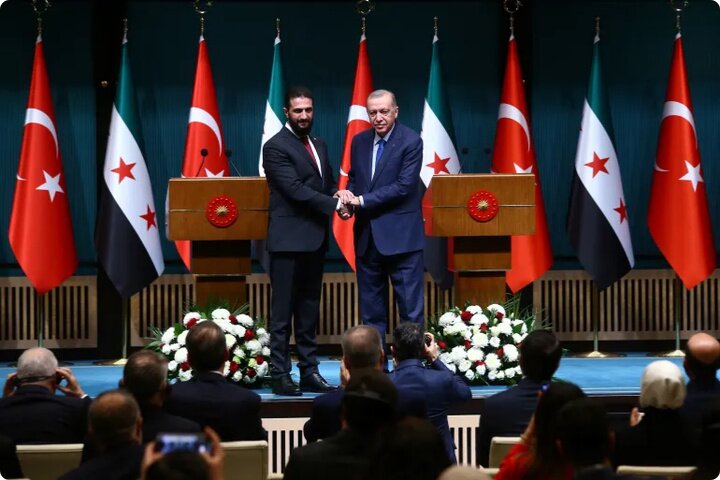
Continuing Israel’s attack on Syria faces the country with major challenges and problems. As a result, Syria’s security and stability remained vulnerable and unstable, and Joranni not only failed to ease the political atmosphere and internal tensions in Syria, but is also helpless in the face of external threats. As for Israel, virtually nothing is said to other officials of the interim government in Jorani and Damascus. This is because since July and August 2025, Israel has carried out at least six major military operations in Syria, including airstrikes, drone strikes and ground assaults.
The Wall Street Journal reported that since December 2024, Israel has carried out hundreds of airstrikes across Syria, averaging one strike every three to four days. Al Jazeera also said in a detailed report that Israel has carried out at least 400 ground attacks in Syria since the collapse of Bashar al-Assad government. In the most recent case, on August 27 (4 days ago), a former air defense base near Arkiswa in southern Damascus was subjected to a fierce military attack by Israel. However, Israelis are not limited to air and drone strikes. In addition to 47 airstrikes and nine ground operations, the base’s Syrian weapons depot, command centres and military equipment have also been targeted by artillery fire, according to the Guardian.
Now it is clear that Netanyahu’s troops observing Jolani’s inaction are significantly strengthening operations in Syria, carrying out a combination of air, ground and artillery strikes. Meanwhile, across Syria’s northern border, Turkey is engaged in diplomatic gestures towards Israel. Turkey is considered a major supporter of the structure emerging from Hayat Taharil al-Sham and issued a statement in Ankara parliament describing Israel’s actions in Gaza as genocide.
However, Türkiye has also maintained a soft stance on Israel’s continued aggressive attacks on Syrian soil. The farthest thing the Erdogan government has made in response to Israeli air and Syria’s ground strikes was a statement from the Foreign Ministry. The current key question is why is there such integrity and similarity between Ankara and Damascus in response to Israel’s attack on Syria? Does this suggest some form of political adjustment between the new Turkish and Syrian regime, taking into account certain short-term benefits?
To find the answer, we need to remember the events of the past few months, especially the diplomatic meetings between Jolani’s team and Israeli officials. It should be remembered that due to the mediation between us and Turkey, at least two high-level meetings were held between Jolani’s interim government and the Israeli government. However, none of these meetings have acted as platforms to express protests against Syria’s repeated attacks, indicating that Jolani officials have refused to take Netanyahu’s solid position against the army.
Who is the main player?
Israeli officials have consistently raised unfounded pretexts such as countering Iranian influence, preventing the transfer of weapons and ammunition, and defensive measures, in justifying the aggression against Syrian soil and airspace. For example, the Times of Israel reported that these attacks were linked to claims that target strategic weapons depots, military airports and naval facilities to prevent senior weapons from being transferred to delegated forces.
But long ago, the Guardian, citing Reuters and Israel Katz, wrote that Israel’s main purpose is “to establish a defensive zone in South Syria to prevent hostile troops and weapons from threatening northern Israel.” In fact, none of these arguments are true. Israel’s two main actions in Syria are to occupy a significant portion of Syrian territory under the pretext of border security and provoke the Druze of Sweida along with Kurdish militia known as the SDF in northern Syria and eastern Syria.
Meanwhile, as a leading Israeli supporter, the US has staged a political show to mask Netanyahu’s intervention, pretending that the issue is in border disputes and that the constant presence and mediation of diplomat Tom Barrack is necessary to resolve these conflicts.
Tom Barrack serves simultaneously as the US ambassador in Ankara and the envoy to the US President of the Syria Files. However, barracks are not limited to this liability. He also plays an interfering role in Lebanon, particularly regarding the US demands for Hezbollah’s disarmament.
At the same time, Israel expanded its control in the Golan Heights Buffer Zone under the pretext of creating a buffer zone, violating the 1974 dismissal agreement. Without a doubt, these actions reveal strategies to create a deep security environment within Syrian territory. More specifically, Tom Barrack pretends to work to resolve the border and political conflict between Syria and Israel, but the Israeli occupation of Golan, continued strikes in Damascus and its suburbs, interference in Sweida, deployment of helicopter-resident troops, threats and troop shows have been measured in stages. Barack has repeatedly argued that his main goal in the ongoing negotiations between Syria and Israel is to reduce tensions and establish a new security framework. Nevertheless, there are no signs of positive change and the situation in Syria remains unstable and vulnerable.
Fear, restraint, or tacit agreement?
Many analysts believe that Syrian military forces and their security and defense structures have yet to be completely reconfigured after the collapse of Bashar al-Assad’s government, leaving them with limited military capabilities and a vulnerable security environment. Furthermore, in the current situation, reconstruction efforts take priority over everything else. Israel recognizes Damascus’ weaknesses and continues to bully them.
In recent months, several defence cooperation documents have been signed between Syrian and Turkish officials in Ankara and Damascus. The main architecture of Syrian new army and intelligence reporting agency is said to be overseen by Turkish advisors. It is therefore clear that the main reason for Jolani’s passivity towards Israeli attacks is not his military capabilities but his political will.
When it comes to Turkish stance, Erdogan and Turkish parliamentarians often rely on tools such as parliamentary resolutions, speeches and symbolic diplomatic condemnation. Ankara is trying to establish herself as a Palestinian advocate, but in reality, Turkey prefers to avoid robbing her solid position against Israel, and instead hopes to be able to manage some of the Israeli threats with our help behind the scenes.
MNA/6577091