
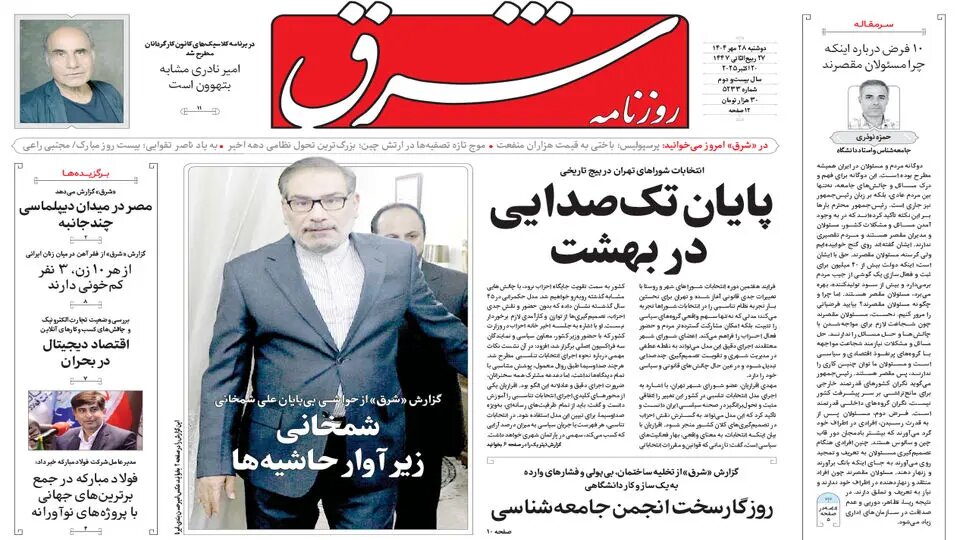
TEHRAN – In his analysis, Shagh examined President Donald Trump’s decision to regain control of Bagram Air Base in Afghanistan after the US withdrawal from Afghanistan in August 2021.
“From Tehran’s perspective, these moves signal the possible opening of a new strategic front on Iran’s eastern border,” the newspaper said. For decades, Iran has concentrated its military and security resources in the Middle East, from the Persian Gulf and Iraq to its conflict with Israel. Redeploying US forces to Bagram could significantly change the security dynamics in eastern Iran, forcing Iran to rethink its defense strategy and reallocate its military assets. This change would require Iran to divert attention from its western and southern fronts to the east, potentially weakening deterrence against both Israel and the United States over time. Importantly, this is not just a tactical military operation. This represents a symbolic re-entry of the United States into a region it was previously thought to have retreated from. If implemented, this measure would not only pose a direct security challenge to Iran, but also serve as a broader strategic warning.
Khorasan: new opportunities for Iran
In his memo, Khorasan considered the expiration of UN Security Council Resolution 2231, which approved the JCPOA. “The termination of this resolution is more than a legal turning point, it marks the beginning of a new phase in Iranian foreign policy,” the newspaper said. With fewer restrictions, Iran can now engage more freely with its eastern partners in areas such as international trade, dual-use technology, defense cooperation, and the exchange of technical expertise. In this context, trilateral cooperation between Iran, Russia, and China, particularly in energy, transportation, and peaceful nuclear development, could serve as a plan for broader engagement within the BRICS and the Shanghai Cooperation Organization. Furthermore, the restoration of Iran’s legal status as a peaceful nuclear-capable state opens new avenues for scientific and industrial partnerships with independent nations. This moment carries with it the importance of active diplomacy and shaping the global narrative. The conclusion of Resolution 2231 is not the end of constraints. It is the beginning of a new chapter in Iran’s active role in the multipolar world.
Etelato: Lessons for the post-JCPOA era
In a recent article, Ettelert reflected on the end of the JCPOA after a decade, arguing that the deal ultimately served as a lesson for Iran rather than a benefit. The JCPOA was intended to lift sanctions and normalize the Iranian nuclear issue, but Western parties showed a pattern of non-compliance from the beginning, making it clear that their true objectives lie elsewhere. According to the article, the most significant consequence of the JCPOA is the low credibility of Western countries. The agreement emphasized that these sanctions remain a permanent tool in the hands of Iran’s enemies, and they have no intention of ignoring them. Pursuing such a path is illogical and futile, the article argues. Negotiations have always been part of Iran’s foreign policy. However, it emphasizes the importance of understanding the purpose and expectations behind the interaction. The alignments and objectives of Iran’s enemies have become increasingly transparent, and their intentions are now openly declared. In this context, the article calls for national unity and cohesion and urges political factions to work together in the face of external pressures. It also emphasizes the need for intelligent global engagement. The article warns that any action that undermines these obligations would effectively aid the enemy and undermine Iran’s own interests.
Armand et Meri: Unity is a strategic asset
In an explanatory article, Arman e-Meri analyzed the snapback mechanism and Iran’s strategy evolving in response to the support of China and Russia, which declare it illegal. The article claims that Iran now intends to reduce its cooperation with the International Atomic Energy Agency (IAEA) and distance itself from the framework established under the JCPOA. The changes are aimed at helping Iran recover from the psychological impact of Western actions, especially those of Europe and the United States. If Iran shows resilience and maintains its position, Washington may be forced to reconsider its pressure tactics and return to the negotiating table. If Iran can successfully absorb the initial shock of new sanctions, it will be able to maintain its current course and prove that coercive diplomacy cannot force Iran into negotiations. The experience of widespread national solidarity during the June 12-day war increased awareness of American excesses and strengthened support for domestic resistance movements. Arman-e-Meri concluded that this convergence between public sentiment and government policy represents an important achievement that should be recognized and sustained as Iran overcomes future challenges.