
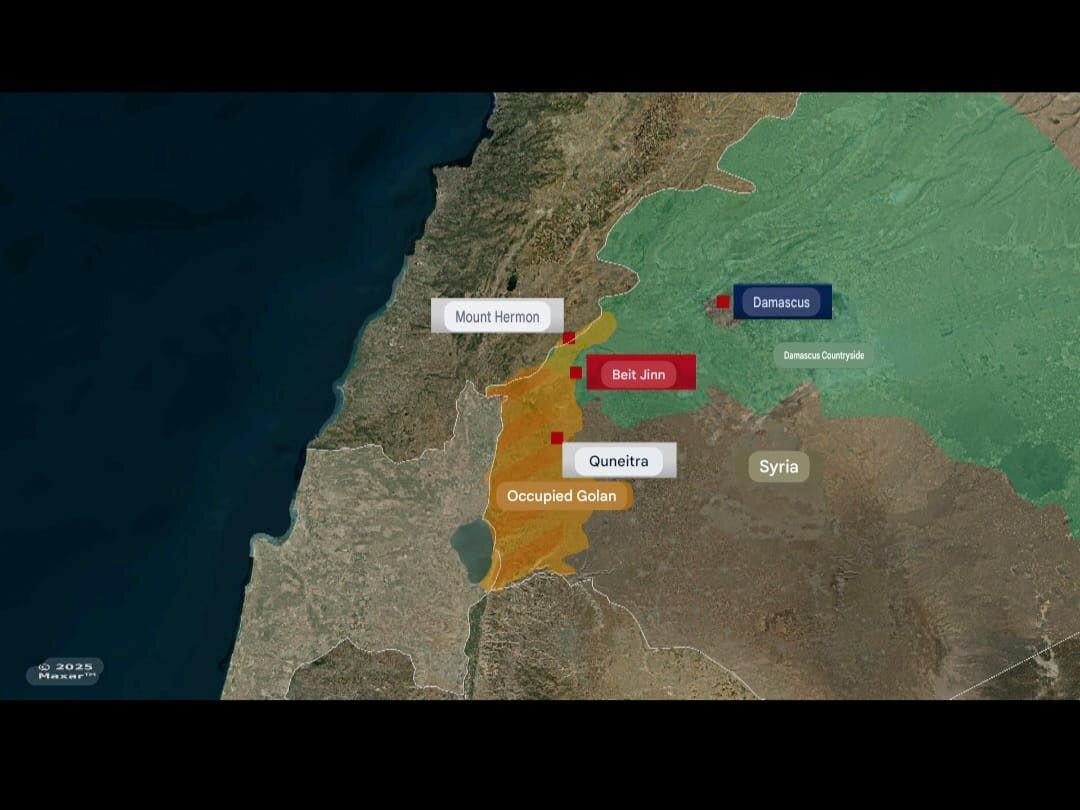
BEIRUT — The dramatic events that rocked Beit Jin at dawn Friday reignited a long-murdered question among regional security officials: Is southern Syria trying to develop its own south Lebanese model of resistance?
The unprecedented escalation unleashed by Israel’s enemies after direct clashes with local armed forces revealed a pattern that reflects the early awakening of Lebanon’s anti-occupation movement.
The conflict began when Israeli occupation patrols entered Syrian territory and arrested three local civilians.
However, a small group of people ambushed the patrol, stopping their vehicles and injuring the soldiers, nearly capturing them.
Their escape prompted a drastic punitive response. About 20 civilian homes were destroyed in several hours of air and shelling, and families were forced to evacuate under the weight of the bombing.
By noon, 13 civilians had been killed, with bodies still lying under the rubble, and more casualties are expected.
Israeli media quickly confirmed the gravity of the incident. The injured soldiers were airlifted to Sheba Medical Center, where a total of five people were injured, three of them in critical condition.
The Hebrew press reported dissatisfaction within the Northern Army, criticizing the poor planning that left the patrols “defenseless and blind.” One newspaper frankly admitted that “southern Syria remains an area where those with weapons are quick to target us.”
This approval is important. It accurately reflects how Israel’s enemies once described southern Lebanon during the occupation. A landscape that cannot be controlled, a population unwilling to submit, and a frontier that refuses to be pacified.
More importantly, the events at Beit Jin shattered a serious illusion. Israel’s enemy has been trying to normalize its invasions for years. This invasion is a small, steady, deliberately unchallenged act aimed at forcing the population into silence.
But Friday’s ambush had the opposite effect: a psychological rift. It showed that despite exhaustion, displacement, and erosion of state power, local communities can still produce fighters, operate independently, and take on Israel’s enemies without waiting for political support.
This is exactly what happened in South Lebanon in the 1980s. Lebanese resistance was not born out of official decision-making. It emerged because the state was absent, the occupiers were brutal, and ordinary people – peasants, students, workers – decided to defend their dignity when no one else could.
Southern Syria today has many of the same elements. This is a weakening of central power. Rural areas are repeatedly exposed to cross-border violence. and deeply rooted social networks that can generate local defensive formations.
What Israel’s enemies fear most is that Beit Zin will become a template. Resistant villages embolden others, especially those with a history of killing civilians, missing relatives, or repeated invasions.
Israeli analysts have already warned that allowing even small groups to operate freely on the Syrian border would be a “fatal strategic mistake”. The word was once used to describe the early Hezbollah cell in southern Lebanon almost literally.
Whether southern Syria fully replicates the southern Lebanon model depends on one crucial factor: the will of the people when the state is unable to protect them. And the signs emerging from Beit Jinn suggest that this will is quietly but unmistakably awakening.
At this crossroads, the words of the Supreme Leader of the Islamic Revolution, Saeed Ali Khamenei, on December 22, 2024, resonate with surprising relevance. “The Syrian youth have nothing to lose. Their universities, schools, homes and lives are not safe. What can they do? They must stand firm and determined against those who orchestrated and brought about this insecurity. God willing, they will overcome them.”
This statement captures the strategic core of the moment. When a generation is stripped of security, opportunity, and normalcy, it transforms rather than retreats.
The pressures that might tear society apart instead forge its most resilient defenders. In this sense, Syrian youth are standing exactly where the youth of South Lebanon once stood. They are kept alive by a fierce clarity that, in the face of danger, defending their land is no longer a choice but an obligation.
If Beit Jinn is a preview, its message is unmistakable. Syria’s young people are not seeking war, but because it is being forced upon them in their homes, on their streets, and in their very existence. And like the young people of south Lebanon before them, they may soon decide that history does not wait for permission. It is made by people who refuse to live without dignity.