
BEIRUT — Marking the 58th anniversary of Yemen’s independence from British colonial rule, hundreds of thousands of Yemenis poured into Sana’a’s Al-Sabeen Square and major public stadiums in several provinces in a powerful show of national unity and revolutionary resolve.
The mass rally, held under the banner “Liberation is our choice…The occupiers disappear”, underlined the collective and unwavering commitment to sovereignty, resistance and solidarity with oppressed countries across the region.
The central communiqué of the gathering clearly demonstrated the people’s resolute stance and full readiness for what it called “the next round of engagement with the enemy and his tools, from a military and security perspective and through public, national and mobilization activities.”
The message was clear. Yemen will not back down from its “just and legitimate position” and will not abandon the Palestinians, the Lebanese people, or the oppressed countries that stand against occupation and invasion.
“With unity of willpower and determination, a nation can achieve great victories,” the statement said.
This year’s anniversary was more than just a ritual. It was a political declaration, an expression of continuity between the revolutionaries who ousted Britain in 1967 and today’s generation confronting the trilateral hegemony of the United States, Britain, and their enemy, Israel.
The large-scale participation of Yemenis symbolized a reaffirmation of the legacy of the historic struggle that forced the “sunless” empire to pull its defeated forces out of Aden.
Participants chanted slogans and reaffirmed their unwavering support for Gaza and Palestine, reiterating Yemen’s long-standing position that the Palestinian cause remains the central cause of Arab and Islamic countries.
Hadramawt’s Shadow War
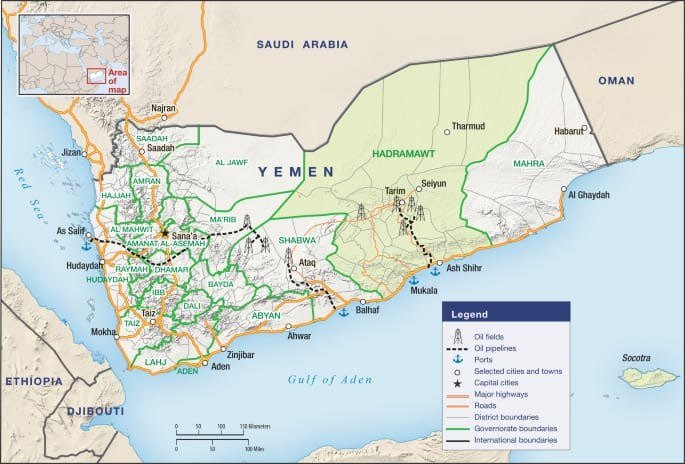
While Sana’a celebrates independence with national pride, eastern Hadramout governorate has been plunged into further instability as rival UAE and Saudi-backed armed groups escalate a dangerous standoff over control of the governorate’s strategic oil infrastructure.
Most recently, fighters loyal to Saudi Arabia were seen storming the Petromasira oil facility in Wadi al-Masira, causing casualties in clashes with officially assigned security forces.
Rival UAE allies issued a fierce statement of opposition, branding the incursion a “blatant act of sabotage” and demanding the attackers’ immediate withdrawal.
What unfolded was not just a local security dispute, but a clear manifestation of a larger conflict between Saudi Arabia and the UAE over influence in eastern Yemen.
Further clashes erupted when tribal fighters associated with the Hadramawt tribal alliance repulsed an attempt by UAE-backed forces to advance into the oil fields.
The situation briefly subsided, but both sides rushed reinforcements to the area and built new fortifications, preparing for what observers fear is a full-scale conflict.
Political analysts have warned that the maneuvers represent an effort by the UAE’s proxies to redraw the balance of power following defeats in Marib, Shabwa and Taiz.
Oil facilities, a vital economic lifeline, are being exploited by rival mercenary networks, while civilians and workers bear the brunt of security instability, economic chaos and paralysis of local services.
They argue that this escalation is further fueled by external agendas. Washington’s pressure on both Riyadh and Abu Dhabi on unrelated regional files prompted Abu Dhabi to respond by escalating tensions in Yemen to secure a foothold along the Arabian Sea and the Gulf of Aden, geopolitical areas that Israel considers ambitious.
The UAE’s aggressive stance has led many to label it a “regional mini-Israel” given its alignment with Tel Aviv’s strategic maritime objectives.
Hadramawt’s future and national responsibility
Hadramawt has long been known for its academic heritage, trade networks, and cultural depth, and largely avoided the domestic battlefields of the war’s early years. But today, Saudi Arabia and the UAE are militarizing the kingdom, fragmenting its social structure and turning it into a realm of power struggle.
The warning issued by the Mafra Sit-in Committee resonated across the country. The explosion at Hadramawt will not be confined within its borders. Rather, it will be used to justify efforts to separate the entire eastern region from mainland Yemen. This plan is closely related to broader colonial plans in the region.
Amid these dangerous dynamics, one truth stands out: Hadramawt’s people are the most vulnerable in a conflict they did not choose. They face a bleak reality marked by rival rulers, foreign interests, and predatory militias vying for control of oil, ports, and territory.
A united nation against division
The 58th anniversary of independence has become more than just a historical commemoration, but a renewed declaration of Yemeni collective determination to resist external domination and internal divisions alike. As the conflict between Saudi Arabia and the UAE threatens to plunge Hadramawt into destructive chaos, Yemenis across the country insist that Hadramawt is Yemeni in spirit and identity, and those who threaten it threaten all of Yemen.
In this volatile situation, national unity and determined resistance remain the only viable path to defending Yemen’s sovereignty, protecting its resources, and thwarting regional plans to clear its land and exploit its people.