
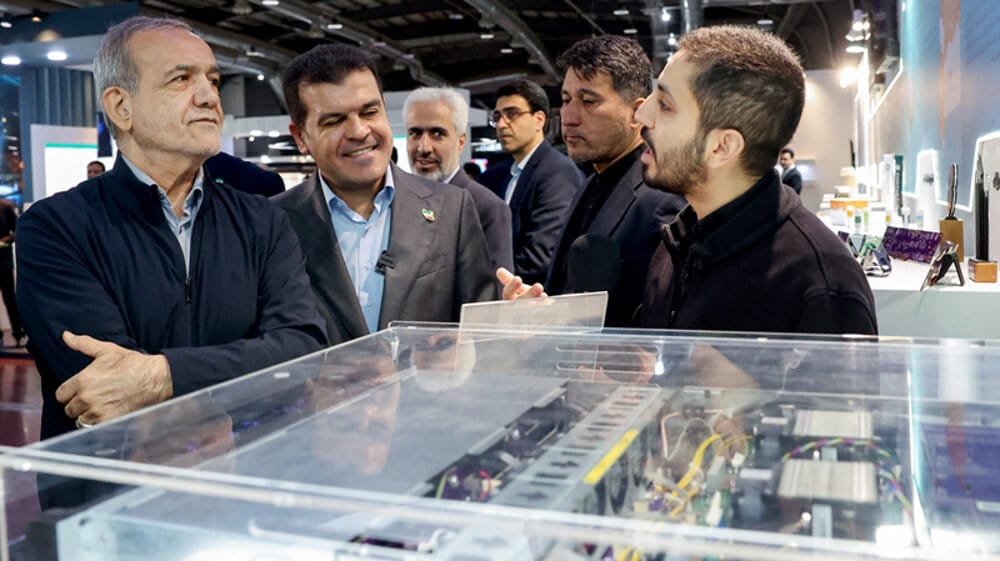
TEHRAN – The President of Iran praised his country’s achievements in advanced and cutting-edge technology and called for improving the quality and export of innovative products from knowledge-based companies.
Masoud Pezeshkian made this statement on Tuesday while visiting the 16th International Nanotechnology Exhibition and the 1st Latest Technology Exhibition held at the Tehran International Permanent Fairgrounds.
The President emphasized the importance of innovative products and the profitability of their exports, adding that such technologies should be utilized to serve Iranian citizens in disadvantaged areas across the country.
“We must take action to improve the quality and export of these technological products. Moreover, in the area of health equity development, these products should be used to serve citizens in disadvantaged regions of the country,” Pezeshkian said.
His visit comes at a time when Iran is making great progress in all fields of science and technology.
“Iran’s current defenses may be stronger than they were during the 12-day war.”
Meanwhile, the president said elsewhere in a meeting with officials that any action taken by the enemy against the Islamic Republic would be met with overwhelming retaliation.
“The Islamic Republic of Iran never desires war or confrontation, but our defense capabilities today are incomparable to what they were before the 12-day war imposed on (Israel). Any mistake by our adversaries will result in a swift, overwhelming and painful response,” Pezeshkian said.
On June 13, Israel launched a blatant and unprovoked act of aggression against Iran, sparking a 12-day war that left at least 1,064 people dead in the country, including military commanders, nuclear scientists, and civilians.
The United States committed a grave violation of international law by bombing three Iranian nuclear facilities and entering the war.
In response, Iranian forces targeted strategic locations throughout the occupied territories, as well as Qatar’s Al Udeid Air Base, the largest US military base in West Asia.
Mr. Pezeshkian also touched on sanctions and called for closer regional cooperation to counter them.
“In addition to all domestic problems and imbalances, we also face increasing pressures and sanctions. However, if we properly leverage the potential of our numerous neighbors, we can definitely neutralize sanctions and even turn them into a serious opportunity to promote regional cooperation and strengthen solidarity among regional countries,” he explained.
His comments came at a time when Western countries reinstated illegal sanctions against Iran. Britain, France and Germany activated the snapback mechanism on August 28, beginning a 30-day process to reinstate all UN sanctions against Iran.
Despite last-ditch efforts by Russia and China to maintain diplomacy, the UN Security Council failed to reach an agreement on September 26. Two days later, the E3 and the US declared sanctions reinstated and called on UN member states to implement them.
Tehran categorically rejects the claims, saying it was the United States and its European allies who undermined the 2015 nuclear deal by not keeping their promises.
Iranian officials insist that U.N. member states are under no obligation to comply with unilateral and illegal measures.