
The initiative follows last month’s US-brokered ceasefire between Israel and the Palestinian resistance, which left Gaza occupied along the so-called Yellow Line, according to a Financial Times report cited by Lebanon’s Al-Mayadeen TV EN website. One side is occupied by Israeli invading forces, while the other side is effectively controlled by Palestinians.
US pressures Security Council to respect Gaza plan
At the same time, the United States is reportedly pressing the United Nations Security Council to adopt a resolution formalizing President Donald Trump’s Gaza peace plan under international law, leaving little room for negotiation, The New York Times reported, citing senior U.S. officials and diplomats involved in or briefed on the talks.
The move has raised concerns among Arab and European countries about the potential marginalization of Palestinian interests.
Devastation and the challenges of recovery
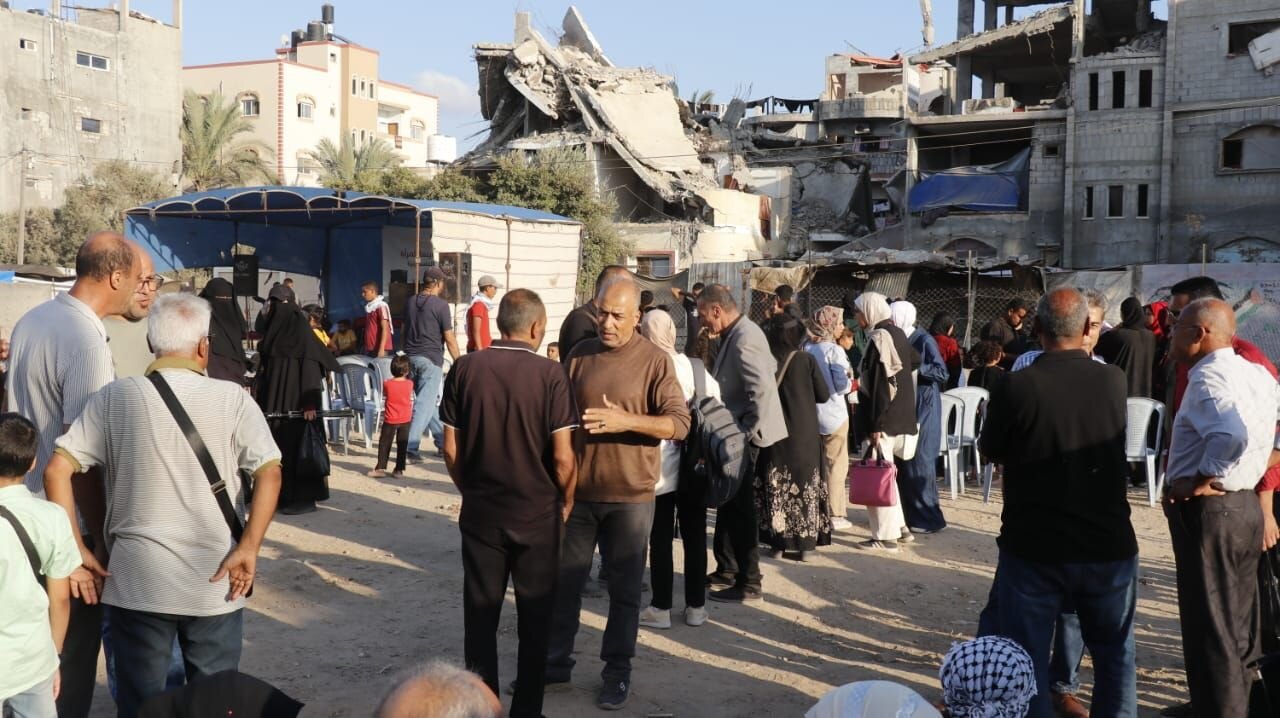
The scale of Israel’s destruction in the Gaza Strip, much of it reduced to rubble by the genocide, has made reconstruction a priority for both Western and Arab countries. Israeli and U.S. officials have ruled out directing funds to “Hamas-held areas,” but some, including President Trump’s son-in-law Jared Kushner, have proposed rebuilding the Israeli occupation side as a way to provide Palestinians with an “alternative” to the resistance.
The concept mirrors an earlier proposal for a “Hamas-free bubble” floated by Israeli officials during the war, which has since been abandoned. Arab, Islamic and European countries have expressed concern to the US that the plan could lead to the occupation of parts of Gaza.
“If the US continues to support Israel’s position on this, there will be conflict between the Palestinians, the Egyptians, many others, the Qataris, the Turks, and between the US and Israel. It is absolutely outrageous,” one Arab diplomat told the Financial Times.
U.S. officials say the plan could jump-start Gaza’s reconstruction and create a “new demilitarized Gaza” that would be safe for Israel. Kushner, the chief architect of President Trump’s 20-point ceasefire plan, argued that construction in “Israeli-controlled territory” could give Gazans “a place to go, a place to get a job, a place to live.” As quoted by the FT, Israeli officials said the idea was one of several options being considered.
Concerns about permanent partition
Arab countries are particularly concerned that the temporary border along the so-called Yellow Line could become permanent. Jordanian Foreign Minister Ayman Safadi stressed that Gaza is “one of the Palestinian territories and part of it,” and called for a clear timetable for “Israel’s withdrawal.”
Another Arab diplomat warned: “Optically it will be disastrous. It will look like we are building for Israel, not the Palestinians. We don’t want Gaza to be stuck like this between war and peace and the status quo.” According to the diplomat, no Arab country would finance reconstruction under these circumstances.
President Trump’s 20-point plan envisions a phased Israeli withdrawal with the deployment of an “international stabilization force,” but the size, mission, and contributors of this force remain unclear.
security, geographic concerns
Egypt has expressed particular concern about the proposed reconstruction of Rafah in southern Gaza, close to the Egyptian border. Concentrating Palestinians in this area could make it easier for “Israel” to attempt to migrate to Egypt. Hardline lawmakers in Prime Minister Benjamin Netanyahu’s government have previously proposed “resettlement” plans for Gaza residents, including the “Gaza Riviera” initiative backed by President Trump.
There are also doubts among Israeli security officials. Former intelligence officer Michael Milshteyn said Hamas was likely to try to thwart the plan, and that “dividing” Gaza, one of the world’s most densely populated areas, would inevitably lead to the separation of families. He argued that the plan reflected previous strategies to contain Palestinian resistance using limited economic incentives, such as a “Hamas-free bubble” and “humanitarian cities” in Rafah.
Skepticism about Palestinian cooperation
Observers say Palestinians, who were repeatedly displaced during the war, may be reluctant to relocate again under Israeli occupation. Dan Shapiro, a former U.S. ambassador to Israel, said: “The idea that we can prove to Gazans that they have a better life outside of Hamas control…I hope that’s true. But I think it’s very difficult to imagine any investment or population movement into the area, at least in the short term.”
Those familiar with the Gulf Arab perspective echoed these concerns, saying the current priority is humanitarian aid and that Gulf states may consider funding the reconstruction of Israeli-occupied territory for relief purposes, but not for broader settlements or a “New Gaza” project.
wider context
The United States is said to be strengthening its ties with Israel with a strategy of claiming partial occupation of the Gaza Strip, and is pushing ahead with a reconstruction project in the Israeli-occupied territory while sidelining the Palestinians.
U.S. officials, including Jared Kushner, are pushing for a “new Gaza” to be placed under Israeli control, with a transitional authority model that could formalize a long-term occupation.
But Arab and European countries have voiced strong opposition, warning that such a plan would permanently undermine Palestinian sovereignty. Concerns include the forced relocation of Palestinians, the creation of a demilitarized zone under Israeli occupation, and the marginalization of Palestinian governance structures. Questions exist even among Israeli security officials about the feasibility of controlling such densely populated areas, while regional actors such as Egypt, Jordan, Qatar, and Turkey are pressuring the United Nations to block formal adoption of the U.S.-backed measure.
For Palestinians, resistance is likely to take many forms. While many may refuse forced relocation or accept the rule imposed by the occupation, Palestinian resistance groups may escalate asymmetric operations. Arab states and international organizations say the plan violates international law and Palestinian rights, and legal and diplomatic challenges are expected. Meanwhile, humanitarian aid operations will remain an important tool for attracting global attention and pressuring donor countries to make reconstruction funding conditional on respecting Palestinian sovereignty.
MNA