
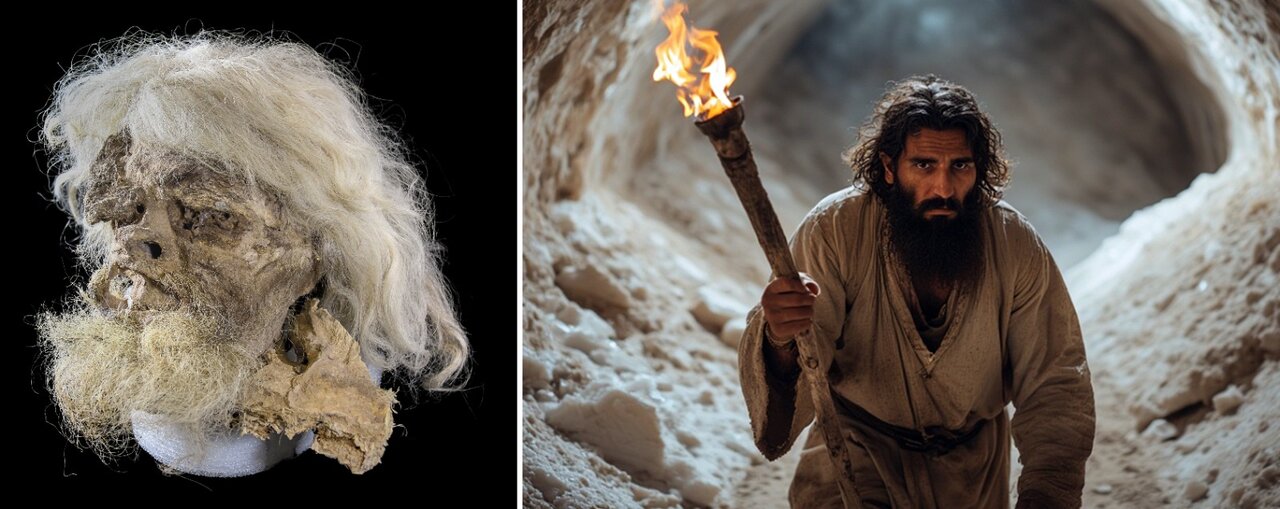
A remarkable archaeological find made by miners in Iran’s Zanjan province 30 years ago has been confirmed, after extensive scientific research, to be the naturally preserved remains of an early Sasanian man.
The discovery was made in January 1993 in the Duzrak salt mine near the village of Chehrabad, where workers extracting salt unearthed an astonishing collection of human bones and personal artifacts, including a human head with a beard and long hair, feet still in leather shoes, part of the chest, and some personal effects.
Some of the related items included a sheathed knife, shorts, earrings, and a small bag. All the artifacts were carefully recovered and transferred to the National Museum of Iran for protection and research.
Over the next 30 years, an interdisciplinary team of scientists conducted advanced tests, including radiocarbon dating, CT scans, and isotope analysis, to uncover the detailed circumstances of the individual’s life and death.
Radiocarbon dating firmly places this man’s life in the early Sassanid period, between 220 and 390 AD, during the reigns of Ardashir I and Bahram IV.
The cause of death appears to have been a sudden major accident. X-ray analysis of the exquisitely preserved skull revealed multiple severe fractures in the skull and jaw, consistent with damage caused by the collapse of the mine’s roof.
The pattern of trauma strongly suggests that the man died instantly in a mining accident. The dry, saline environment of the salt mine acts as a powerful natural preservative, and CT scans even showed some abnormally retained brain tissue inside the skull.

Further isotope analysis of the remains revealed a diet rich in dairy and meat products, suggesting that the man was a local resident whose livelihood was closely tied to the region’s pastoral economy.
The researchers also propose an interesting possibility. This means that the recovered head, foot and chest parts may not belong to a single person, but more than one, adding further mystery to this important discovery.
Today, the public has a rare opportunity to encounter this ancient miner firsthand. The Salt Mummies of Cheherabad are the centerpiece of the National Museum of Iran’s major new exhibition, “Ancient Iranian Storytellers: A Selection of National Museum Exhibits.”
One of the museum’s largest exhibitions to date, it runs until November 22 and features hundreds of artifacts. Visitors can tour the mummies and other priceless items Saturday through Wednesday from 9 a.m. to 5 p.m., Thursday and Friday from 9 a.m. to 6 p.m.
The Salt Mummies of Cherabad provide a unique window into the lives of ordinary people during the Sassanid period, revealing intimate insights into their labor, diet, and the sudden tragedies that shaped their existence.
morning