
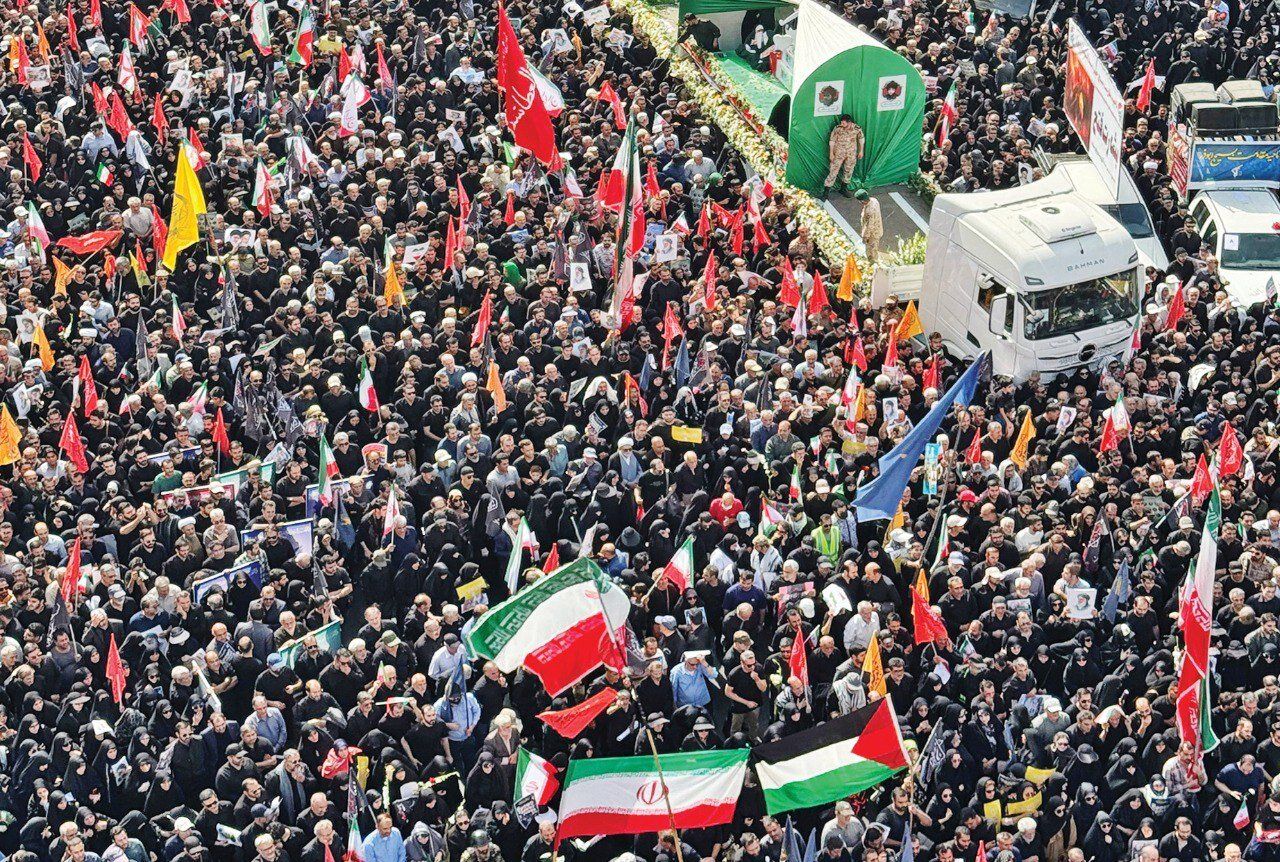
Tehran – Tehran, the heart of Iran, has witnessed tragedy for centuries as the nation’s capital. We have seen all the major events and dramas that carved the modern history of ancient lands.
Tehran remembers a war that caused stab wounds on foreign boots during two world wars, fatal artificial hunger, and sacrificed millions of Iranian lives. It remembers the collapse of the democratically elected government of Mosadegu, coordinated by the US and the UK. Remembers missile Saddam Hussein, which rained during the brutal eight years of invasion. And recently he has lamented the loss of the brightest mind, commanders and scientists, and has been led through Israel, once again a victim of enduring colonial ambitions in the West, and now his proxy.
But there was more emotion than just sadness or sadness in every corner of Iran during the funeral procession that took place on Saturday. The millions of people who flooded the streets to honor the fallen commanders and officials were also proud. After decades of bowing to foreign invaders, the country is prideful that it has finally managed to punish the attackers, enforce them from the borders, and maintain their sovereign land.
The funeral procession began at 8am in one of the city’s central squares and stretched 11 kilometres from another square. People from all walks of life joined the march: old and young, men and women, religious and not religious. Tears slid down on many faces. The middle-aged woman accompanied by her children glanced at Amir Ali Hajizadeh’s co. She cried temporarily, wiped her eyes and began to chant slogans. “They thought killing Hajizadeh would prevent his missile from reaching them,” she told reporters. “But within 12 hours, these missiles raided strategic locations, leaving cities in abandoned, crushing spirits. His disciples only build even more lethal weapons to protect this nation.”
General Hajizadeh was one of several commanders assassinated by Israel at the start of the war on June 13th. Over the next 12 days, the regime escalated its aggression with attacks on Iran’s nuclear facilities, military facilities, more residential buildings and civilian infrastructure. In total, 627 lives were lost during these Zionist attacks.
Israel argues that the attack on Iran is to prevent the development of nuclear weapons. A weapon that Iran has claimed for for 20 years to be “two weeks away.” However, in reality, it is widely believed that Israel’s decision to attack Iran was made with full US support and ultimately direct involvement, based on two important assumptions. First, the top military commander paralyzes Iran’s retaliation. Second, the attack, coupled with a savvy propaganda campaign, would incite Iranians to rise up and overthrow the government. People eventually took them on the streets, but their reasons were the exact opposite of what Israel had imagined.
Analysts suggest that the unshakable unity demonstrated by the Iranians was even more critical in defeating the enemy than the country’s military power and arsenal of missiles and drones. After being characterized by the humiliation and tragedy supported by foreigners for centuries, Iranians understand that their country is their ultimate sanctuary, and that the price of resistance is always less than the “complete surrender” demanded by US President Donald Trump. During the First World War, Second World War, and the 1953 coup, fragmentation and inuniformity were some of the main reasons why Iran was imposed next to the powerlessness of its rulers. Iranian collective and historical memories pay attention to this.
“They can start the war again,” said his man in his 20s, who said he was preparing to complete forced military service. “But this time I will write the end again. It is time for foreign powers to decide what we can and cannot do. We will continue our peaceful nuclear program and crush any forces that will try to stop us.”
During its war with Israel, Iran ended up destroying a large range of occupied territory to the ground. It also attacked Aludade Air Force Base in Qatar, Washington’s largest base in West Asia. Iranian officials say the new attack on Iran will be filled with even stronger responses.