
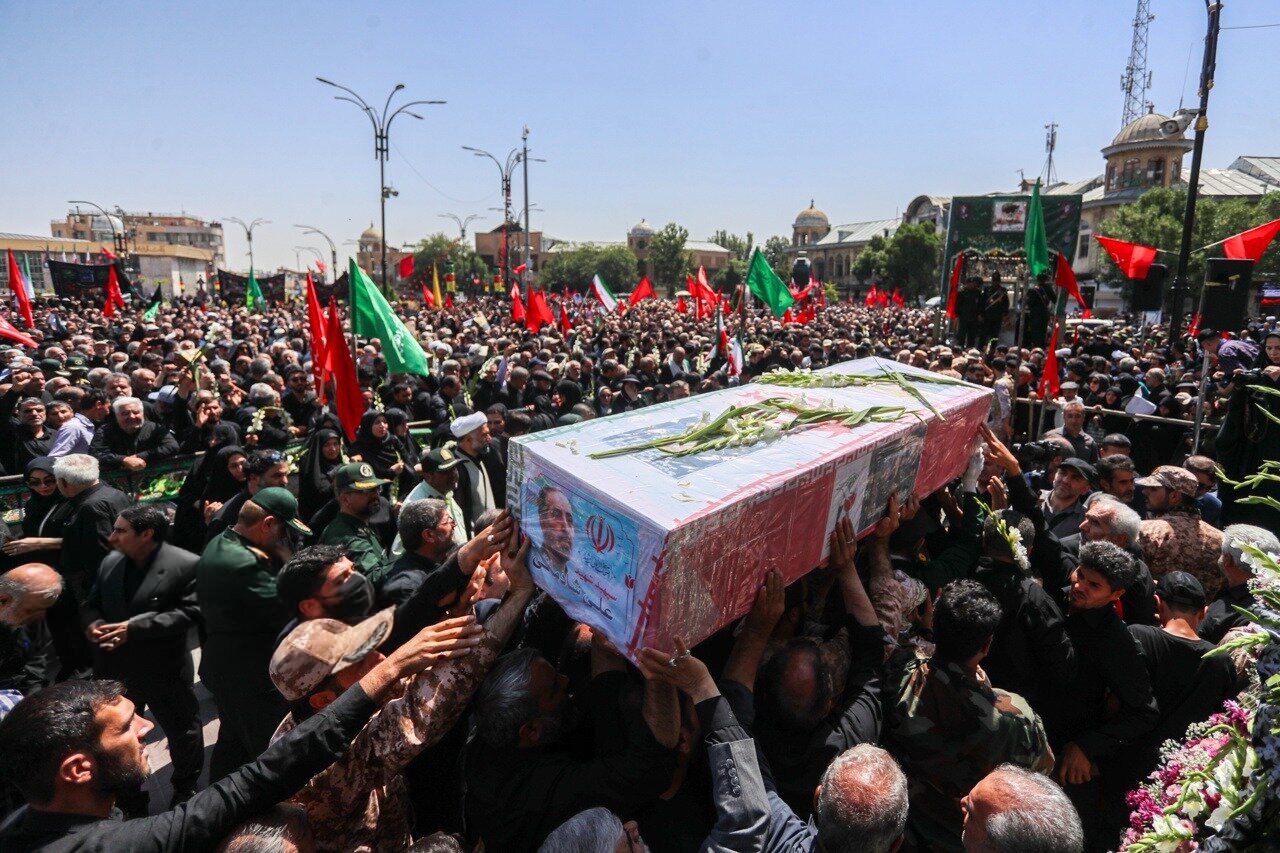
TEHRAN – In a scene of deep national grief, Iran’s Islamic Republic took three of its most respected military commanders to rest on Sunday.
Generals Hossein Salami, General Amirali Hajizadeh and General Ali Shadmani, who were martyred in the terrorist attacks by the Israeli regime during the 12-day war with Iran, were buried in a massive public procession that millions of people had sworn to continue the path of resistance.
The funeral was a peak of the days of national mourning following the commander’s martial teaching.
Saturday witnessed an unprecedented overflow in Tehran. There, more than a million citizens flooded the streets to accompany the bodies of display analyst martyrs, who are described as a referendum on Islamic Revolution and allegiance to its leadership.
“The second half casem”
The body of General Salami, a former commander of the respected Islamic Revolutionary Guard (IRGC), was placed to rest in the sacred precincts of Hazrat Abdul Azim al-Hasani (AS) in Lei, south of Tehran.
Salami, a veteran commander of the sacred defence era (Iraqi invasion of Iran in the 1980s), martyr with his brother.
Following a majestic funeral procession through the capital, his body was transferred for prayer and burial.
Senior military personnel and politicians attended the strict ceremony. IRGC Quds Commander Brigadier General Esmail Qaani paid tribute, but Ali Larijani, the leader of the Islamic Revolution, praised Salami as “a perfect commander with integrity and intelligentness.”
General Ahmad Vahidi, an advisor to the IRGC Commander, addressed mourners, emphasizing the country’s fortitude.
“The enemy nurses the delusion that it will break the will of the Iranian state,” declared Vahidi, claiming that such “vain hope will be buried in the grave.” He vowed that the path of revolution would continue to be deterred.
At the same time, the body of General Amirari Hajizadeh, a brave former commander of the IRGC Aerospace Force, was placed to rest in Section 50 (Advocate of Sacredness) of Behesht-e Zahra Cemetery, Tehran.
The ceremony attracted a large number of citizens.
Hajizadeh was renowned for coordinating pivotal businesses such as the 2024 Operation True Promise I and II, the 2017 Laylat al-Qadr missile retaliation, the 2018 drone and missile retaliation against the Malivan, and the 2019 American Global Hawk Drone Fall.
During his tenure, the IRGC Aerospace Force was subject to a transformative evolution that is widely regarded as its golden age.
Under his command, the forces proceeded from limited missile capabilities to sophisticated multi-tier deterrent systems. At the same time, the drone sector has evolved from a basic surveillance platform to an advanced attack system that can coordinate swarm attacks. This was all seamlessly integrated with the domestic air defense radar network.
These technical milestones were unified through Indigenous command and control infrastructure, enabling cohesive aerospace attack capabilities.
“We will not hesitate to do our resolve to fight.”
In the western city of Hadan, vast crowds gathered to mourn General Ali Shadmani, who served as commander of the Katam al-Ambya Central Headquarters for several days before the Israeli regime killed him in a recent war.
The most emotional moment came from his daughter, Madie Shadmani. Standing by her father ffin, she delivered a powerful will, rejecting despair and rebelling against her grief.
“I will not swear against the enemy or chants of war,” she declared, speaking directly to the Zionist regime and the United States. “If Israel and America consider these martialism, these sadness, these longings, if we create a momentary hesitation in our fight’s resolve, let us dream.”