
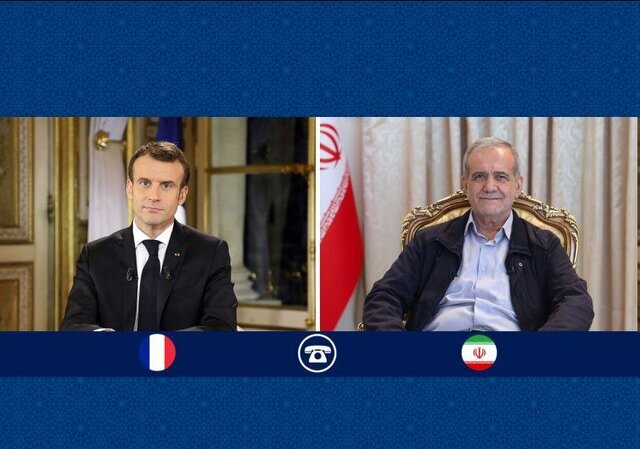
Tehran – Under the strict responsibilities of the UN Nuclear Watch Agency, President Masuud Pezeshkian has declared Iran to halt cooperation with the International Atomic Energy Agency (IAEA).
In a Sunday call with French President Emmanuel Macron, Pezeschkian emphasized that Grossi did not condemn the attack and that his agency’s “politicized reports” had shattered Iran’s trust.
“Today, the position of Iran’s government, parliament and people is that the IAEA Director-General acted prejudice towards our nuclear program despite establishing cooperation. This is absolutely unacceptable,” Peshshkian said.
He questioned the reason why the IAEA relies on the “criminal Israeli regime” rather than a party to the Nuclear Non-Proliferation Treaty (NPT) as a reference to its report, warning that such double standards “stimulate a serious threat to regional and global security.”
President Pezeschkian emphasized that rebuilding the trust requires the IAEA to “completely adhere to its own rules” and end the hypocrisy of the Israeli regime’s undeclared nuclear weapons.
“What message will this send to the world when the country is bombed despite allowing testing?” Pezeschkian asked Macron.
The president repeated Iran’s commitment to diplomacy, but warned that without IAEA reform, the agency risked it becoming irrelevant, or even worse, an accomplice in the attack.
Pezeshkian’s condemnation comes after Iran experienced 12 days of Israeli attacks on nuclear, military and civilian infrastructure.
On June 12, the IAEA committee, driven by the US, UK, France and Germany, expelled a resolution that denies Iran as “non-compliance” over uranium enrichment levels.
Grossi later revealed that the IAEA discovered “no evidence,” but Iran is building nuclear weapons, but the resolution was weaponized to justify Israel’s bombing campaign.
“Grossi masked the truth with his biased report, which was used by the Genocide regime for the war with Iran,” wrote Esmaeir Bakaei, a spokesman for the Ministry of Foreign Affairs.
In a formal letter, the Iranian Atomic Energy Organization (AEOI) reveals that IAEA confidential documents have been found in Israeli occupation territory, suggesting agency conspiracy with Tehran’s enemies.
“Grossi has blood in his hand.”
When the Israeli regime bombed Iran’s civilian nuclear site and assassinated its scientists, Grossi’s prominent silence, coupled with his refusal to condemn the strike, was widely interpreted as implicit support.
When the US joined the attack on June 22, when it deployed bunkerbuster bombs and Tomahawk missiles against Fordou, Natanz and Isfahan, Grossi once again refused to accuse him of the strike, demanding Iran instead immediately access his inspector.
Mohammad Eslami, head of AEOI, declared that Grossi “betrays its duties” by ignoring IAEA protocols that require accusations of attacks on protected facilities.
Former Foreign Minister Mohammad Javad Zarif went further and demanded Grossi’s firing to “open the way to war.”
Criticism of Grossi was not limited to Iranian voices. Former UN Weapons Inspector Scott Ritter accused the IAEA chief of allowing Israel to thwart Israel’s Iranian nuclear program by sharing the intelligence that led to the assassination of Iranian scientists.
“Grossi has the blood of an Iranian nuclear scientist,” declared Ritter, urging him to remove him and create a new testing framework with strict protections.
Additionally, in a June 25th interview with Fox News, Grossi sparked new rage.
He speculated that 900 pounds of rich uranium refused to be “immeasurable” and refused to rule out storage at “ancient sites” near Isfahan.
Congressional Speaker Mohammad-Baqer Qalivaf exploded to inspect Grossi’s “meaningless and malicious” bombed facilities, declaring the IAEA “selling international credibility.”
On June 25, Iranian parliament unanimously approved a bill that would suspend all IAEA testing until the agency ensured the safety of Iran’s nuclear facilities.
The move, approved by the Guardian Council, limits cooperation to the minimum required amount under the NPT.