
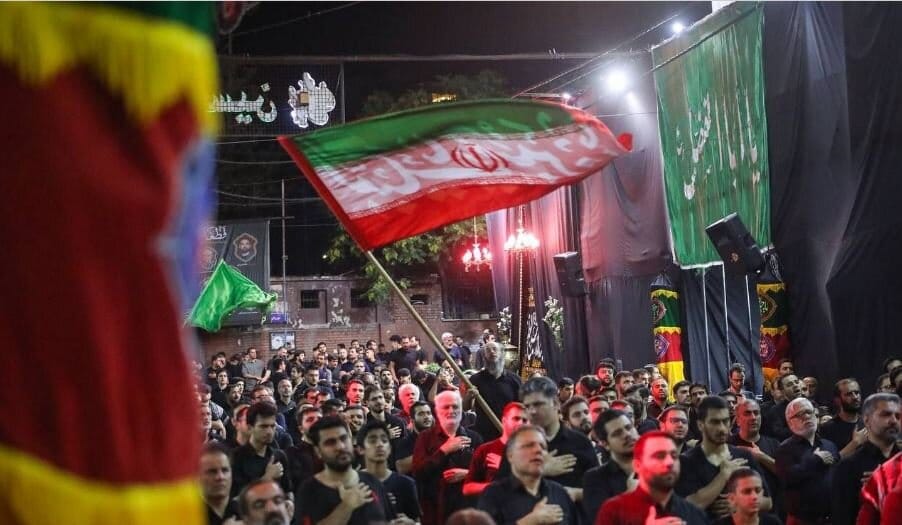
Madrid-Iranian Muharam rituals, traditionally understood as strictly religious rituals in the West, have in fact deeper and more complicated significance. It is not just a spiritual memorial, it is a political act that unites identity, historical memory and resistance.
To fully grasp this dimension, we must first interrogate the category of “religion” – understood as modern colonial construction – recognise that Muharam is embedded in discourse that transcends the traditional boundaries between secular nationalism and the Islamic republic, shaping a shared project of sovereignty and autonomy.
Religion as a colonial category
In contemporary studies of religion and politics, thinkers such as Talal Assad, Sabah Mahmoud, Gill Anijar and Jasbir Poor challenge the concept of religion as an autonomous and universal realm separated from politics. In particular, Assad argues that “religion” is a modern European invention and is imposed on non-Western traditions as a form of epistemological and disciplinary fragmentation. This process helped depoliticize certain practices by entrusting collective institutions to deprived private or spiritual realms.
Saba Mahmood expands this criticism by showing how religious practices can embody complex forms of ethical and political institutions, often outside of liberal or secular frameworks. Gill Anijar emphasizes that the division between “religion” and “secularism” is a central mechanism of modern Christian governance, but Jasbil Poor demonstrated how religious categories helped justify both colonial rule and colonial hierarchy of states.
From these perspectives, muharam should not be read as a form of political ontology, not merely a religious observance. It is a mode of existence in the world that mobilizes the influence, bodies, memories and symbols in the practice of resistance and sovereignty.
Muharam as a political memory
Muharam commemorates the martialism of Imam Hossain of Karbala. This is an event that symbolizes the lasting struggle between oppressed people and oppressors, the lasting struggle between justice and tyranny. Far from being a purely dedicated story, Karbala’s paradigm is the fundamental story of collective memory in Iran. It serves as an ontological framework through which people’s political identities are shaped, giving meaning to historical trajectories characterized by resistance to domination.
Every year, Muharam rituals reinvigorate this paradigm – not through ritual repetition, but through the symbolic renewal of the struggle against injustice. Mourning, elegant chants, processions, and joint meeting performances project a common horizon of dignity, sovereignty and sacrifice. The past is engraved in the present as a living historical continuity that justifies the current form of resistance and predicts future ones.
Nationalism and the Islamic Republic: false opposition, real convergence
In the Iranian context, Muharram also plays a central role as a place of national unity. However, this unity should not be understood as merely a point of encounter between two opposing Poles, nationalism and Islamism, but as a deeper clarification of the shared purpose, namely the defence of Iranian sovereignty.
The assumed opposition between nationalism and Islamism is primarily an ideological structure, which serves certain historical forks, but is insufficient to capture the complexity of Iran’s political landscape. Both cultural nationalism and revolutionary Islamism share a common matrix of resistance to foreign interference, colonialism, and confiscation. In Muharam, this convergence finds expression in a shared symbolic language that integrates religious, historical and political things.
During the Pahlavi monarchy, for example, nationalism was often served by the regime as a tool to justify its authority, at the expense of Shia Islam as a source of general legitimacy. However, religion regained its central role during the Islamic Revolution of 1979, particularly the eight years of imposed war between Iran and Iraq. Kalbala’s story provided an ethical and emotional framework that gave meaning to national defense. The war was interpreted as a continuation of Imam Hossein’s struggle, and the use of religious symbols was not only accepted, but equally accepted by fighters and civilians.
Muharram 2025: Between Memory and Current Struggles
Muharam in 2025 has particular importance in the aftermath of the recent 12-day war between Iran and Israel. The conflict is widely recognized as an act of foreign attacks across Iranian society, catalyzing a new moment of national unity. The massive mobilization throughout Muharam was not merely an act of devotion, but a politically accused expression in which unity, sovereignty and dignity of the people were reaffirmed.
Mourning ceremonies, public speeches and grassroots demonstrations predict the narrative of historical continuity, from Kalbala to QODS, from Imam Hossain to modern martyrs. Rather than simply commemorating the sacred past, the Iranian people are reinvigorating it as a political practice in the face of current threats. Thus, muharam becomes a clear place between memory, resistance and collective action.
Iranian muhalam cannot be properly understood through the lens of reductionism of religion as a modern category. Rather, it must be seen as a political ritual that embodies a particular mode of being and resistance. This is a collective practice that clarifies memory, influence, identity and sovereignty. In times of external attacks, such as the recent conflict with Israel, Muharam serves as a catalyst for national unity, enhancing internal consistency among people, combining Islamism with liberating political projects.
Beyond the superficial tensions between nationalism and the Islamic Republic, rituals become spaces of convergence and affirmation. History and theology, culture and politics meet in a common practice of defensive autonomy. In this sense, muharam is not merely a memorial, but an act of sovereignty in itself. It is a declaration that Iran does not bow, that its memories will continue to live and that its future will be shaped by its own people.
Understanding this dimension is important not only to grasp the specificity of Iran’s Shia Islam, but also to assess non-Western forms that clarify religion and politics. Ultimately, Muharam is a living expression of the nation that resists through its memory and asserts itself through its faith.