
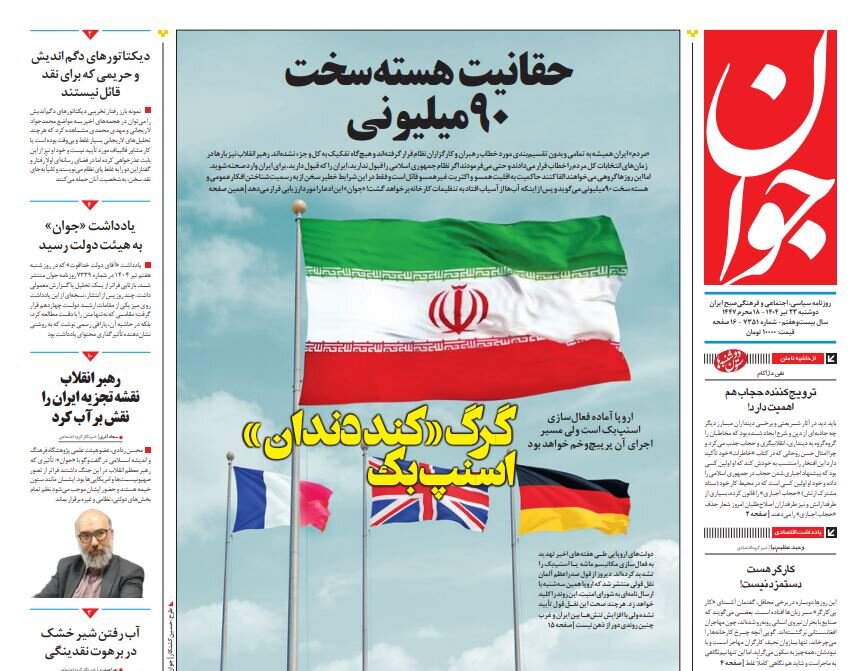
Tehran -Javan discussed in his article how Europe is ready to activate the snapback mechanism.
It writes as follows: The European government has reinforced the threat of energizing snapback mechanisms in recent weeks. On Saturday, a quote was released that the German Prime Minister would cause a mechanism by sending a letter to the Security Council on Tuesday. The credibility of this quote has not been confirmed, but such a process remains unanimous as tensions between Iran and the West are rising. Iran’s Foreign Minister Abbas Araguchi warned that the implementation of the snapback mechanism “marks the end of Europe’s role,” and that it would result in complications that Europeans probably cannot overcome easily or quickly. Snapback paths seem simple on paper, but their practical implementations face major challenges. On a large scale, the activation of snapback mechanisms could escalate security council conflicts. The Security Council will become a geopolitical field rather than a location crisis management. Catherine Smith of the Brookings Institute believes that “Europe is trying to use it as a pressure tool to bring Iran back to the negotiation table, not to recover past sanctions.”
Khorasan: Unstable America is reducing threats
In the analysis, Khorasan discussed economic instability in the future situation of the US and Iran. It wrote: We will likely enter a period of new economic instability in the United States and the whole world. The more unstable the more likely it is to attack. Therefore, the US may adjust its language towards Iran in days or weeks, as the US needs to control tensions in the Middle East. An approach to the possibility of resuming negotiations is also important. The other side is not sitting for negotiations. Rather, it tries to impose that will. In the meantime, the core of the US problem is strategic negotiations with powerful non-US countries, turning the idea of “weak Iran” into “strong Iran with aggressive capabilities” in Trump and the larger Western mind, causing a strategic blow to the administration. It is wrong to actively look at negotiations, especially in situations where the enemy is not fundamentally looking for negotiations. The issues are military security, economics, politics, ideology and technology. It is our need today to carefully assess this complexity.
Resalat: The Definitive Role of Diplomacy
In the commentary, Resalat tackled the very important role of diplomacy after the 12-day war between Iran and Israel, and in the recent 12-day imposed war, the authority and capabilities of the Islamic Republic produced and brought surprises to the Islamic Republic’s military authority and capabilities under the orders of the wise leaders of the revolution, bringing surprises, and Israel supported the European kingdom. Now is the time for the diplomats in this country to enter the field of diplomacy and bring their enemies to their lap in this arena, relying on faith, wise leadership, a resilient nation, and a proud army. To win in diplomacy there are important strategies that must always be argued, including highlighting the natural rights of Iran to benefit from peaceful nuclear knowledge and technology, suspending cooperation with the International Atomic Energy Agency, certifying its neutrality, and suspending cooperation with the international Atomic Energy Agency until identification continues and proves that Israel will withdraw from the NPT if it does not participate in the NPT. Without a doubt, if the diplomats don’t speak properly and show weakness, their achievements on the battlefield will be harmed.
Etemad: The role of Russia in managing tensions between Tehran and Washington
In an interview with Abdolreza Farajirad, a professor of geopolitics, Etemad investigated Russia’s role in managing current tensions between Tehran and Washington. He said: Russia appears to have a more prominent role in this respect than when the JCPOA was concluded. Trump and Putin have been discussing the issue, but it is not yet clear whether Iran has concurrently discussed the issue with Russia. In any case, Russia is considered an important intermediary in this process, and the West may also accept the active role of the Russians. In this situation, this will be useful in the negotiation process if Iran can prove that 400 kilograms of enriched uranium is still present and the bombing has not destroyed it. In such circumstances, Tehran would probably prefer to deliver this rich uranium to Western countries rather than Russia. Of course, this process is conditioned on the assurance that Iran will receive in return to ensure that our country’s security and national interests are preserved.