
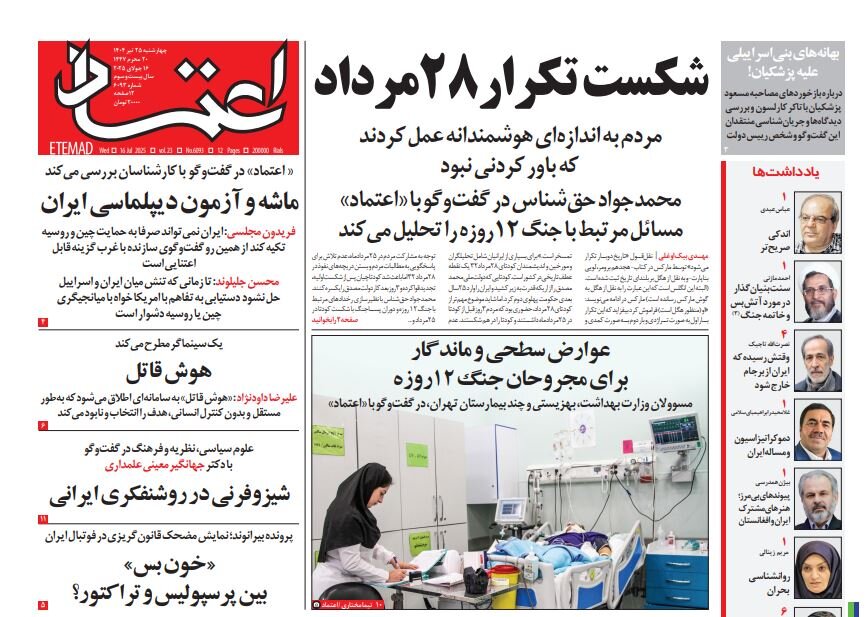
Tehran – In an interview with Qiuomars Yazdanpanah, a professor of geopolitics at Tehran University, Etemad considered Moscow’s approach to tensions between Iran and the United States.
He said: Russia and Iran are two countries that have seen many ups and downs in their relationship over the years. As two neighbors, they see each other through a geopolitical and strategic lens. However, one thing to note is that Russia is not considered a key player by the powers of other worlds. This is a reality that Iran must fully understand. The attack on Iran with Israel (a 12-day war) is exaggerated to convey this idea. Nuclear activities in the Islamic Republic are both threats and still threats. This is a malicious move that uses pretexts to escalate pressure and causes new conflicts with Iran. Therefore, Iran needs to adopt its position towards a statement or position by Russian officials on issues relating to Iran’s nuclear program, as it seeks excuses that its enemy can use to justify its actions against Iran by relying on formal and documented arguments and data.
= Shargh: Europe’s impact on the negotiation process
Sharg spoke with Mohammad Irani, a senior analyst on Middle East and Arab issues, about the possible revitalization of snapback sanctions by European trioes (French, German and British) and Iran’s nuclear diplomacy in the coming weeks or months. He said: Tehran threatened to withdraw from the NPT if this (snapback) mechanism was implemented. boiling point. Therefore, Tehran and Washington are aware of the 30-day process for the return of UN sanctions, and are likely seeking a temporary agreement through diplomacy to prevent Europe from taking such a step. Some believe that the activation of the snapback mechanism by Europeans will not have a significant impact on the course of negotiations between Iran and the US, and both sides will pursue benefits for new rounds of negotiations. On the other side, some acknowledge that the activation of the snapback mechanism and future direction of negotiations are two issues that will affect each other. Whether we like it or not, if three European countries request the Security Council to activate a snapback mechanism, it will affect negotiations.
Arman-e-Melli: Proactive diplomacy is needed
In an interview with political affairs expert Mehdi Pazoki, Arman-e-Melli dealt with negotiation and diplomacy as a tool to prevent the invigoration of snapback sanctions. He said: Obviously, adopting active negotiations and diplomacy is not only an option, but also a necessary part of maintaining Iran’s national interests. The emotional response to this issue is playing in Israeli-designed fields, particularly as Israeli officials repeatedly emphasize that now is the best time to activate the snapback mechanism and complete the Iranian sanctions cycle. Israel is taking advantage of current conditions that shake up our support and Europe. By relying on strategic control in terms of international conditions and existing diplomatic capabilities, Iran can manage problems in a way that not only resolves the crisis, but also reduces foreign pressure, improves economic situations, and reconstructs the path of international interaction. At this point there is an opportunity for interaction that can be used in intelligence and excitement, which will benefit the country and prevent the unilateral exploitation of the Israeli situation.
Khorasan: Good negotiation, bad negotiation
In the memo, Khorasan discussed the quality of possible reopenings of future negotiations, writing: Although the recent 12-day war on Iran’s Islamic Republic began in negotiations between the United States without justification, hegemonic strategies once again showed no fundamental changes with changes in faces and government. The claim to prevent nuclear enrichment is merely a cover for imposing strategic pressures and political will towards the Iranian state. However, given recent experience, the Iranian state has chosen strategies that are not emotional or ideological, by exercising its authority over the years. Rather, the logic is based on strategic rationality and Islamic principles. That strategy is also derived from positive resistance. Negotiations are not only acceptable, but are necessary when you want to impose your will on the enemy. But negotiating to please the enemy is never in parallel with the political rationality of Islam. Based on Islamic teaching, negotiation is an intellectual movement.