
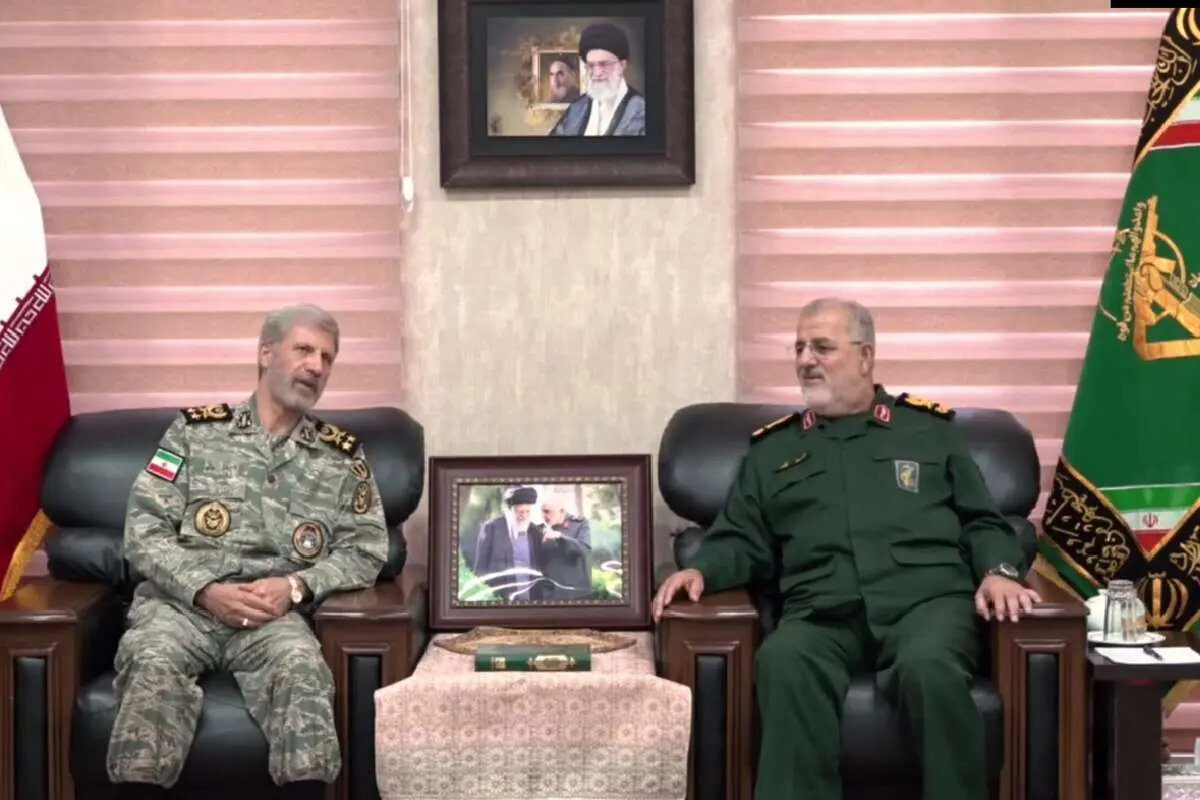
TEHRAN – At a critical meeting with the highest class of Iranian military forces, the senior commander emphasized the country’s preparations to deal an even more decisive blow to the enemy.
Major General Amir Khatami, commander of the Islamic Republic of Iran (Artesh), met with Major General Mohammad Pakpur, commander of the Islamic Revolutionary Guard (IRGC) on Thursday.
In this high-level consultation, General Pakpour highlighted the exceptional morale of IRGC combatants and announced that the country’s troops would stand in “full preparation and coordination to attack the enemy again.”
General Pakpur paid tribute to the martyrs in the 12-day attack on Iran by the Israeli regime.
He praised the grand resistance of the Iranian state during the recent 12-day war, describing the immobility of the people as the most important asset and support for the military.
“Unification of diversity,” said Pakpur, “is the most impregnable fortress in Iran.” He argued that the Islamic Republic of Iran, backed by the country’s grand support, neutralised the most complicated wars and instigation in its history against the country.
“The determination and enthusiasm of the Iranian people and the military have won on the battlefield. We stand together and are determined,” Pakpur declared, adding that Iran has never been defeated by standing up to his enemy.
Emphasizing the state resistance of the leaders of the Islamic Revolution and the changes in the calculation of the enemy due to strategic leadership, Ayatollah cried out Ali Khamenei, the Israeli commander emphasized that the Israelites “witnessed the hell that they had promised with their own eyes on the last day of the war.”
He issued a harsh warning: “We will not release the invaders and the invader’s collars. We will resume the war and fight the invaders exactly where it has been stopped.”
Speaking on the same day, reflecting the commander’s assessment, Brigadier General Ahmad Vahidi, adviser to the IRGC Commander, detailed the profound impact of Iran’s recent military action.
General Vahidi declared, “Under the intense pressure of Iranian missiles, the Zionist enemies have been crushed to the extent that we are now witnessing a tsunami of change in leadership within their ranks.” He directly attributed the upheaval to the serious blows brought by Iran.
Vahidi pointed to important achievements in confronting Israel’s enemies in the Islamic Republic, saying that it “has made a new scene of the struggle between the country and its combatants.”
He emphasized hospitalizations from the Israeli regime itself, saying, “The Zionist air defense commander explicitly stated that they had never witnessed such an unprecedented war and unprecedented attack.”
These entrances highlight the power and effectiveness of the Islamic Republic strikes and its combatants, Vahidi added.
The Iranian general further dismissed the display of Israeli strength as intense, saying, “The Zionist regime tries to portray as strong with screams and howling, but its forces are well aware that the real winner is the Iranian country.”
He spoke of recent developments in the field of conflict, citing the “moral, political, cultural and social decline” of the Zionist regime as a clear indicator of the monumental defeat given by the Islamic Republic of Iran.
Unprecedented damage: Infrastructure crippled and morale shattered
The commander’s statement directly points to the consequences of Iran’s massive missile and drone attacks against Iran’s massive missile and Israeli attacks, responding to the unattacked aggression of the Israeli regime, and responding to the launch of a 12-day war with Iran on June 13th.
The Israeli regime, fearing global exposure to its vulnerability, imposed one of the most severe military censorships in its history, banning journalists, photographers and even settlers from recording the devastating effects of Iran’s ballistic missiles.
However, military analysts and international observers have a detailed and lasting impact.
– Infrastructure Damage: Hundreds of Indigenous Iranian ballistic missiles, cruise missiles and drones have overwhelmed the highly famous Israeli and Allied missile defenses, achieving unprecedented penetration.
Major military neurological centers, particularly Nevatim Air Force Base (important for F-35 operations), Mossad Intelligence Headquarters, and Aman’s main logistics bases, maintained multiple direct and substantial hits.
Analysts said the strike caused “decreases” and “irreparable damage” to strategic assets such as radar installations, command bunkers and air defense artillery items, enforcing serious operational disruptions and exposing the administration’s hollow security claims.
The scale of the destruction is so immeasurable that even former President Donald Trump admitted that “Israel was hit really hard” and publicly acknowledged the devastating effectiveness of Iran’s indigenous missile barrages.
– Social Conditions: The deep psychological and social impacts within the occupying area have led to what local analysts describe as existential crisis for Zionist organizations. Wide range of panic, mass evacuation and serious disruptions over daily life and the economy have been documented.
Importantly, the strike ignites a crisis of deep confidence in the administration’s security equipment and political leadership, shattering the myth of carefully cultivated invincible.
The unprecedented scale of the attack – some consider it to be even heavier than the 1973 Yom Kippur war, but it fundamentally exposes the regime’s strategic vulnerability, shaking the colony’s community to its core, revealing the inherent vulnerabilities covered by decades of Western protection.
Minister of Information: Attack strategy: From within
There is a prospect of a new conflict with Tel Aviv with Iranian Intelligence Minister Esmaeil Khatib, and outlines another dimension of pressure on the Israeli regime.
Speaking to reporters on Friday, Katib argued that “the Zionist regime must stand up against an offensive strategy from its own right.”
Khatib said in parallel with the military pressure exerted by Operation True Promise III, “all intelligence and security equipment are working hard, just as the shocking missiles of our troops were forced to stop them.”
He pointed to recent actions by the Israeli regime as evidence of this internal pressure. “In the past few days you’ve seen them being forced to hold an explanatory program to counter the infiltration of intelligence reporting agencies within the Zionist regime.”
Katib also highlighted Iran’s internal resilience despite enemy plots, saying, “despite all the instigation of the enemy, designed to overthrow the Islamic Republic, or they ended it and ended it – we witnessed the country’s internal security throughout these 12 days (of the conflict).”
His statement highlights a comprehensive approach, combining demonstrated external military capabilities with secret internal pressures, suggesting that it is actively adopted against the Israeli regime if hostilities resume.
The security chief’s emphasis on “attack strategy from within” combined with the declared military preparation for external action, strongly implies that Iran is ready to escalate in further attacks on diverse forms of retaliation.