
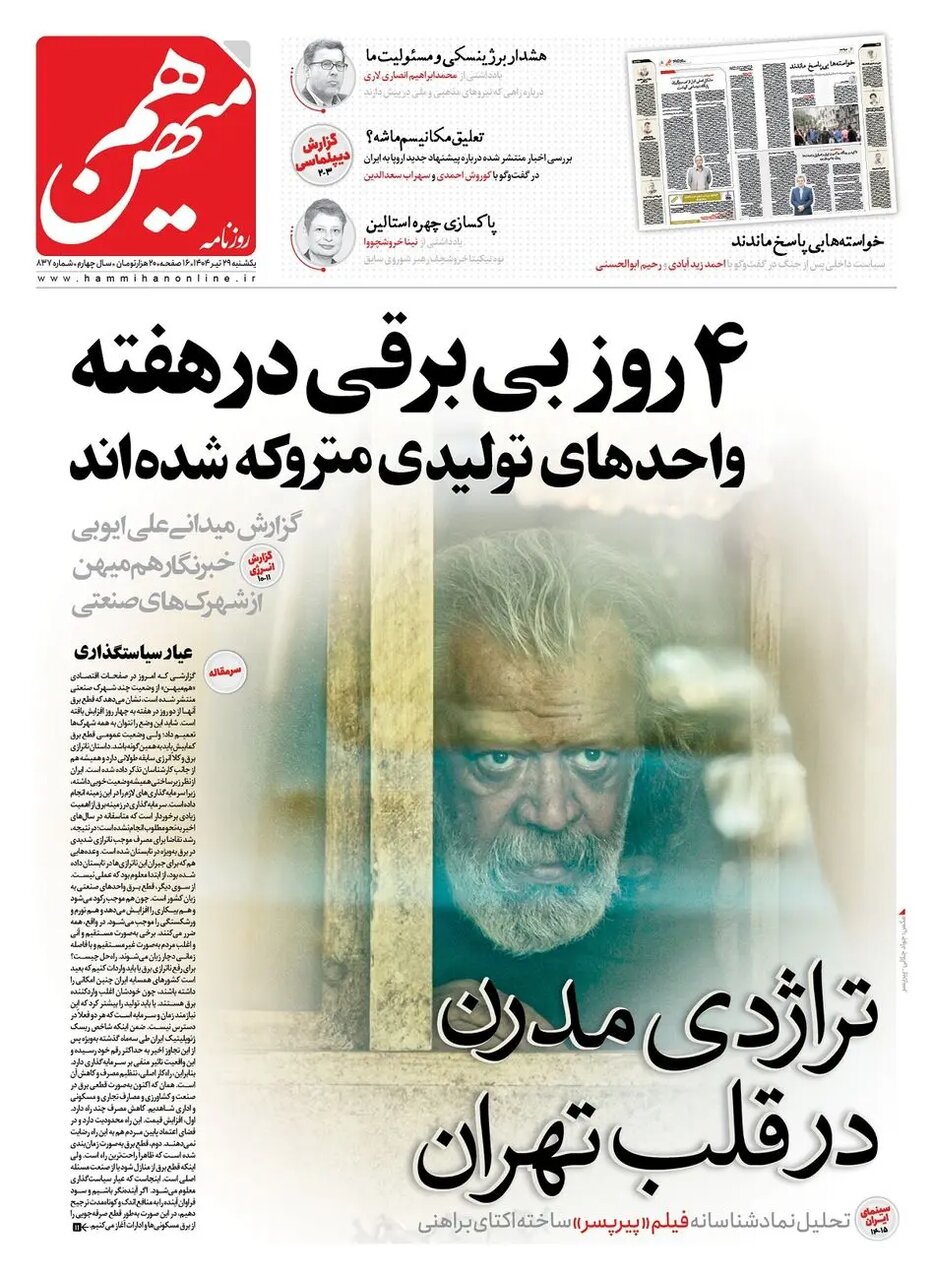
TEHRAN – In a memo, Ham Mihan addressed Actios’ claims about the option to stop Iran enrichment at Russia’s demands, claiming that after Axios’ news outlet cited western diplomats last week, the Russian president proposed an option to accept the option of halthing the nuclear case to Iran.
As one of Iran’s leading diplomatic supporters in nuclear talks, Russia has supported Iran’s rights to enrich uranium in recent years, and has denounced the US for withdrawing from the JCPOA due to controversy surrounding Iran’s nuclear programme. The Russian Foreign Ministry called Axios’ claims a “dirty campaign with political goals” to damage Tehran-Moscow relations. The goal is clear. It is to create discrepancies and pessimism between countries that have established good and constructive relationships with each other. Our relationship with Russia is based on respect and mutual interest. The Russians are very aware that the Islamic Republic of Iran has made independent decisions on all issues related to foreign policy, including the nuclear issue, and the Kremlin has always respected these independent decisions.
Vatan-e-Emrooz: Targeting Weizmann or world leadership!
In the analysis, Vatan-e-Emrooz tackles Iran’s detailed attack on the Weizmann Institute of Science, writing: From Iran’s view, the attack on the institute could be interpreted as a retaliatory measure in response to the Israeli attack in June. The attack also indicates an increase in Iran’s missile capabilities and could send messages about its deterrent, counterattack or countermeasures, but from Israeli views the dimensions of the attack cannot be easily repaired. The Iranian attack caused a huge loss to the institute, retreating its strategic importance to the extent that Zionist officials have said “Israel will return to world leadership” and are committed to rebuilding it. This was not a simple science centre, but a key centre in the development of Israeli advanced technology. However, targeting this agency should be viewed as an important part of the future geopolitical and regional security competition between Iran and Israel.
Khorasan: How to deal with the hybrid war
In a recent commentary, Khorasan worked on development following the Iran-Israel conflict in June. New tensions that emerged in Syria and Iraq warned that the US and Israel are showing a broader strategy to destabilize regional nations, aiming to destabilise regional nations and broaden unrest over Iran’s borders. The commentary also criticized the UK, France and Germany for failing to maintain their commitment to the JCPOA and for attempting to raise a snapback mechanism. These moves are also obvious and hidden – considered elements of the broader hybrid war targeting Iran. He argued that responses to such wars must be multifaceted, combining aggressive and defensive actions. As the military continues to strengthen its preparation, Iranian diplomatic devices must mobilize all legal and communication tools available. According to the film, the enemy was injured and now focuses on investigating Iran’s vulnerabilities. While Iranians have consistently demonstrated resilience in defending their homelands and ideals, the commentary emphasized that one of the key factors behind their continued strength is national unity. Preserving this unity requires vigilance and active participation from all Iranians.
Iran: European objectives in the threat of snapback
In an interview with Heidar Ali Masoudi, professor of international relations at Shahid Beheshti University, the Iranian newspaper considered the main European goals of setting deadlines for snapback mechanisms. He said: It appears that Europe’s ultimate goal in setting deadlines for activating snapback mechanisms by the end of August is not necessarily intended to restore security council sanctions. What is seen is attempts to put political pressure on Iran with the aim of putting pressure on him to give nuclear concessions and other issues, opening ways for Europeans to return to the negotiation process. The preferred scenario for Europeans is not to intensify international pressure, but to redefine their position in nuclear diplomacy. In this context, we can get the impression that Europe is still moving within the framework of its previous order and its diplomatic principles. Europe is not completely distanced from multilateral diplomacy, rather using pressure tools for this purpose, but continues to act as an active mediator.