
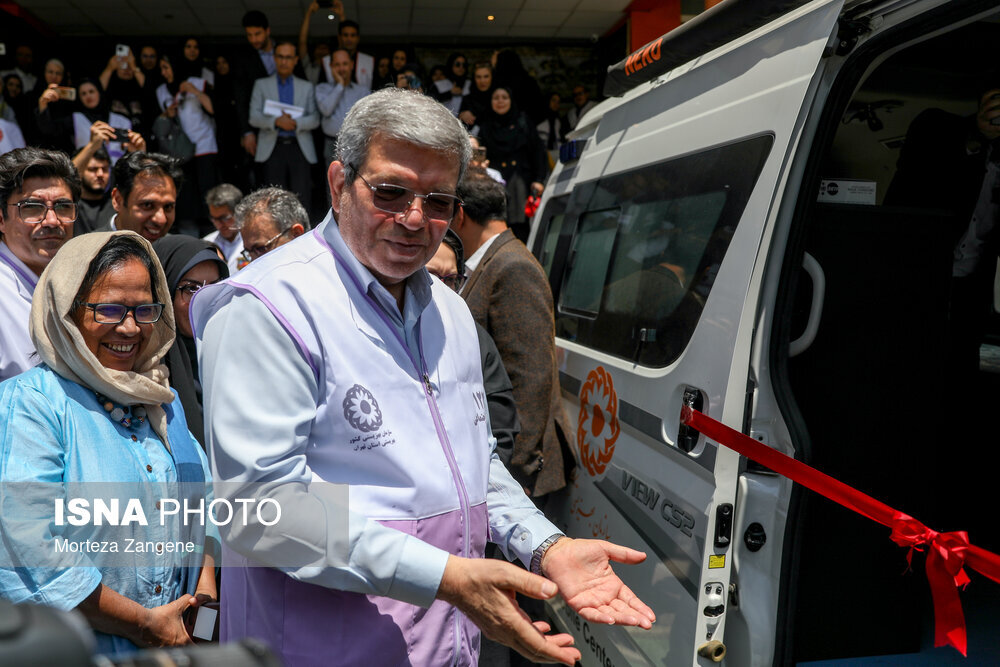
Tehran – Advertising interim area for resident representatives of Iran’s United Nations Development Programme (UNDP) Aishani Medagangoda Rabe has praised the services of welfare agencies for achieving commitment, inclusivity and aspirations over the past 45 years.
Welfare organizations are extremely reliable and provide services everywhere from big cities to the farthest villages.
She made her remarks Monday while addressing a ceremony for the deployment of Tehran’s Harm Reduction Mobile Centre.
She noted that the organization’s relentless efforts are based on Article 29, which guarantees the rights of social security for all citizens. Article 29 specifies that you are eligible for Social Security benefits related to retirement, unemployment, old age, disability, caregiving, lack of accidents, medical and treatment needs, and that you are responsible for using national income and citizen contributions, as outlined in the law.
The organization has brought dignity and care to those facing deprivation and social exclusion by providing services such as mobile clinics, harm reduction centres, and programs for women, children and those in need of special services, Medagangoda-Labé added.
UNDP has honoured cooperation with welfare organisations through global funding to combat AIDS, tuberculosis and malaria, says Medagangoda Rabe.
The partnership has led to the development of a resilient and person-centered infrastructure with over 430 service centres and 58 mobile vans. Over the past year, committed medical staff have directly served around 19,000 vulnerable people in remote locations through mobile clinics.
She went on to say that these efforts and services did not halt even during the 12-day war that Israel imposed on the country.
The results speak for itself. Over 60% of people living with HIV know their condition, and over 40% of high-risk populations have received a prevention package from their organization over the past year.
Welfare organizations provide most HIV services in the country, with over 90% of people receiving treatment, which keeps the viral load down.
“On the way forward, the UN Development Programme and Welfare Organizations will continue their joint efforts. Our goal is to expand mobile services, expand databases to address social harm, comprehensively and respond to future needs, and develop evidence-based policies based on human dignity.
The collaboration could also be expanded by including mental health services, violence prevention, maintenance treatment and professional rehabilitation.
“Today, we celebrate not only our past (effects) but also a promising future that benefits from the dignity, hope and care of our villages, communities and families,” the formula emphasized.
National Welfare Week
National Welfare Week was held nationwide from July 16th to 22nd. This year, it was observed in The Mother ‘Together for Leaveing. I’ll take part today and give you strength tomorrow.”
Welfare organization head Seyed Javad Hosseini said 10,566 housing, employment, society and rehabilitation projects of 520 billion rial investment (approximately $580,000) will be launched on the 45th anniversary of National Welfare Week.
Approximately 77% of the projects will focus on employment, 21% will focus on housing, and the remaining 2% will focus on social and rehabilitation sectors, officials noted.
Additionally, 359 projects have begun, most of which will be implemented in Carman, Laurestan and Isfahan.
Over the past year, 14,000 housing units have been provided to beneficiaries and people with disabilities. 45,966 homes are under construction. Also, 1,942 housing units will be handed over to people with disabilities in a week, Hosseini emphasized.
Officials continued to announce the launch of the Employment Support Fund. “Thanks to welfare services, nearly 200,000 beneficiaries and individuals with disabilities are employed, with the services sector accounting for 62% of the employment.
UNDP activities in Iran
Currently, UNDP activities in Iran focus on four key areas including social and economic welfare, health, the environment and reduction in disaster risk, Medagangoda Rabe said in April.
Authorities made statements in response to the ceremony held during the 20-year partnership between UNDP and welfare organisations, Mehr’s news agency reported.
“One of the main tasks of the UN Development Programme is to promote successful models from other countries and introduce them to welfare organisations. We are trying to ensure the necessary financial resources to support the activities being carried out in Iran.”
Top priorities for UNDPs in economic and social welfare areas include conducting research, supporting micro and small businesses, and improving social and economic well-being for at-risk groups, such as female head heads and vulnerable youth.
Health is the second area of work, and involves fighting infectious and non-communicable diseases. Here, UNDP works closely with other UN agencies, such as the World Health Organization (WHO) and the United Nations Children’s Fund (UNICEF).
The third area is the environment. UNDP seeks to protect the country’s natural resources, wetlands and biodiversity. It also helps to meet the impacts of climate change in accordance with international standards.
Officials continue, saying the energy sector is focusing on the use of renewable resources. Currently, Iran uses 1% of its potential for renewable energy such as solar, wind and water.
“We hope to leverage our national and international capabilities to develop solar energy in various centres, such as health,” said Medagangoda Rabe.
The fourth region of domestic UNDP activities is disaster risk reduction. The successful experience of reducing sand and sandstorms is a prime example of cooperation in this sector, officials further noted.
mt/mg