
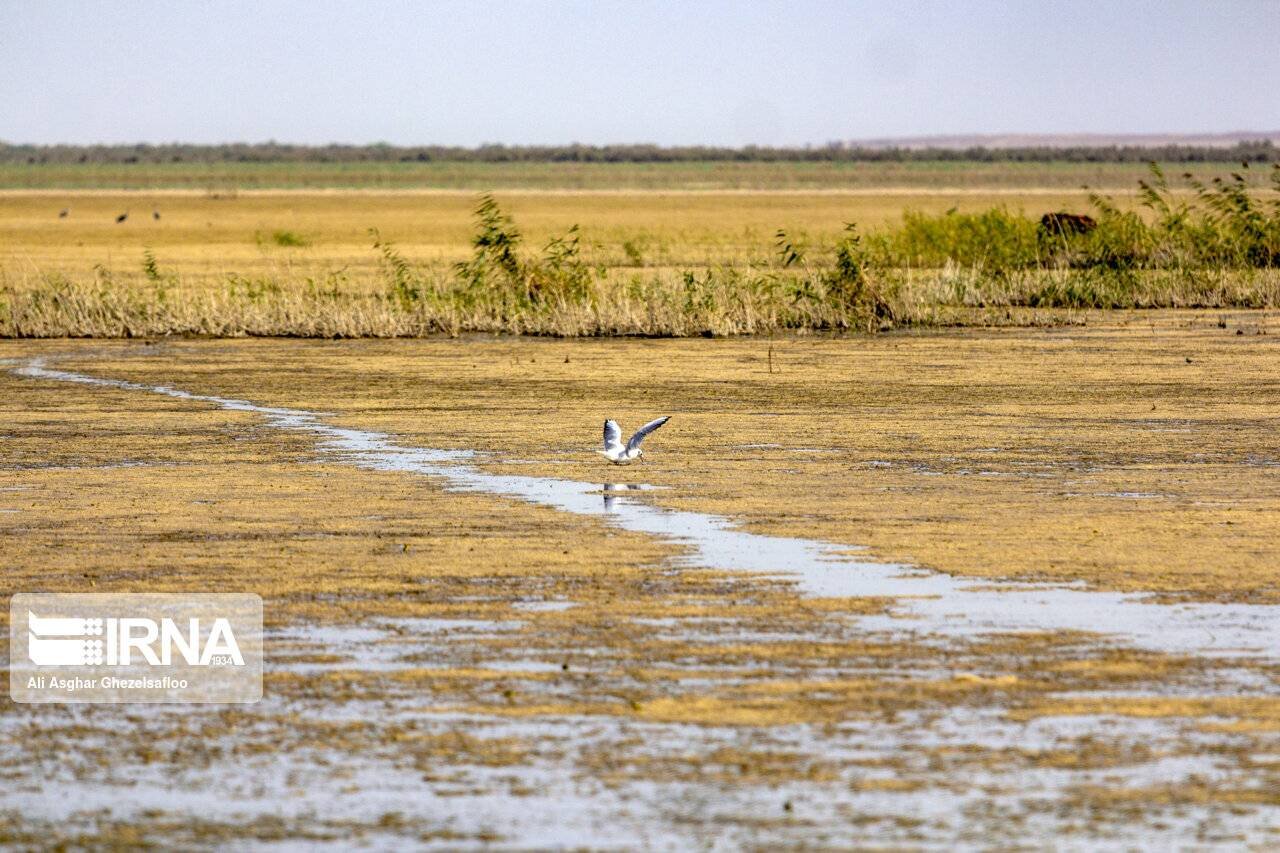
TEHRAN – Three international wetlands in northern Golestan province were drying out due to drought last year, but are recovering thanks to recent rains, the provincial environment director said.
Aragol wetland, Ajgol wetland, and Almagol wetland are located near the border of Iran and Turkmenistan. IRNA quoted Mojtaba Hosseini as saying that the Ajgor and Almagor wetlands were completely dry and only about 5 hectares of the Aragol wetlands were filled with water.
Of the three wetlands, Aragor is the largest. He added that the area of the wetlands is about 2,500 hectares, followed by Ajgor wetland (320 hectares) and Almagor wetland (207 hectares).
After years of drought and low rainfall, precipitation has increased over the past few months, especially in the first months of spring. On April 6, more than 100 mm of rain was recorded in various parts of the north.
Hosseini pointed out that the Atraq basin, the main reservoir for the three wetlands, was filled with water due to flooding caused by heavy rains.
Interestingly, the rains have significantly increased the water volume of rivers and streams flowing through protected areas such as Jahan Nama, Hyrkaniya and Golestan National Parks, he added.
Aquatic ecosystem restoration improves habitat diversity and contributes to supporting a variety of bird species and animal populations such as ewes, goats, gazelles, red deer and roe deer during the next breeding season.
According to a recent census carried out in winter, Golestan’s habitat is home to more than 13,000 rams, ewes, goats and gazelles, as well as 134,000 waterfowl and riparian birds.
Wetland conservation project
The Department of Environment (DOE) is restoring four wetlands: Bamdej in southwestern Khuzestan province, Gomishan in northern Golestan province, Arjan in southern Fars province, and Kuligol in northwestern East Azarbaijan province.
The project to restore the Bamdej wetland began about two years ago with private sector assistance and has invested 1.3 trillion rials (about $8 million), with an additional 2 trillion rials (about $12 million) needed to complete the project, ISNA quoted Ahmadreza Rahidjanzadeh, deputy director general for marine wetlands at the Ministry of Environment, as saying.
Spread over 4,000 hectares, this wetland is home to more than 134 plant species from 49 families, including lutea, Carex brunea, reeds and sipelas, 22 species of mammals, 12 species of fish, 15 species of amphibians and reptiles, and 148 native and migratory birds.
The Gomiyama wetland is expected to be restored by June. This wetland was registered under the Ramsar Convention in 2003. It is known as one of the major bird habitats. The wetland is home to approximately 20 species of fish, 24 species of reptiles, more than 100 waterfowl and riparian birds, and more than 30 species of mammals, including the Phoca Caspinus.
The Kuligol wetland has a high potential covering approximately 160-200 hectares. Once restored, it will become one of the major tourist attractions. The wetland is home to more than 92 species of birds, all migratory except for the coot, 14 species of reptiles, four species of amphibians, and one species of fish.
The Arjan restoration project is still in its early stages. Covers 2000 hectares. Wetland water is determined by rainfall. This wetland is one of the main habitats for migratory birds such as cranes, flamingos, ducks, and geese. Wetland plants include reeds, vetch, and sagebrush. The wetlands are also home to mammals such as wild boars, jackals, and foxes.
Iran’s geography is unique and full of diverse landscapes. In Iran, 141 wetlands of ecological value have been identified, covering an area of more than 3 million hectares, 27 of which are registered under the international Ramsar Convention.
DOE announced the launch of a new phase (2025-2028) of wetland conservation projects to enhance sustainable livelihoods and reduce pressure on wetland ecosystems.
IRIB news agency quoted Feresht-e Jadri, an official at the Ministry of Energy, as saying on November 25, that the project provided the basis for promoting wetland protection and improving sustainable resource use, backed by successful experiences in Lake Urmia, Gilan, Fars and Parishan watersheds, and watersheds in East and West Azerbaijan oblasts.