
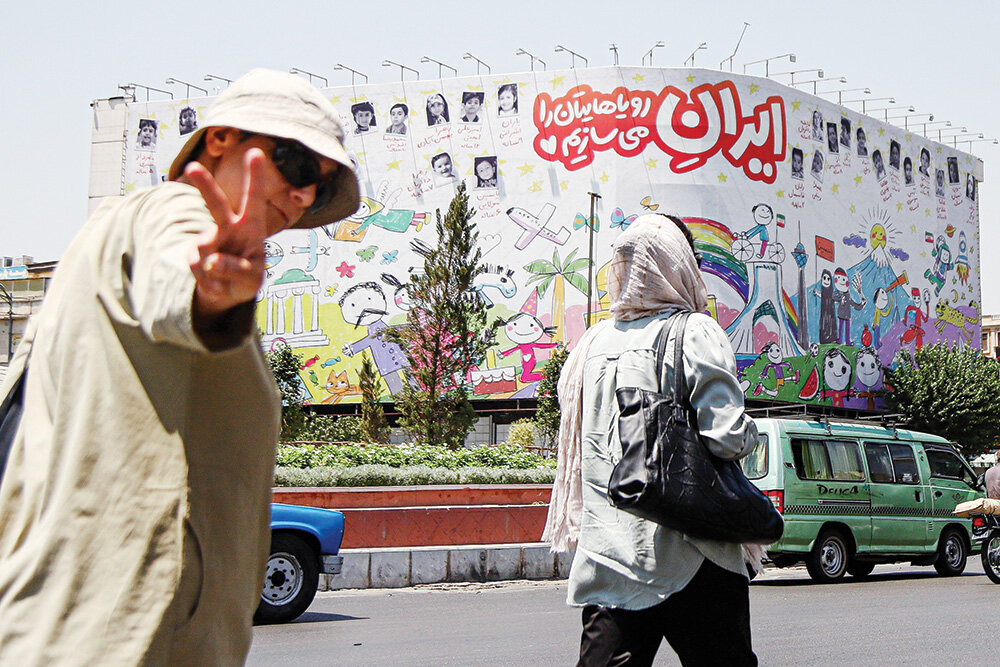
TEHRAN – As Tehran public attention is unfolding, a wall-sized respect for Iranian children killed during Israel’s 12-day military attacks has ruled a recent comment by Israeli Benjamin Netanyahu over the deep collective mourning and fierce rage of Iranian society.
On July 21, Netanyahu reiterated his now familiar claim that distinguishes the Iranian government from its people, saying, “There is no opportunity for peace with Iran’s current regime, but yes, those who want to overthrow the regime.”
His statement coincided with what was painted under a moving message, painted alongside his childhood painting, except for the sadness of the child’s portrait.
“We will build the Iran you dreamed of.”
Civilian victims
Official statistics compiled by the Iranian Ministry of Health, supported by multiple relief organizations, estimate Iran’s death toll in 1,062 12-day attacks, with at least 276 being identified as civilians. Of these victims, 102 are women and 38 children, with Tehran reporting the highest casualties. A more gloomy estimate suggests that total civilian deaths could reach 436. The attack caused serious damage to private infrastructure, including residential areas, several schools and at least two hospitals in the capital.
Many independent monitors and international observers highlight the devastating impact on children and families, with images of child victims dominating headlines both domestically and internationally.
I visited Engelab Square on an unusually hot afternoon as temperatures in late July skyrocketed well beyond typical levels, forcing many to avoid staying outside. The vibrant squares all year round presented a completely different scene, usually close to Tehran University and cultural venues. The fever thinned the normal crowd, leaving only intermittent pedestrian pockets.
I arrived at noon and first took a little time to settle in a small shade near the mural, observing the environment and passersby. Most people have moved, pausing temporarily to use ATMs, glimps at small food stalls running by aged vendors hawking miniature handicrafts from various Iranian cities, and through static air.
The swelling heat suppressed the usual vibrancy of the square, but it did not suppress the quiet gravity surrounding the mural.
Mourning, rebellion, voice from Engelab Square
The first person to paint me for an interview was a young woman of my age. Her shining smile, not touched by the heat, invited me. Introducing myself as a reporter, I sought her thoughts on the mural and its message. Despite her waiting companions nearby, she happily shared her feelings, revealing her sadness mixed with subtle resolve.
Shortly afterwards, a man retracting money nearby asked me about my line of questions. After I explained, he also volunteered to his perspective, adding layers to the public sentiment.
As I took the pace under the hot, sparse shades and watched the passersby’s expressions and pace, I gently requested a brief moment for a conversation.
“Peace with people, not with government”
In his latest remarks, Netanyahu argued that Israeli military operations target only the Iranian state and nuclear infrastructure, not the citizens, and the war as follows:
“There is no opportunity for peace with Iran’s current regime, but there is no peace with those who want to overthrow the regime.”
Calling the attack the “Operation Raisinglion” he emphasized that the target was to neutralize Iran’s missiles and nuclear capabilities. He portrayed evil deeds as essential to Israel’s security and the security of the world. He further suggested that these operations may provide Iranians with an “opportunity” to rise for their government.
Through escalation, Netanyahu has been permanently casting himself as an ally of the “Iranian people,” a rhetorical strategy that justifies military action and encourages internal dissent.
Chorus of rejection and sadness
The group under the mural, symbols of unity of sadness, Iranians of various ages, backgrounds and beliefs expressed unanimous rejection of Netanyahu’s statement.
Kanrou, 45, a child educator, expressed widely shared feelings.
“If this war is not with the Iranians, why are the children dying? Why are their faces on this wall?”
She called the attack “genocide,” drawing out similarities between the suffering of Iranian families and Palestinian mothers, adding:
“The hijab or hijab is standing now as a person.”
To her, Netanyahu’s claim was “absurd and meaningless.”
Raha, 38, highlighted the innocence of the child victims, saying, “These children were not involved in conflict or politics.”
Gitty, 52, her mother described Netanyahu as a demonic incarnation that must fight for just fighting.
She also ridiculed her hopes for negotiations:
“You should not talk about peace with those who bomb children.”
Her words reflect the erosion of broader confidence in not only Israel but also in the Western allies.
The mother, in her early 40s, described the attack as a “crime against humanity,” admits:
“Viewing images of young victims as mothers is more than I can endure.”
Another woman expressed a categorical rejection of violence, regardless of the agitator.
“No matter who starts it, war is never beautiful. Iran, Israel, or the United States.”
The man in the mid-40s dismantled the Netanyahu division between the state and its citizens.
“We see leaders as part of ourselves. Pretending that there is a difference is a lie.”
He argued that such rhetoric would only serve to justify a change of government. For many Iranians, all losses collectively hurt the people.
Habib, a middle-aged driver, concluded in gloomy:
“It is always the people who suffer the most, not officials. The costs of this war are borne by children and families.”
Words meet reality
Despite the repetition that Netanyahu’s message separates the regime from the people, these words rarely resonate within Iran. The interviews reinforced the broader perception that such rhetoric merely obscures military escalation and serves as an excuse for a change of government. The evidence of civilian casualties, particularly between women and children, is in stark contrast to the claim that the war is holding back on the Iranian masses.
Being familiar with similar past rhetoric deepens the public’s disgust and promotes stronger national unity rather than division.
Collective sadness and a solidarity
Netanyahu’s overture on the “Iranian people” does not relieve anger or reduce the pain seen on the streets of Tehran. Instead, sadness and anger strengthened resolution and strengthened unity that filled generations, genders and classes.
As Iranians gather under a mural depicting lost children, the bay between political rhetoric and reality is more clear than ever. The message from Tehran is clear. Solidarity will last longer grief, and unity will last despite foreign pressure.
As one citizen has heartfelt summary:
“We are in mourning, but we are not broken.”