
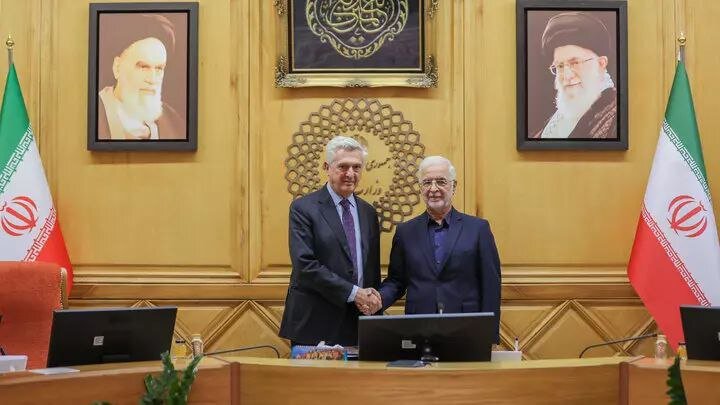
Tehran – Home Minister Escandar Momeni and UNHCR High Commissioner for Refugees (UNHCR) Filippo Grandi have explored ways to address issues relating to the country’s refugees and deportation issues.
Officials met in Tehran on Tuesday. The conference focuses on holding a trilateral meeting between Iranian officials, Afghan officials and UNHCR representatives to increase financial support from international organizations, organize Afghan refugees and prevent drug trafficking, according to the Home Ministry’s website.
During the meeting, Grandi praised Iran’s generosity in hosting refugees over the past 40 years. “I personally know the burdens the country and Iranian people are experiencing. Unfortunately, international support for Iran has declined significantly in recent years. However, Iran gradually reverts (illegal) immigration and asks not to put pressure on Afghanistan because of economic and social issues.”
Officials hoped Iran would continue its humanitarian approach with the contribution of the international community.
On his part, Momeni states: “Unjust refugees are returned to their homeland without being questioned anywhere in the world. However, in Iran, their return will not be violently deported if life in Afghanistan is threatened or if they need to stay here for treatment.
The governor of Afghanistan has seen first hand how deported people were treated with respect. ”
Officials went on to say that around three to four legal Afghans work and live in a country that is respected by Iranians. Their children attend the same school as the Iranians and work in Iranian workshops, he added.
Nadar Yar Ahmadi, head of the National Immigration Agency, said Iran has been hosting Afghan refugees for more than 40 years and will continue to do so in a different way. Only documented refugees can benefit from domestic services.
“Grandi confessed that international financial support is nothing compared to the country’s extremely expensive measures, and we hope that the international community will strengthen its support,” Yar-Ahmadi emphasized.
Deported Afghans receive medical services at border terminals
Around 36,000 illegal Afghan refugees have benefited from the health services provided at the Degaron border terminal in Teibad in northeastern Kholasan Razabi province, returning to their home country, health ministry officials said on Monday.
They were visited by doctors and received nursing services. They were also educated on proper hygiene practices and how to avoid infectious diseases. The suspected cases were also tested, the IRNA quoted Soudabeh Nekouhi as saying.
Heat stroke, food poisoning and high blood pressure are one of the main reasons to visit health centres, she added.
Since the beginning of the current Iranian year (March 21), medical products worth 1 billion rials (nearly $1.150) have been distributed among de Garon’s undocumented refugees. Additionally, 22,492 Afghans who legally entered the country have been screened, and 10,753 have been vaccinated as part of the prevention programme, Nekohi said.
All Afghan nationals, 85% male, have been screened and tested for 16 different illnesses, she noted.
In May, Grandi praised Iran’s efforts to serve refugees in various fields such as health, education and employment.
The IRNA quotes Grandi as saying that the valuable services provided by Iran are truly valuable and admirable in the face of sanctions and some economic issues.
Officials made a statement during a meeting with Health Minister Mohammad Reza Zafarkandi. Officials met bystanders at the 78th World Health Parliament (WHA) held in Geneva, Switzerland from May 19 to June 27.