
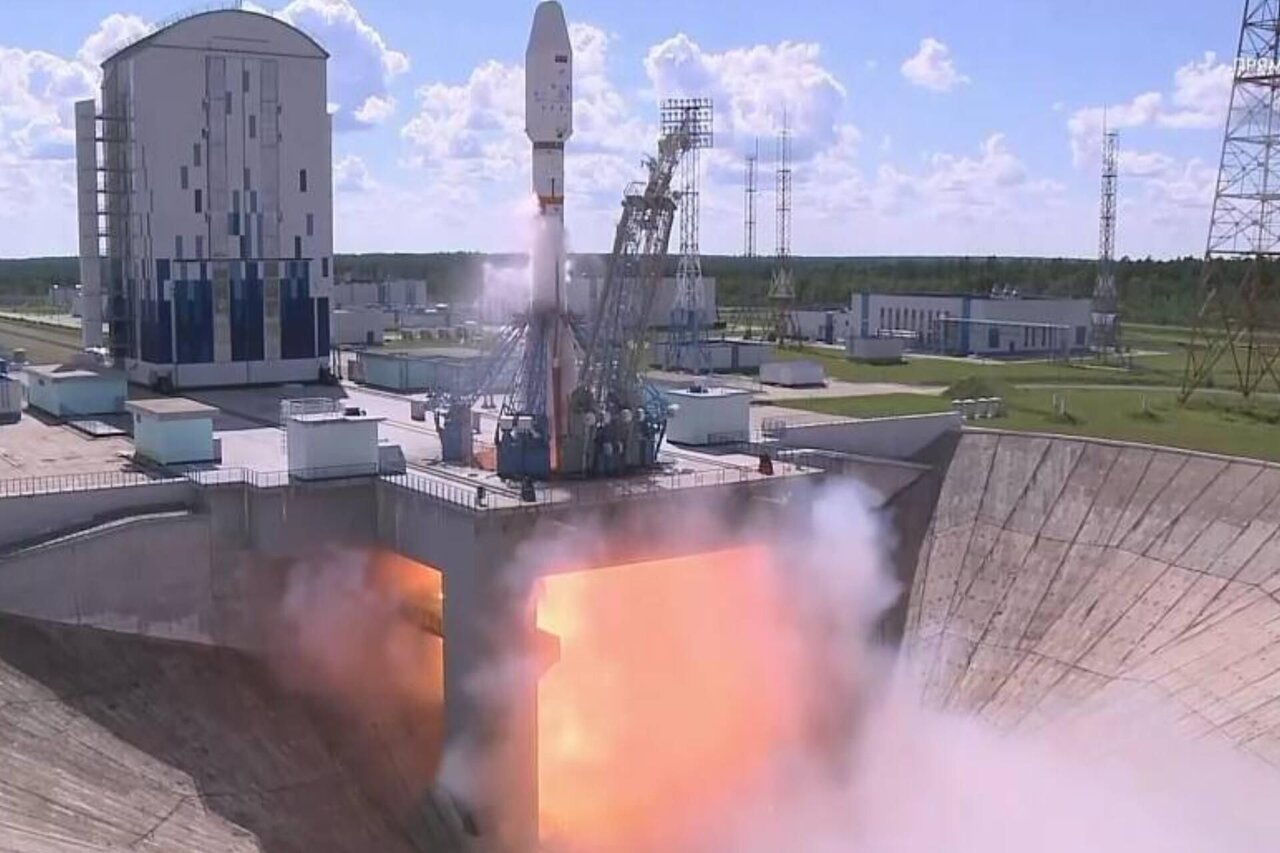
TEHRAN – Nahid-2, a communications satellite built in Iran, was launched into orbit on Friday on a Russian Soyuz rocket from Vostochny Cosmodrome in eastern Russia.
The launch included some of the multi-payload missions, including Russia’s Ionosfera-M3 and M4 satellites, as well as 18 other satellites from various countries.
Developed by the Iranian Space Agency (ISA) in collaboration with the Iranian Space Research Center and a network of knowledge-based domestic companies, NAHID-2 represents an important step in Iran’s efforts to improve the aerospace capabilities of indigenous peoples.
In a symbolic move highlighting its official participation in Tehran’s launch, the Iranian Space Agency emblem was markedly displayed on the Soyuz launch vehicle.
Telemetry data received immediately after its release confirmed that NAHID-2 was successfully deployed to a low Earth orbit of 500km and was nominally operating. The satellite is designed to remain in orbit for up to five years.
According to ISA officials, the Nahid-2 is equipped with a domestically developed propulsion system that allows for up to 50 km of orbital altitude. This is an important feature for maintaining position and countering orbital collapse. The fully constructed propulsion modules in Iran include high-performance high-temperature gas thrusters, combined fuel tanks, high-pressure valves and precision control mechanisms.
The satellite also features sophisticated subsystems developed in response to years of Western sanctions, where access to Iran’s foreign aerospace technology is limited. These include domestically manufactured space-grade lithium-ion batteries that can withstand tens of thousands of charge decomposition cycles. It also includes indigenous polymer coatings and thermal adhesives designed for thermal regulation and structural integrity.
Additional mission systems under evaluation include 3-axis attitude control, multi-band bidirectional communication, data management, and power distribution modules.
The launch is considered a milestone in Iran’s long-term strategy, particularly for expanding its presence in space, in satellite communications and low Earth orbit constellations. According to Iran’s Ministry of Information and Communications Technology, NAHID-2 is “an important step towards developing domestic satellite communications networks, forming domestic Leo constellations, and preparing future high earth orbit (GEO) missions.”
ISA chief Hassan Salarie said earlier this year that Iran is planning to launch multiple satellites in 2025, including Zafar-1, Payam and Nahid-2. He also said that the next generation of Nahid satellites are already in design and will be launched in the future using domestically built Iranian launch vehicles.
The result, despite years of unilateral US sanctions and technology embargo, Iranian officials say it has only accelerated the country’s push for independence in advanced space systems.
The successful launch of NAHID-2 has led to Iran joining a small group of countries that can independently design, manufacture and operate telecommunications satellites. This is a propaganda of development Tehran as a symbol of the nation’s scientific resilience and strategic progress.