
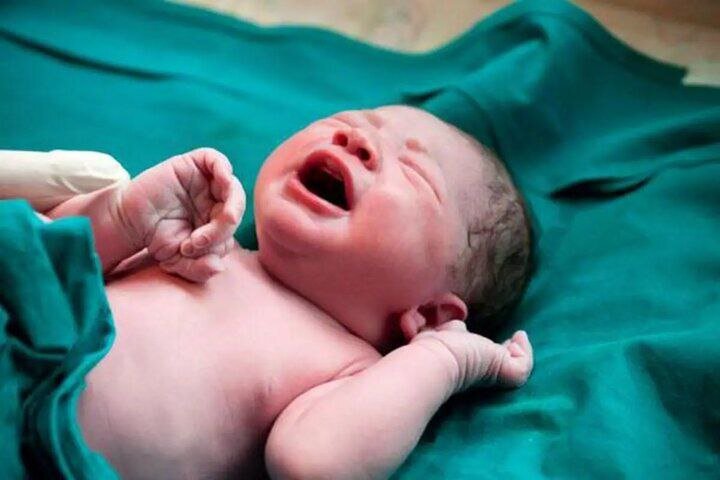
Tehran – A total of 214,223 births have been registered in the country during the first three months of the current Iranian calendar year, which began in March 2025, the Civic Registry has announced.
The boys and girls accounted for 11,238 and 102,985 births, respectively, but Mehr’s news agency cites Hashem Kargar, a civil registered organisation official.
Of the births registered in the spring, 4,202 were twins, 120 were triplets and five were squares, officials added.
Kargar noted that Iranian women have an average age of 27.5 giving birth to their first child, while the average age for men to become fathers is 32.5.
Over 129,000 marriages were registered nationwide during the same period. The average age for the first marriage was 28.4 for men and 24.1 for women, officials further noted.
National Population Week
National Population Week was based on the theme of “Children and Life Assets” from May 14th to 20th.
This year, the days of the week were named as follows: Wednesday, May 14th, “Father, Mother, Feelings of Goodwill.” Thursday, May 15th, “Motherhood, Elixir of Young People.” Friday, May 16th, “Want a Child”; Saturday, May 17th, “My Lonely Child”; Sunday, May 18th, “I Want to Live.” Monday, May 19th, “My Old Age.” Tuesday, May 20th, “Child-Friendly Society.”
The enactment of the Youth Population Act has stabilized total fertility rates and has seen a slight increase in the general fertility index over the past two years. After experiencing a seven-year decline of about 20%, the birth rate remains stable at around 1.6.
The total fertility rate reached a downward trend from 1402 (2023-2024) in 1394 (2023-2024), leading to a downward trend from 1402 to 1401 to 1401 (March 2022-2023) in 1394 (2015-2016), resulting in a sudden decline in total fertility rate.
However, it is increasing concerns about the declining trend in population growth over the next few years and the possibility of turning Iran into one of the oldest countries in the world, Irib cited Mohammad-Javad Mahmoudi, an employee of a civil registered organisation.
“At best, Iran’s population with a total fertility rate of 2.5 will reach 102,890,000 over the next seven years,” Mahmudi said.
A key factor that contributes to a country’s lower birth rate is the cost of living. In fact, many families have chosen to have a smaller family size due to high inflation and the expensive real estate sector. The current trend of one child is common in many young Iranian families, many of whom must support older parents.
There is another factor, along with delays in marriage and the extended interval between births.
Many incentives have been introduced to encourage childbirth by Iranian welfare organizations and the Ministry of Health.
However, in Iran, the population aging rate is rapidly increasing. According to a recent report, Iran is expected to enter the population phase between 2041 and 2046, with nearly a third of its population over the age of 60 by 2050, and news TV quotes Mehdi Malmir, a national headquarters employee.
The number of Iranians over the age of 65 is currently 7.5 million, accounting for less than 10% of the country’s total population.
mt/mg