
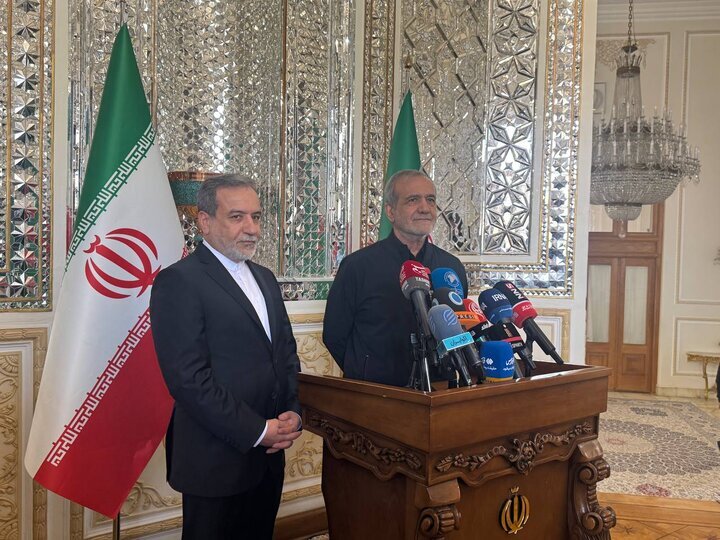
In line with the recommendations of Ayatollah Seyed Ali Khamenei, leader of the Islamic Revolution, President Tehran – Masoud Pezeshkian has stated that Iran must actively and effectively pursue both defence security and diplomatic tracks in the aftermath of the Israeli attacks.
During his visit to Iran’s Foreign Ministry, President Pezeshkian emphasized the importance of improving relations with neighboring countries and called on diplomats to adopt a more positive attitude.
He referenced Ayatollah Khamenei’s leadership that Iranians are ready to defend but should prioritize peace and diplomacy, and emphasized that living in peace is more favorable than war.
Tackling regional tensions, Pezeshkian condemned Israeli attacks on Israeli prisons, criticising Western countries and human rights groups for their perceived hypocrisy regarding human rights abuses in Gaza, and questioning the way they justify such cruelty.
Domestic, he said Iranian officials are working to strengthen their ties with citizens by hearing their complaints and addressing the issues.
He thanked the Ministry of Foreign Affairs staff for their tireless efforts in implementing the country’s foreign policy, particularly during the recent 12-day conflict imposed by Israel, and emphasized that all major international organisations (except the UN Security Council) condemned Israel’s actions.
Focusing on BRICS, the Shanghai Cooperation Agency and the Eurasian Economic Union, Pezeshkian reaffirmed Iran’s intention to expand ties with friendly countries, highlighted continued coordination with Russia, China and other global partners, and continued involvement with Europe based on prudence, dignity and public interest.
Frontline diplomacy
Foreign Minister Araguchi also worked on the meeting, highlighting extensive diplomatic efforts during the recent 12 days of war and the most recent 12 days of war.
Araguchi highlights the close coordination between Iranian troops and diplomats during the recent conflict, calling it a clear example of battlefield and diplomatic synergy.
He highlighted that in addition to military resistance, Iran’s unique governance played an important role in forcing the enemy to retreat and seek a ceasefire.
Through the efforts of the embassy and telephone diplomacy, over 120 countries have condemned the attacks and supported Iran, with most international organizations supporting Iran except for the UN Security Council and the IAEA.
Araguchi pointed to continued diplomatic work to document Israeli crimes and coordinated efforts to halt Israeli atrocities in Gaza, including the lockdown that is used as a political tool.
He also said indirect Iranian negotiations mediated by Oman have progressed through five rounds before being confused by Israeli attacks.
On June 13, the Zionist regime launched a military attack on Iran, targeting military, nuclear facilities and civilian areas for 12 days. The US later escalated the conflict on June 22 by carrying out airstrikes at three Iranian nuclear sites (Natantz, Fordau and Isfahan).
In a rapid retaliation, the Iranian forces launched a series of powerful counter strikes. The Islamic Revolutionary Guard Corps (IRGC) aerospace forces carried out a 22-round missile attack on targets in the occupied territory during Operation True Promise III, causing serious damage and casualties.
In response to the US strike, Iran also launched a barrage of missiles at Aldeid Air Force Base in Qatar, the largest US military facility in West Asia.
Hostilities ceased after the ceasefire contract came into effect on June 24th.