
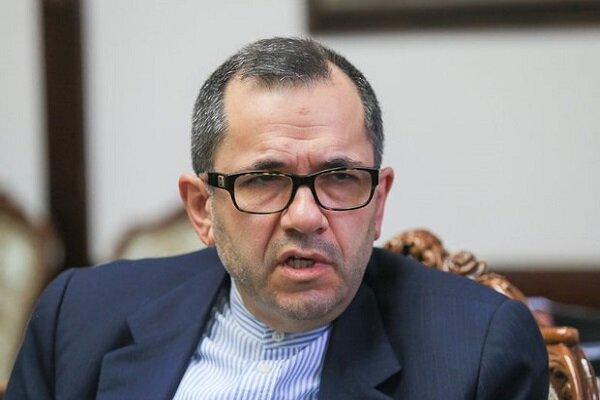
TEHRAN – Iran’s Minister of Political Affairs, Majid Takt Ravanchi confirmed on Tuesday that Tehran and Washington exchange messages through the middle states, simultaneously setting strict conditions for future direct negotiations following US-Israel’s “diplomacy betrayal” against Iran’s 12th attack.
“Iran and the US are exchanging messages through intermediaries,” Tak Ravanch said in an interview with Turkish Haberg TV in Istanbul.
Iranian diplomats made their remarks after discussions with the E3 countries of Istanbul (France, Germany and the UK), which have been described as part of the ongoing process at the deputy minister level.
He emphasized that Iran’s core position remains unchanged. Any agreement must include the lifting of all US and EU sanctions, known as “essential elements,” and affirm Iran’s right to enrich uranium domestically for peaceful purposes under the Nuclear Non-Proliferation Treaty (NPT). “The enrichment of zero is impossible and unacceptable for us,” he emphasized.
Deputy FM provided an important context for Iran’s current stance, recalling the recent collapse of diplomacy.
He referenced an indirect negotiation by Oman between Iran and the United States, covering five rounds aimed at reaching a nuclear deal.
However, Takht-Ravanchi claimed that this diplomatic process was violently confused.
“We were in the middle of the negotiation process when we first faced an attack by Israel and then by the US,” declared Takht-Ravanchi. “This was a diplomatic betrayal, this was an attack on diplomatic work.
He characterized the US and Israeli strikes as “unprovoked naked attacks” against Iranian people, and characterized them as more than 1,064 martyrs, mostly civilians, and thousands of people injured.
Iran views these attacks as a powerful violation of international law and the UN Charter, which fundamentally undermines trust.
Given this experience, Takht-Ravanchi outlined that before beginning negotiations for a new round with the US, he outlined clear prerequisites for a re-engagement with the US. “The non-repeat of diplomacy is an essential condition for us.”
He emphasized that Iran will not be invited to talks just to be “surprised” by the military strike again.
He further emphasized that any dialogue must be meaningful and be based on mutual respect and “principles that are favorable to both parties.”
“We don’t want dialogue just to ‘interact.’ Dialogues must produce results that satisfy both sides,” explained Tak Ravanchi, firmly rejecting the notion of accepting US dictatts. “We cannot have a real dialogue without being convinced that negotiations will continue and that the US will not impose that will.”
Takt Ravanchi, who dealt with recent claims about Iran’s nuclear program, reiterated Iran’s long-standing position. “No, Fatwa (by the leader of the Islamic Revolution that bans nuclear weapons) is still in effect. Our stance has not changed. We are not pursuing nuclear weapons,” he said.
He defended Iran’s right to peaceful enrichment in the soil under the NPT and rejected the call for zero enrichment.
Regarding the damage caused by the US and Israeli attacks on Iran and military infrastructure, Takt Ravanch acknowledged it as “serious and heavy,” but postponed a detailed assessment of Iran’s Atomic Energy Organization (AEOI).
He confirmed that the International Atomic Energy Agency (IAEA) knew where the nuclear material was located before the attack.
The interview also addressed a wider range of local issues. Takht-Ravanchi strongly condemned the ongoing Israeli attacks on Gaza, describing it as a “genocide” made possible by US support and the inaction of the UN Security Council.
“If the international community, particularly the countries in this region, have not shown unity in protecting Palestine and denounced Israel, Israel will be able to act freely,” he warned.
Takht-Ravanchi called for unified regional action and pressure on the US to halt the supply of arms and diplomatic cover of Israel. “If not, Israel might think of attacking other countries. This would be a very dangerous scenario not only for the Middle East (West Asia), but for the entire region,” he warned.