
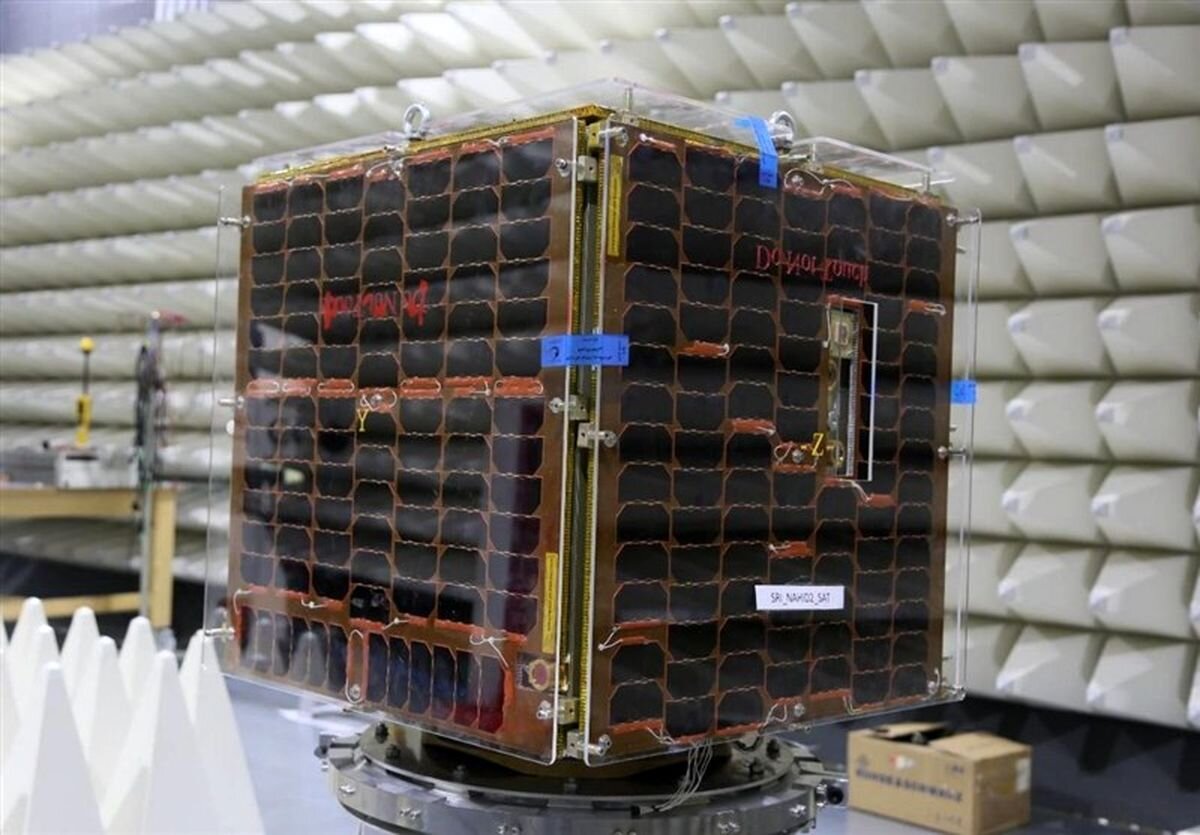
Tehran – Iran has successfully tested the NAHID-2 satellite’s rotational stabilization subsystem, marking another milestone in the ongoing in-orbit testing and evaluation process of the satellite, according to the Iranian Space Agency (ISA).
This test, part of a comprehensive operational assessment program, confirmed the proper functioning of the rotating Dettleling mechanism. This is an important component that helps stabilize the orientation of space satellites. The ISA said the results reflect the solid performance of the entire NAHID-2 subsystem and steady progress in the post-launch verification campaign.
Released on Friday, July 25th, the Nahid-2 is Iran’s first Ku-Band Telecommunications Satellite and is currently receiving a detailed evaluation of its onboard system. So far, several major subsystems have been successfully tested, including power generation, distribution and management units. Thermal and temperature control systems. Telemetry and telecommand communications in S and U/V frequency bands. Attitude stabilization and control systems, including related sensors and actuators.
The ISA notes that functional testing of additional subsystems will continue for the coming days, with the results gradually being shared with experts and space enthusiasts.
Commissioned by the Iranian Space Agency and developed in collaboration with the Iranian Space Research Center, the NAHID-2 was mounted on Russian Soyuz rockets as part of an international multi-payload mission that includes Russia’s Ionosfara M3 and M4 satellites, and released 18 people from various countries.
At a symbolic moment, the Iranian Space Agency logo appears on the Soyuz launch vehicle, indicating Iran’s official participation in the international space mission.
The NAHID-2 is designed for five years of missions in low Earth orbit at an altitude of approximately 500 km. One important engineering challenge for satellites in this range is the progressive orbital damping caused by Earth’s gravity. To counter this, the Nahid-2 is equipped with an Indigenous propulsion system that can adjust the altitude up to 50 km.
The propulsion system, fully developed by Iranian engineers, uses homemade hot gas thrusters and features sophisticated components such as composite fuel tanks, high pressure valves and precision control nozzles. Due to technical complexity, such components are rarely available in the global market, further highlighting the importance of domestic production.
In addition to propulsion systems, NAHID-2 incorporates several other Iranian-made technologies, including tens of thousands of charge decomposition cycles, space-grade adhesives, lithium-ion batteries that can be coated with polymer-based coatings for thermal insulation and conductivity adjustment.
With successful subsystem testing, the NAHID-2 mission represents another step in Iran’s push to expand its independent space capabilities and satellite technology expertise.