
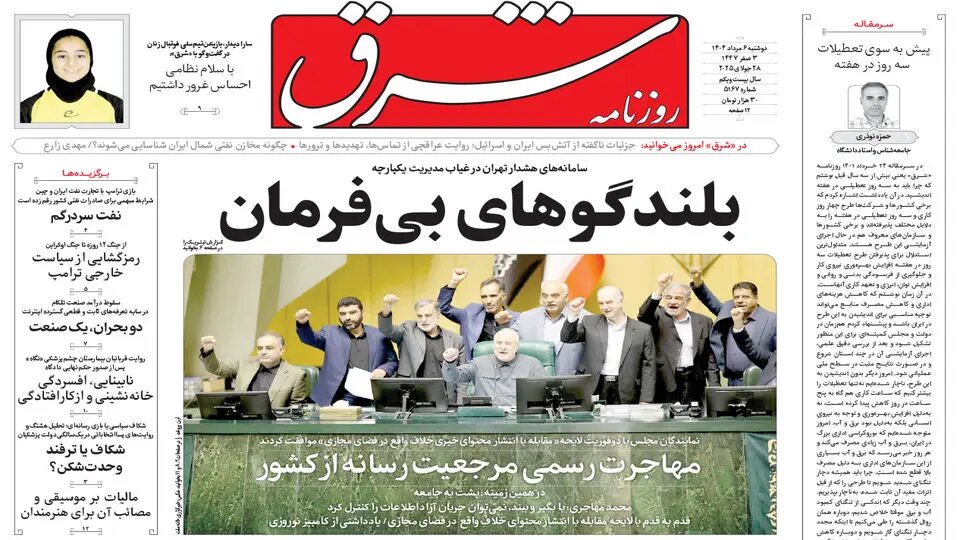
Tehran – In its analysis, Sharg explored Saudi Arabia’s refusal to supply Israel with Thaad missile interceptors following US demand during the Iran-Israel war in June.
The United States, a traditional ally of Israel and Saudi Arabia, had asked Riyadh to provide Israel with a portion of its THAAD stockpile amid escalating Iran’s missile attacks. However, Saudi Arabia rejected the request. This denial indicates a calculated change in Riyadh’s foreign policy. With its recent recovery of diplomatic relations with Iran, Saudi Arabia appears to be committed to maintaining regional balance rather than promoting conflict. From this perspective, withholding military aid to Israel appears to be a deliberate effort to maintain neutrality and cool tensions. Saudi Arabia has come to try to portray itself as a regional stabilization and mediation force. Defence Minister Khalid bin Salman’s visit to Tehran and ongoing trust building efforts have established Riyadh not as a party to the conflict, but as a potential crisis manager and peace broker.
Ham Mihan: We must continue on the right path
In the analysis, Ham Mihan dealt with the possible activation of the snapback mechanism by the European trio (UK, France, Germany) returning UN sanctions on Iran, which were lifted in the JCPOA conclusion in 2015. That’s especially advantageous for domestic hardliners these days, as they’re busy saying why diplomacy is not good and should take other paths. They believe that Iran would have been in a better position now if the same costly paths had continued, rather than avoiding diplomacy. I wish there was no snapback mechanism. But before that, we should consider that if the right policies had been adopted, there would have been no Security Council resolution that forced Iran to pull it out of this pit. (UN Security Council) Without the resolution, there would not be a snapback. Even today, despite all the problems and obstacles, diplomacy is ongoing. The key is why Iran is currently pursuing a path to dialogue with the European side, or the narrow windows of dialogue with the US, are not closed at this point. The country cannot remain under pressure from the Security Council, such as the conditions of the 2000s and early 2010s. We must continue on the right path.
Arman-e-Melli: Iran must be wise
Former vice president and presidential candidate Mostafa Hashemitaba told Arman-e-Melli that Iran must be wary of Zionist regime and US conspiracy. He said: There could be another military attack by the US and Israel against Iran, which could affect the future of the country. The point is that the risk of activating the snapback mechanism is less than the risk of war. The key point in this regard is whether Iran will fight Israel or the US in the future. If the war with Israel continues, we can think in the short term. However, negotiations and diplomacy are not effective in the event of a war between Iran and the United States. This is a field designed for us and we should not participate in this game as we don’t know what its fate will be. Iran must be wary and refrain from entering the designated game. For this reason, Iran should not act emotionally and passionately in these situations, but should approach the issue with more tact.
Etemad: China’s mediation may reopen consultations with us, harmonizing Iran’s views
In an interview with foreign policy analyst Rahman Ghahramanpour, Etemad discussed the ambiguity surrounding the reopening of talks between Tehran and Washington. He said: The main issue regarding the resumption of talks between Tehran and Washington appears to be the atmosphere of distrust that spread after Israel and the US attacks on Iran. The US attack on the Fordow nuclear power plant has formed two different views on talks about the political atmosphere of Iran. One group believes the meeting is a deception from the start, but another group that supports diplomacy should stand up to the United States by resorting to tougher levers. Some believe that the suspension at the start of Iran and the US speech may be due to talks with Iran with China on how to start consultations. If so, it can be said that the two domestic views will likely approach together and in some way agree to Beijing’s mediation. They believe China can end the current deadlock in talks.