
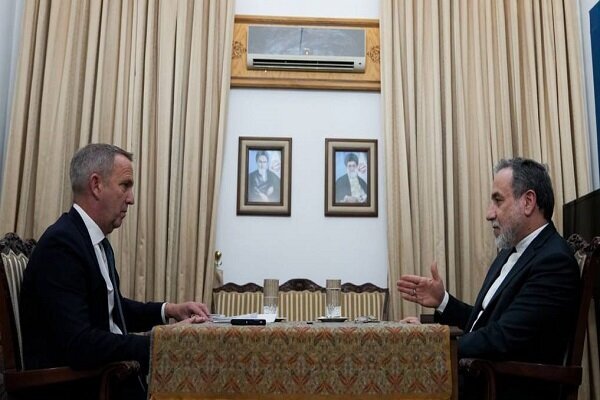
TEHRAN – Iranian Foreign Minister Abbas Aragchi says the resumption of nuclear negotiations depends on serious commitments from the US, while the path to diplomacy remains open.
In an interview with the Financial Times released Thursday, Araghchi said the Islamic Republic cannot return to the negotiation table under current circumstances, describing last month’s attack as a deliberate and coordinated effort to undermine diplomatic progress.
“We cannot accept a return to business as usual,” Araguchi emphasized. “They have to explain why they attacked us in the middle of negotiations and give them the assurance that such an attack will never happen again. Furthermore, they have to compensate for the damages they inflict.”
The Foreign Minister had mentioned a 12-day conflict in which the Israeli regime launched a shocking and provocative war against Iran, targeting high-ranking commanders, nuclear scientists and civilians.
Over a week of the invasion, the US joined hostilities by bombing three Iranian nuclear facilities. This is a move Tehran has condemned as a serious violation of international law, the UN Charter and the Nuclear Non-Proliferation Treaty (NPT).
In retaliation, Iranian forces carried out a precise strike on strategic targets across the occupied Palestinian territory and the U.S.-run Aldeid Air Force Base in Qatar, serving as the largest US military facility in West Asia.
These critical operations, carried out on June 24, forced Tel Aviv to demand a ceasefire, effectively halting illegal attacks and highlighted Iran’s ability to deter Iran.
“Negotiations that can only be made with guarantees and compensation”
Reaffirming Iran’s openness to diplomacy, Araguchi made clear that future consultations must involve tangible trustworthiness measures, including guarantees of non-attack and financial compensation.
“The road to negotiation is narrow, but it’s not closed,” Araguchi said. “I have to convince my boss that the other side is approaching a meeting with the true political will for an outcome that is beneficial to both sides.”
He said that US envoy Steve Witkoff continued to exchange messages with him during and after the war, suggesting that consultations resume. However, Araguchi stressed that Iran cannot move forward without a clear commitment from Washington.
“We need to see real change on their side. The war just strengthened our distrust. President Trump, in particular, has already tore the JCPOA.”
According to Aragucci, the Iranian masses remain deeply skeptical of new negotiations with Washington given their records of betrayal and military hostility.
“People are telling me not to waste their time and not to deceive again,” he said. “There is a strong belief that once the US returns to the negotiation table, it is merely a smokescreen for other hostile actions.”
Iran and the United States had held five rounds of indirect talks focused on reviving the JCPOA prior to the start of the Israeli invasion. The sixth round was scheduled for June 15th in Muscat, Oman, but had to be cancelled after a military escalation.
On June 22nd, Washington officially entered the war by targeting Iran’s nuclear sites.
Iran rejects our demand for “zero enrichment”
Iran’s foreign minister has also repeatedly called it a non-starter, saying that Tehran never accepts Washington’s demand for zero uranium enrichment.
“There is no possibility of a transaction under these conditions,” Araguchi insisted. “We are both ready to engage in negotiations that present their arguments, but if they insist on enrichment of zero, there’s nothing to argue.”
Tehran warns Europe about the threat of “snapback”
Araguchi also criticized the JCPOA’s European Party (UK, France, Germany) due to recent warnings that failure to speak to the International Atomic Energy Agency (IAEA) and the US could stimulate the so-called snapback mechanism, which is reimposed UN sanctions on Iran.
He said E3 had already failed to respect their obligations under the nuclear deal and warned that if they proceeded with the snapback move, Tehran would cut off all negotiations with them.
“There’s no reason to negotiate with Europeans right now,” Araguchi said. “They can’t lift sanctions or provide consequences. When they activate snapbacks, it’s the end of the road for them.”