
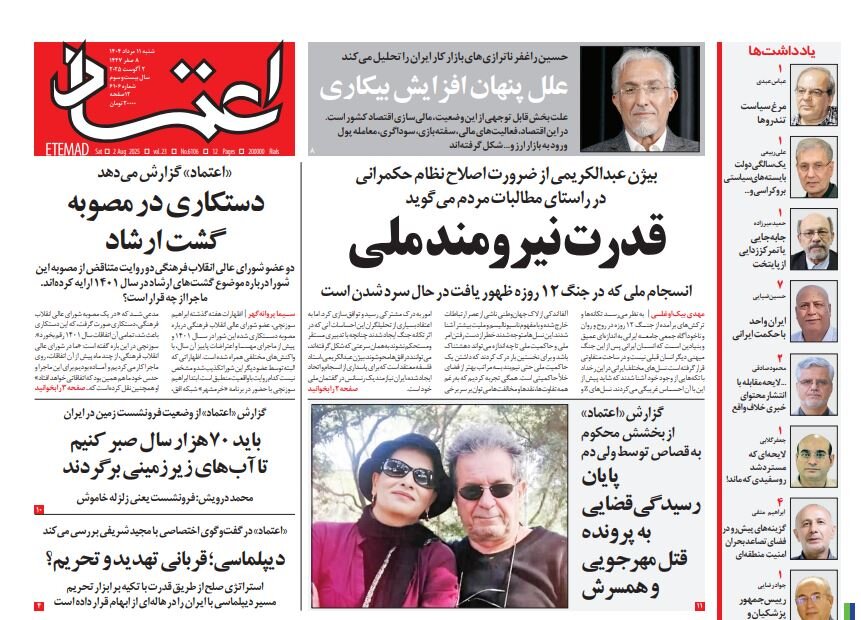
In a Tehran-analysis, Etemad investigated the proposed Zangezur Corridor Project and highlighted its geopolitical implications.
According to reports from Armenian media, Turkey has been seeking access to the so-called Zangetur Corridor, nearly a century. The Armenian government has framed the initiative as a way to unlock economic interests, but the project does not have any true commercial or economic justification. Its main function appears to be geopolitical rather than economic. The corridors restructured the local order, allowing Türkiye and Azerbaijan to assert leadership in the South Caucasus. This shift could alienate Russia’s influence and significantly reduce Iran’s strategic presence along the northern border. For Iran, the consequences can be serious. Disturbance in geopolitical balance, widening Türkiye’s influence, the possibility of the US presence near the border, and cutting off direct access to Armenia, Georgia and the Black Sea. Furthermore, Iran may rely on routes through Israeli-influenced Azerbaijan, but its role in China’s belt and road initiatives could diminish. If control of the corridor is handed over to Baku, Tehran risks losing leverage not only across South Caucasus, but also across northern trade routes in Russia and Europe.
Ressalat: State power in the face of Israel’s war against Iran
In the article, Ressarat emphasized national unity following Israel’s 12-day war with Iran. It writes as follows: Today, the Islamic Republic is at its peak military, political, cultural, social, intelligence and security thanks to the resilience of the Iranian state. This power was revealed in the war imposed by the US and Zionist regimes using all NATO combat, intelligence and security capabilities against the Iranian state. Today, we realized that the world is facing a superpower called Iran. Iran is a superpower that was able to attack important places in Israel and the United States with missiles and drones. Iran’s “national rights” were able to humiliate the Zionist occupation regime and confront the ruins of Haifa and Tel Aviv cities. What is clear is that two elements of “religion and knowledge” are the driving forces of power in this state. The West does not want a civilization based on religion and knowledge. Therefore, we believe that the only way to stand up to the Iranian state is to attack religious scholars and scientists. A system based on both religious principles and academic insights exemplifies the strength and effectiveness of Belayat-e Faqih (Supreme Jurisdiction Rules) in guiding social governance. This deeply rooted internal structure is resilient and cannot be easily damaged by domestic or foreign forces.
Farhikhtegan: The best time to quit the JCPOA was after Trump’s withdrawal
Mohammad Esmaeli, an expert in international law, told Fahhictegan that when Donald Trump withdrew from the JCPOA in May 2018, it was the best time for Iran to do so. He said: It was the day Trump withdrawn from the JCPOA that Iran was able to minimize the outcomes of the JCPOA. Iran should have retreated that day. Now we have to proceed with caution. Suspending activities in the IAEA is now better than withdrawal. This is because decisions can bring a military dimension to Iranian society. It is good to suspend cooperation with the NPT right now, but after examining security, political and defense considerations, this suspension can be turned into a retraction. As Europe wants to be the centre of developments related to Iran’s nuclear activities, excessive dialogue with the US will also benefit Europe. However, we must pay attention to the fact that withdrawal from the JCPOA is not bad, but this is not a positive obstacle to preventing the activation of the snapback mechanism. Diplomatic devices must make the correct diplomatic decisions, and this is something to be noted.
Hamshahri: Why has West become radical again?
In the commentary, Hamshali tackled the new threat of a military attack on Iran by Trump and Israel. It wrote: Last week, the Zionist regime and US leaders once again strengthened Iran’s rhetoric on the Islamic Republic and spoke about the possibility of a new military attack on Iran. These radical positions seemed meaningful, especially as Western governments put pressure on Tel Aviv to promote humanitarian assistance to the people of Gaza, and they have committed to quickly acknowledging the Palestinian state under certain conditions. And as the Zionist regime is currently not in good condition due to urgent demands from the world masses to end the hunger in the Gaza Strip, the regime is trying to free itself from pressure by updating the threat of another possible invasion against Iran. The next goal is to destabilize public opinion in Iran and prevent the situation in our country from becoming normal. In other words, Zionists and Americans, together with cybermercers, are trying to put the Iranian state in a state of “struggle for survival” and not allow issues such as development or progress.