
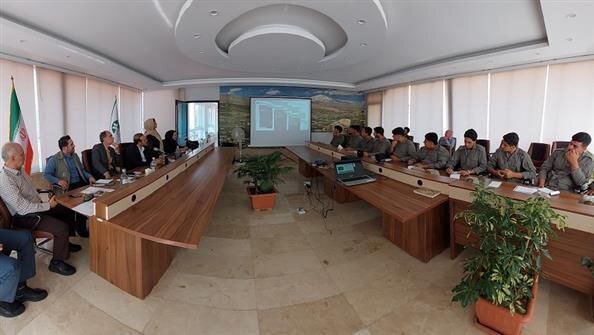
Tehran – The Ministry of the Environment (DOE) is working with the United Nations Education, Science and Cultural Organizations (UNESCO) to conduct educational workshops to empower students studying environmental protection.
The project, sponsored by Mazandaran, aims to enhance students’ ability and skills in protecting the environment based on international standards, and to enhance their knowledge by familiarizing themselves with contemporary concepts in environmental protection.
Throughout the workshop, students will actually learn the best strategies for effective interaction with the local community, conflict resolution, biosphere reserve conservation principles, community roles, and how to collect and record biodiversity data.
Environmental protection is a field of research provided by technical and vocational training organizations aimed at educating professional forces for environmental protection.
Currently, the research fields are offered in Mazandaran, Fars, Huzestan and Aadivil Provinces.
UNESCO Program
Environmental Education is on the list of major UNESCO programs in Iran and aims to develop sustainable solutions and international cooperation to address environmental challenges.
From a UNESCO perspective, environmental education is a learning process that raises public awareness of the environment and its challenges. Equipping individuals with knowledge, skills, values, experience and goals to address these environmental issues, the IRNA cites Hassan Faltosi, Secretary-General of Iran’s UNESCO National Committee.
Officials made their remarks while working on the 8th National Conference and the Environmental Education Specialty Exhibition held on May 20th.
According to this definition, environmental education includes achieving environmental awareness, understanding challenges and carrying out actions, Fartosi noted.
UNESCO helps the state and educational institutions develop and implement effective environmental education programs. It strives to maintain the environment through international programs in the fields of natural and earth science education, officials added.
These include the International Hydrology Program, International Geoscience and Geopolitics Program, Intergovernmental Oceanography Program, and International Basic Science Program. The Greening Education Partnership, he said, is one of the most important initiatives UNESCO has adopted to help the country help tackle climate change.
UNESCO works to reduce global change and the impact of water resources and promote education for the sustainable use of water resources. The organization is calling on member states to cooperate to address these challenges more effectively.
The 8th conference served as a platform for sharing ideas, expertise and achievements to promote sustainable development by conducting scientific research, utilizing modern technology and developing innovative solutions.
Courses for government employees
In March, Ministry of Environment official Mohammad Medadi said the DOE would hold environmental protection courses for all officials and managers working in the government sector.
Passing these training courses is mandatory, and the IRNA quotes the medals as saying.
Environmental Education Centre The Environmental Education and Conservation Centre has developed three training courses related to environmental governance, as well as components for government agency managers and professionals, he explained.
Without a doubt, these training courses will help the government face new challenges, such as imbalances in energy resources, water and biological pollution, he added.
Sheena Ansari, director of the Ministry of the Environment, said that a single organization cannot maintain the environment on its own. Environmental issues are best addressed through public participation.
“Habitats, wildlife and wetlands have many environmental challenges and cannot be addressed by the Ministry of Environment’s efforts and measures alone,” Irib cited Ansari as saying.
President Masoud Pezeshkian offers a program focused on the preservation of environments, which are composed around six axes. Management and improvement of various quantitative and qualitative dimensions of environmental imbalances (economics, energy, water, etc.). Effectively protect biological resources (including natural resources and biodiversity). Achieve excellent environmental governance; address public demands in the field of the environment and strengthen international bilateral or multilateral cooperation in the field of the environment.
mt/mg