
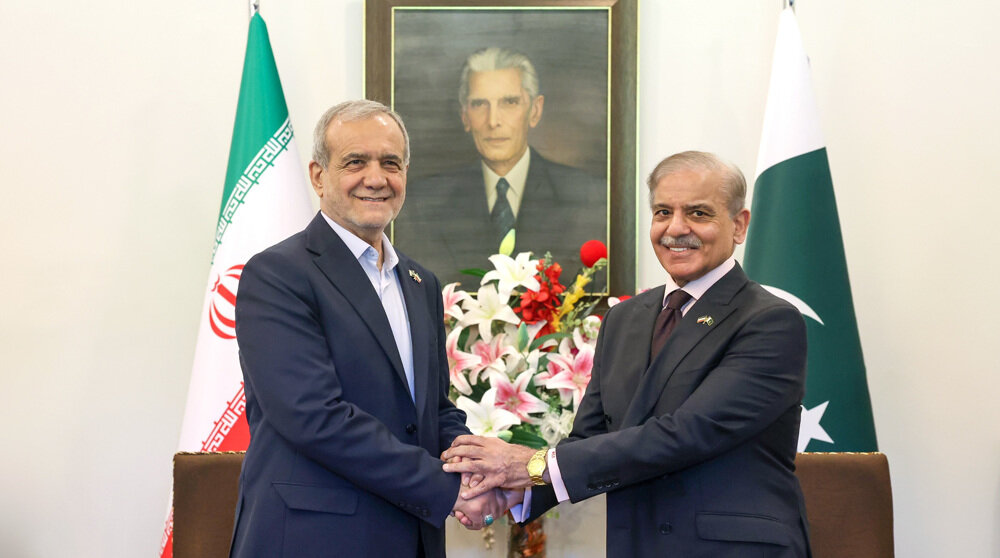
ISLAMABAD – The visit of Iranian President Masuud Pezeshkian to Islamabad over the weekend was more than a routine diplomatic involvement.
It sent a timely message to the region and the world. He arrived after an open conflict with Iran’s Israel, where Pakistan’s two top prime ministers, Prime Minister Ishak Dah, and Army Chief of Staff Asim Munier, visited Washington and held careful meetings with policymakers across political spheres. In this geopolitical context, the warm embrace of Pakistan Iran shows a rebalancing of diplomacy that is worthy of attention.
The importance of President Pezeschkian’s visit is further enhanced by the fact that this was his first official trip. It was a gesture that reflected a sense of trust, intimacy and shared priorities in diplomatic protocols. This symbolism would have been nowhere nearer than Lahore, where he visited the shrine of Muhammad Iqbal. Poem by Iqbal – “If Tehran becomes Geneva in the East, the fate of the world may change” – represented as more than a poem. It reads like a mission statement.
Bilateral discussion focusing on trade, security, energy cooperation and regional convergence. The two countries have pledged to increase bilateral trade annually to US$10 billion from the current US$3 billion. This is a commitment that, if perceived, can revive economic tourism and unlock the possibility of being suppressed by sanctions, border tensions and bureaucratic red tape. In particular, the talks also address the establishment of free economic and trade zones, border markets and transport corridors that can link Iran to China, Central Asia and Europe via the Silk Road, as well as Pakistan.
Before leaving Tehran, President Pezeshkian said, “We have a silk route and are connected to Pakistan and China, and this path may extend to Europe.” This desire aligns neatly with Islamabad’s ambition to establish itself as a trade hub within the Economic Corridor (CPEC) of China and Pakistan. Geography is what blood is in veins in diplomacy. Iran’s reach west and Pakistan’s eastward direction can complement each other.
Long considered an underutilized area, energy cooperation has once again gained traction. Foreign Minister Ishak Dal told reporters: “The United States cannot afford to ignore Pakistan’s national interests. For Pakistan, US sanctions are not important.” The long gas pipeline of Iran-Pakistan, which has been launched for years due to geopolitical constraints, is being reconsidered with a new resolve. Iran has already completed its segment. Islamabad appears willing to challenge the long-standing taboos as it faces an energy shortage and rising fuel prices.
Energy provided by friendly countries like Iran is more than just an economic supplement, adding strategic depth to Pakistan’s economy.
Surprisingly, a Memorandum of Understanding (Mous) and agreement were signed during a visit covering areas such as science, ICT, tourism, plant protection, cultural exchange, maritime safety, judicial cooperation, and weather collaboration. These contracts suggest a pivot towards real cooperation over iconic gestures, but implementation is still a real test.
Prime Minister Shebaz Sharif has repeatedly supported Pakistan’s support for Iran’s rights to peaceful nuclear energy. At a joint press conference, he said, “Iran has the right to develop nuclear capabilities for peaceful purposes.”
This solid attitude on international law reflects Iran’s own position. When the world is marked by tensions and American pressure, Pakistan’s position is to support the sovereignty of the state over alignment with external expectations.
However, bilateralism was not the sole purpose of the visit. It should be seen in the broader context of a changing multipolar world. When Israeli airstrikes shook Iran in June, Pakistan issued strong condemnation. The Congress has passed a rare, reciprocal resolution expressing solidarity with Iran and opposed Israeli aggression. The law sent a clear signal that Islamabad would not remain a passive observer if local neighbours are facing destabilization.
This spirit of multilateral diplomacy was reflected in the recent joint declaration of the Shanghai Cooperation Organization (SCO). A more freer geopolitical space is emerging as both China and Russia have expressed concerns about Israeli overreach. Their support for Iran’s sovereignty is a welcome development. At this point, Pakistan appears to be keen on pursuing a multi-aligned foreign policy, but is not constrained by traditional alliances.
Even minor gestures of reconciliation were made during President Pezeskian’s visit. Prime Minister Shebaz Sharif said before him that Pakistan is open to dialogue with India. Islamabad thinks that even the enemy prefers involvement over conflict. Such feelings are not out of place in the world’s capitals.
Nevertheless, major obstacles remain. The gas pipeline in Iran and Pakistan is more of a problem of paperwork than reality. Past efforts to boost trade have collapsed under the weight of bureaucracy and third party pressure. Balochistan’s border tensions and cross-border extremists will continue. However, both sides now agree to strengthen shared intelligence and joint counterterrorist efforts. Whether this new commitment can withstand pressure will be tested in time.
The stakes are high. If the increased involvement between Iran and Pakistan is supported by institutional continuity, infrastructure development and geopolitical realism, it can lay the foundation for a broader regional restructuring that is fixed in sovereignty, stability and economic cooperation. The Middle East and South Asia have long delayed development due to external interference and internal fragmentation.
It may be time to rethink local diplomacy in terms of shared heritage, mutual strategic interests, and mutual respect. Tehran’s dream as “Geneva of the East” is not a fantasy, but a blueprint for a viable geopolitical alternative, something that has not yet been realized.
It cannot be overly stressed that Pakistan and Iran should maintain their course beyond ritual visits and beyond strategic ambiguity, opening doors to areas governed by cooperation rather than conflict. And that’s not a bad thing to carry during this particular time of trouble.