
Tehran – We are well aware that Iran was the first country to recognize Pakistan’s independence in 1947 and opened an embassy in Karachi, then the capital of Pakistan. Similarly, the Pakistanis were the first to officially recognize the victory of the Islamic Revolution in Iran in 1979.
People from both countries share cultural, linguistic, historical and religious connections and have supported each other in both bitter and sweet moments throughout history. The cultural commonality between the two countries is such that citizens of either country do not feel estranged or foreign when traveling to neighboring countries. In Tehran, there are prominent locations such as the Mohammad Arijinna Highway and Pakistan Street. Similarly, major Pakistan cities, including Karachi, have street signs with names like Iranian Avenue, streets named after Iranian poets such as Feldousi, Saadi, Hafez and Kayam.
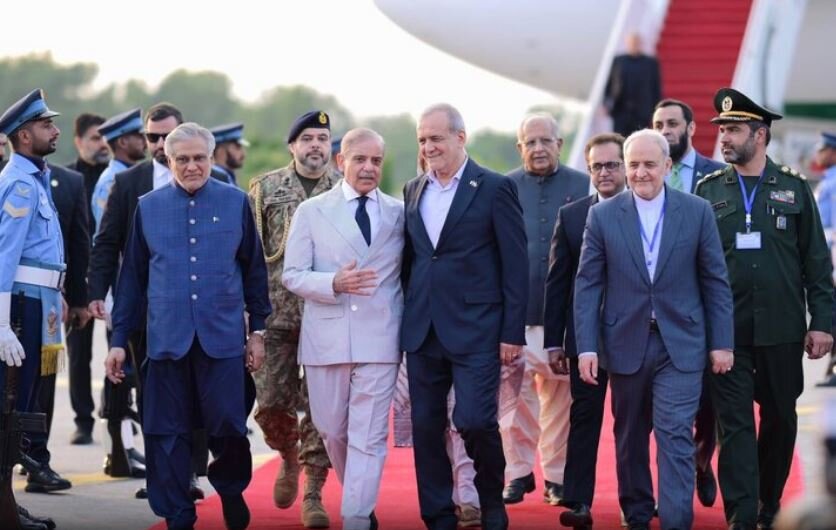
Islamabad, the capital of the Islamic Republic of Pakistan, hosted a delegation with Iran’s honorary president, Dr. Pezeshkian, August 2-3, 2025. It is worth noting that in April 2024, martial artist Ayatollah Raisi visited Pakistan for three days, including the cities of Lahore, Karachi and Islamabad, and was warmly welcomed by the people and officials of the country. After the crash of a helicopter and Ayatollah Raisi and his fellow martials, Pakistani Prime Minister Shebaz Sharif, along with other officials, traveled to Tehran to pay respects and attend the memorial. In May this year, Shebaz Sharif visited Tehran again and expressed his gratitude for Iran’s stance on the Indo-Pakistan war. Therefore, Dr. Pezeshkian’s recent visit corresponded to the invitation of Shebaz Sharif and essentially the return trip to Tehran.
Dr. Pezeshkian began his official visit in Lahore, the capital of Pakistani philosopher and poet, by paying homage to the spirit us of Arama Iqbal. It is said that more than 8,000 verses of Iqbal’s poems, which account for 70% of his total works, are written in Persian. During the continuing visit in Islamabad, Iranian delegations met with the Prime Minister, President, Foreign Minister, Army Secretary, Senate and Parliamentary Chairman, and Pakistan’s business community, and in fact attempted to implement a “neighbors first” policy.
The current volume of annual trade between the two countries is around $3 billion, but many economic and commercial possibilities remain undeveloped. During this recent visit, 12 cooperation agreements have been signed in areas such as transportation, science and technology, tourism and free trade.
One indicator of strong political relations is the frequent travel of officials between countries. Less than two years later, top Iran and Pakistan officials visited each other’s countries four times, without including meetings held on the sidelines of major regional and international summits. These frequent encounters highlight the close bonds and importance of relationships now, especially when the need to expand cooperation is growing. Over the past decades, relations between Iran and Pakistan have enjoyed relative stability, and mutual visits and exchanges between authorities have been regular events. What makes the recent presidential visit to Pakistan particularly important is the unique political situation and development in South and West Asia, and even globally.
The four-day war between India and Pakistan in May 2025, as two nuclear forces, created a highly sensitive situation in the region. Although simple, the outcome of this conflict continues to affect both countries and the wider region and the world. Furthermore, the ongoing war and genocide in Gaza have had a major impact on global politics. In this regard, the stance of Islamic countries such as Iran and Pakistan is extremely important. Tehran and Islamabad have consistently adopted a shared, solid position, highlighting their full support for the Palestinian cause. The 12-day war by the Zionist regime on Iran has significantly changed geopolitics in the region and the Islamic world. Its status as one of Pakistan’s largest and most influential Muslim countries is important, and Iranian people and officials have always appreciated the brave and brotherhood of Pakistan.
Islamabad officials expressed their gratitude to Iranian goodwill and initiative for offering to mediate between the two countries in various ways, and for Iranian Dr. Aragut, due to his extremely important visit to Pakistan and India, to alleviate tensions.
The key factors linking Iran and Pakistan’s foreign policy are the sensitivity of public opinion in both countries to the Palestinian issue and mutual opposition to the Zionist occupation and crime in Gaza. This shared stance is rooted in principled policies set out by the founding leaders of both countries, Imam Khomeini and Muhammad Ali Jinnah, and continues today. There are now deep concerns about joint misconduct between the Zionist regime and the US against Iran’s nuclear facilities, as well as the possibility that similar scenarios may be repeated elsewhere.
The condemnation of the Zionist regime’s aggressive attacks on Iran by a permanent representative of Pakistan’s UN Security Council was well received as a non-permanent member and a rotating president. Support for Pakistan’s dialogue and negotiations, as well as the affirmation of Iran’s right to nuclear knowledge, was also reflected in a joint press conference held by Shebaz Sharif and Dr Pezeshkian.
Officials from Iran and Pakistani have come to a common understanding that more than 900km of borders in the two countries should move from safer borders to economic boundaries. Both sides have created joint mechanisms to improve coordination in the fight against terrorism. There is an ocean of undeveloped possibilities in both countries, and it requires a serious political will to activate it. Travelling of hundreds of thousands of Pakistani pilgrims as part of religious tourism is one such opportunity. Currently, the borders of two lands, Rimdan and Mirjabe, are in operation, promoting travel for tourists and traders. Enhanced infrastructure is essential to increasing travel between two people. People-citizens’ interactions can play an important role in raising awareness of each other’s abilities.
Given the complement of the two economies, meeting mutual needs should be a top priority for both private sectors and businessmen in both countries. Many of the things Iran imports from other countries are easily accessible in Pakistan, and Pakistan also exports goods that Iranians also import from a variety of sources. The opposite is also true. Pakistan can meet many needs through Iranian producers, benefiting from proximity and low logistics costs. In the writer’s view, the Iran-Pakistan Joint Chamber of Commerce should be upgraded from the state to national capabilities to play a more important role.
The Iranian proverb states: “A good neighbor is better than a distant relative.” Pakistan is both a good neighbor and relative, and we Iranians are grateful to this precious neighbor.