
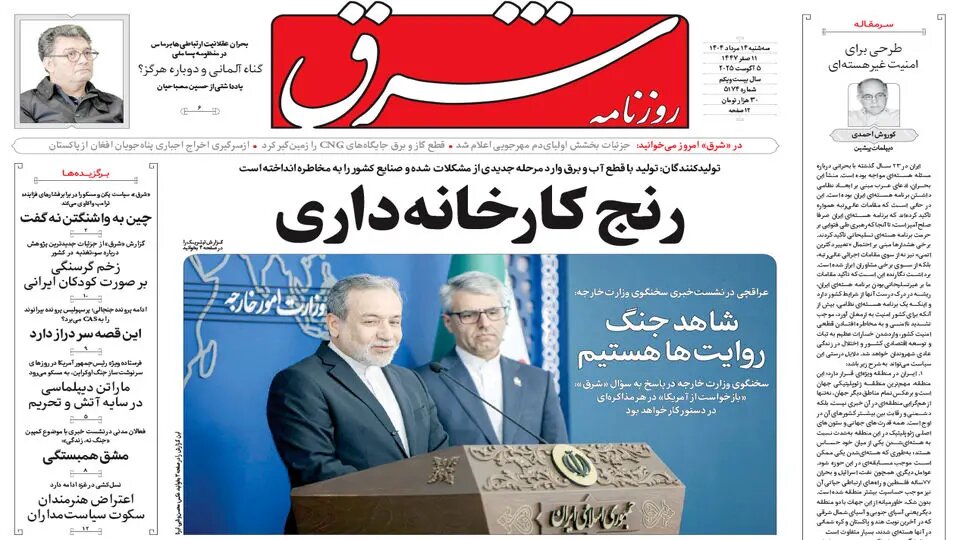
Tehran – The Sharg Newspaper is considering ways to ensure national security by employing a variety of strategies and approaches, including intertwining with international trade.
It writes as follows: In situations where military nuclear routes are seriously at risk of national security, it is a nuclear-free route that ensures that national security can deter, local impact, and strengthen national defense. On the military side, the path includes comprehensive strategies, including traditional defense, missile and drone programs, cyber defense capabilities, strengthening anti-intellectual capabilities, and defense alliances with national and non-state actors. The diplomatic aspects include the shift to regional convergence, the adoption of trustworthy measures and collective security structures in the Persian Gulf, rebuilding relations with European and eastern allies, and developing soft power to reduce doubts towards ease tensions with the US. In the third dimension, this comprehensive strategy should lift sanctions, strengthen domestic economic resilience, engage in the development of foreign economic relations, international production chains, engage in corridor diplomacy, and emphasize economic diversification. In the fourth and most important aspect, strengthening the relationship between people and the political system must be the center of attention.
Sobh-e-no: Iranian and Pakistani friends in difficult days
In the memo, Sobh-e-no discussed Pakistan’s position in the 12-day Israeli war with Iran in June. It writes: Pakistan’s support for Iran in the 12-day war, and a sharp response by Ayatollah Saeed Hafez Rias Hussein Najafi – the chief of Pakistan’s Shiite Education Alliance – the dim-remark statements against the leader of the Islamic Revolution against Trump’s dim-remark statements have shown that one of the resistance and Islam has shown some degree of presence and Islam between resistance and Islam, and Islam, among them, are among themselves. The firm support of such an Iranian figure is a valuable ability for the Islamic world. The trip has become a turning point for deepening unity and fraternity between two adjacent Muslim countries. Iran and Pakistan showed at a critical moment that they did not abandon each other, and considered the common concerns of the Islamic world as their own. This unity and fraternity are valuable assets for both countries that can be used to secure mutual benefits and strengthen solidarity in the Islamic world. A recent visit to Islamabad opened new doors for comprehensive cooperation and reminded me once again that “we can remove obstacles and bring honor and pride to the nation and the Muslim community.”
Etemad: Tension and difficult days in negotiations
In an interview with Abdolreza Farajirad, a professor of geopolitics, Etemad looked into Tehran and Washington’s recent positions on Tehran and Washington’s nuclear program. Farajrad said: Iranian officials are opposed to Western action, and this position shows that Tehran has taken a more decisive approach than in the past and is not in a hurry to resume negotiations unless Tehran’s terms are accepted by Washington. In these circumstances, the atmosphere shifts to applying more pressure on nature. Meanwhile, Trump believes that using European leverage can be used to pressure Iran to come to the negotiation table, even before activating the snapback mechanism. It seems we need to prepare ourselves for more difficult situations. Maximum effort must be made to prevent the snapback mechanism from being activated. Otherwise, Iran will respond. In this regard, if Iran does not withdraw from the NPT, it will likely cease technical cooperation with the International Atomic Energy Agency.
Iran: Consequences of instability at the eastern border
The Iranian newspaper reported that Balochistan (Pakistan’s largest and most complicated state) has long been plagued by armed conflicts and a persistent terrorist threat. Its importance goes beyond security concerns. The port of Gwadar, a cornerstone of China-Pakistan’s Economic Corridor (CPEC), is located in the region and places Balochistan as a strategic link between South Asia and the changing geopolitical and geopolitical landscapes beyond. In this context, instability within the Islamic Republic of Iran has a direct and serious impact on Balochistan’s security. The most pressing impact is the erosion of limited cooperation in counterterrorism efforts and intelligence sharing between terrorism and Islamabad, or the complete breakdown. This fragile collaboration now plays a key role in reducing cross-border threats. A security vacuum could emerge, providing fertile ground for extremist groups such as ISIS to expand their operations and deepen their local impact.