
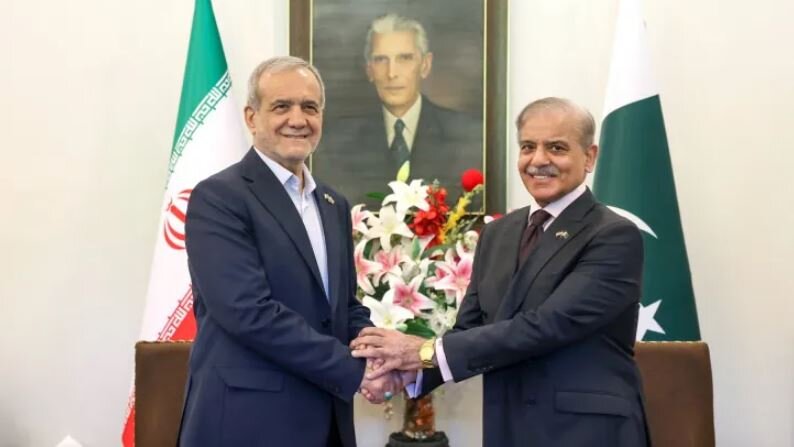
Islamabad – A study of expansion in bilateral opportunities, a predicted trade volume of $10 billion, and a review of Iran-Pakistan ties were important strategic achievements of Iran’s recent visit to Pakistan from Iran’s President Massaud Pezeshkian.
This visit is not only important in terms of strategic relations between the two brothers, Islamic countries, but also serves as a launchpad to a joint future in the context of regional dynamics, economic instability and ever-changing geopolitical circumstances around the world. The political and national decisions of both countries came into the spotlight during a visit where 12 bilateral agreements were signed, signed as evidence of their long, strong economic and brotherhood partnerships.
Cultural roots and mutual regional dependence serve as the backbone of development. For both Iran and Pakistan, the $10 billion trade volume is an understatement of what the two countries plan to achieve together through a mutually beneficial and globally aligned wave of transformative change. Current volumes of trade between Pakistan and Iran are very limited, mainly due to global sanctions, limited banking channels, infrastructure issues at borders, and logistical challenges. However, with recent bilateral commitments, the two countries plan to revive barter trade, strengthen customs coordination to improve trade permits, and establish a joint trade facilitation system to achieve greater and more stable trade volumes. Iran’s exports to Pakistan can focus on the much-needed oil, gas and electricity sectors, but Pakistan can provide Iran with world-renowned textiles, pharmaceuticals, agricultural products and budding industrial products.
In private sector business interactions, both governments can provide trade and business organizations such as the Chamber of Commerce, Business Council, and SME networks to trade organizations. These institutions can explore investment and development opportunities in key sectors such as agriculture, petrochemicals, tourism, and information technology. Iran’s interest in participating in the Belt and Road Initiative (BRI) during the visit is perhaps the most important regional trade development seen in decades. Through this expected partnership, Iran will not only propose a partnership in the revolutionary China-Pakistan Economic Corridor (CPEC), but also provide Pakistan with the opportunity to serve as a logistical and commercial bridge between China and Iran, creating the strongest corridor of trade and energy in the global south.
Pakistan’s modernized road and railway network was developed under the BRI and CPEC and will help exports to and from Iran and create a strong, protected, economically viable supply chain. Trade through the port of Gwadar could help reduce dependence on expensive sea routes, allowing Pakistan to acquire the region’s transportation revenue, infrastructure development and even geopolitical stability.
Bilateral trade and partnerships between Iran and Pakistan can be revived over the centuries, capable of addressing Central Asia by linking Kazakhstan, Turkmenistan and Uzbekistan to the wider regional trade chains. The expected routes will not only revolutionize regional trade, but will also help bring together regional power in a vision of regional peace and stability.
Pakistan and Iranian leadership can recognize the futurist potential of Gwadar and Chabahar ports that complement each other, and play an important role in expanding the region’s maritime connections. The idea of a Joint Maritime Cooperation Framework could prove mutually beneficial as both ports can be connected via roads and rail, increase freight, create jobs, and promote economic activity across the Baluchistan and Sistan Baluchistan regions. Gwadar Chabahar’s model of cooperation is important to guide port cities in other regions that can support the growth of the blue economies of South Asia and the Middle East and inland Central Asia.
During the visit, Iran and Pakistan jointly agreed to upgrade Quetta Zahedan’s railway line and revitalize interest in the long-term Islamabad Telan Istanbul (ITI) railway project. Modernised projects not only support timelines and cargo, but also help integrate infrastructure based on trust between the two countries. As travel volumes between the two countries are constantly increasing, better rail and road links not only reduce travel time, but also reduce transportation costs and risks associated with sea routes. For purposes, the number of vehicles operating along border routes during visits has increased, improving cross-border logistics. Pakistan’s proposal for the formation of bilateral working groups to accelerate the implementation of these projects aims to transform diplomatic ambitions into economic realization.
People-to-people interaction, cultural interaction, and media collaboration remained other important areas of mutual interest during the visit. Under the context, both sides agreed to increase existing religious tourism, educational cooperation, and youth and academic exchanges between the two countries. Among other media organizations, the All Pakistani Journalists Association (APJA) has expressed a strong interest in working with Iranian counterparts to create joint reporting projects, exchange programs and co-produced documentary videos that highlight bilateral development narratives. The unified narrative of progress, peace and resistance to oppression is a key consideration for both Pakistan and Iran in an age of digital and information warfare. Media-media relations not only serve as a reflection of diplomacy, they also help to raise understanding between the two countries and dispel myths and misconceptions that often lead to rifts and misunderstandings.
Prime Minister Shebaz Sharif and Pakistani President Asif Ali Zardari visited as an opportunity to repeatedly reiterate Pakistan’s unwavering support for Iranian and Iranian people in the face of Israeli invasion and foreign hostilities. Solidarity was recognized and highly praised by Iranian leaders for its message of love for consistent support by the Pakistani state. For both brothers, diplomatic support is not just symbolic, but a repetition of the fact that both countries are partners of regional stability and that each of them is a supporter of Muslim unity. In the global disparity in geopolitics, Pak-iran unification is nothing more than a strategic asset. Both Iran and Pakistan understand that regional peace and stability are necessary for economic development. The joint efforts of both countries in strengthening border security, leading counter-terrorism cooperation and taking anti-crowd initiatives show that both Iran and Pakistan share their commitment to striving for investment and progress.
For both countries, peace and harmony are not just visions and dreams, but also important parts of regional policy. Only through regional stability and cooperation can the two countries reach the joint goals envisaged in the economic agreement signed during this visit.
The success of Dr. Masuud Pezeshkian’s visit to Pakistan opened an era of revival for mutual trust and bilateral trust between Pakistan and Iran. The visit has laid the foundation for the development of key strategic areas such as infrastructure, trade, diplomacy and culture, but all aspects require consistency, coordination and commitment follow-up at all levels of leadership.
Over time, the leadership of both countries is more determined that both countries have a common responsibility for the prosperity and development of their people. The Pak-Iran partnership is being seen as it is ready to move towards a future of mutual development and trade, as the world has never seen before.