
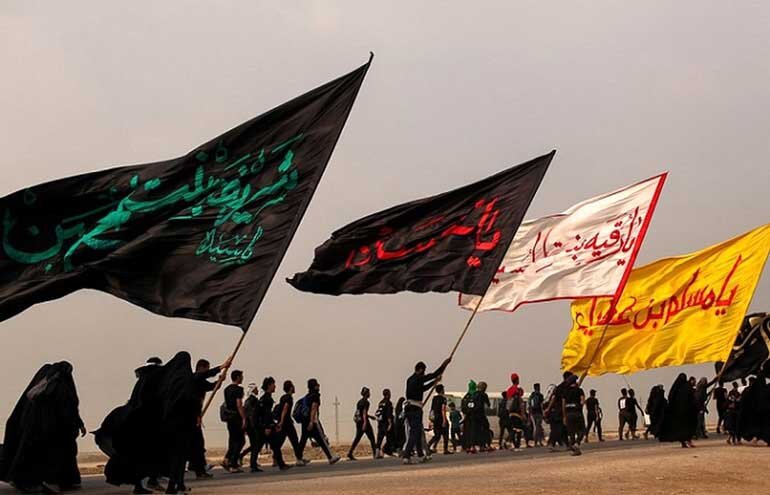
Madrid – Albain is a pilgrimage that brings millions of people on the road to Kalbara every year, transcending readings reduced to mere rituals to be the core of the pedagogy of political and historical protests at the heart of 21st century Islam.
Traditionally, the albain marks the 40th day, the basic symbol of Shia Islam and a universal symbol of dignity in the face of oppression, the day after the martialism of Hossain ibn Ali of Karbala. It cannot be ignored that Arbaeen has become one of the most powerful sociopolitical phenomena in the region. This is an event that condenses and renews the central themes of resistance, sacrifice and justice, which are key pillars in the ideological and theological architecture of Iranian Islamic Republicans.
The Arbaeen Pilgrimage operates at various levels as a stage of mass mobilization, as affirmation of the joint Islamic identity, and as a political operation focusing on the internal legitimacy and external projection of the Iranian state.
Resistance performance
Albain condenses the founding story of Shia Islam. Dignity is preserved in the memories of Imam Hossain of Karbala, the suffering of injustice, and even physical defeat. This historical core has been translated into the pedagogy of resistance along with Iran’s political discourse and practice. It is a collective act in which millions of people embrace sacrifice experiences not only as something of the past, but also as a positive principle of the present and the future.
Arbaeen’s pilgrimage stages the idea that resistance is possible and necessary in the face of harmful political reality. Pilgrims can walk hundreds of miles in unstable conditions, embodying the ethics of action, solidarity and perseverance, and illuminating the general ability to overcome externally imposed material and political limitations. Resistance here is framed not as an act of violent conflict, but as faithfulness to one’s body offerings as principles of justice, autonomous mobilization, and political testimony.
Arbaeen’s message challenges passivity. It is against the global hegemony of tyranny, structural injustice, and exclusive models. Therefore, sacrifice is red not as an isolated act but as a moment of establishment of a political community that survives and resists.
Justice as a political and social foundation
In modern reading, advanced by the Islamic Republic, Albain is more than a memorial of original injustice. It is the revival of the demands of justice as a principle of political, social and organizing the Islamic state. The matrix is a joint testimony to all forms of oppression. The story of Imam Hossein speaks to all participants and links them to the current struggles of alienation, colonialism and instrumentalization of the people.
Islam refers to Irvine, who argues that, both discourse and political practice, justice is not abstract, but a concrete requirement that it leads to the local community to the geopolitical stages of the region. Iranian authorities do not hide their purpose in transforming historical memory into modern mobilization. The message conveyed by the Islamic Republic is that hegemonic actors, organized people who are loyal to Islamic heritage, whether foreign empires or corrupt domestic elites, must challenge the current Quo.
Arbaeen acts as a political pedagogy where the injustice that has been damaged does not lead to victims, but rather to lasting demands for dignity, equality and the redistribution of power. The Iranian state recognizes itself, justifies it as an heir to this struggle, and presents its political system as a means of achieving Islamic justice.
Sacrifice and community
One of the most powerful elements of Arbaeen is the formation of an extraordinary political community about shared sacrifices. The act of walking, overflowing hospitality along the route, voluntary organization of services, and self-regulation of the flow of pilgrims constitutes the technology of social cohesion that strengthens the fabrics of Iran and the country.
Internally, the state uses this material and symbolic infrastructure to reaffirm citizens’ loyalty to political theological projects in which attribution is actively and collectively alive. The pilgrimage seeks to dismantle domestic boundaries and replicate the Islamic identity of the nation that lives in, rather than the mandated practice. This process strengthens the internal legitimacy of the political system. When millions of Iranians join Abain, it is not blind submission that is celebrated, but the renewal of a joint agreement facing the challenges of the times and external forces.
Islamic identity and geopolitical projections
Iran does not consider Irvine as a domestic phenomenon alone. Pilgrimage is also a framework for the country’s international predictions and legitimacy. When millions of Iranians travel to Iraq, what unfolds is the geopoliticalization of the Islamic experience, which challenges the logic of sectarian divisions promoted by external actors across boundaries.
Arbaeen allows Iran to introduce its status as a mobilized Islamic gravity center. This is a country that can direct discourses on multi-purpose, infrastructure construction and local justice. Through Muslim pedagogy, the Iranian state promotes supranational unity and integrates its communities within the political horizon that challenges the narrative of imperialism. This message is not merely rhetorical. Arbaeen is a practical visualization of alternative civilization projects that prove that Islam can function as a basis for just and sovereign politics, independent of import or imposed logic.
In this way, pilgrimage will help counter Iran’s international pressure. Aaaaain will be a strategic stage to strengthen the axis of resistance and lay the foundation for future national communities with liberating occupations.
Each year, Aaaain reconstructs the issues of justice meaning and the possibility of political responses, confirming that although it cannot reduce Islamic experiences to rituals and doctrines, they live in the process of collective transformation, the distribution of examples, and the highbritis of discourse.
Albain’s vitality lies in its openness to criticism and renewal, and stands up to anything that hinders concrete and effective justice. And, in response to a vision to reduce Islam to the issue of depoliticized rituals, pilgrimage maintains the political centrality of the community as agents of justice.
In a world marked by fragmentation and conflict, Aaaain emerges as a material reminder that an Islamic community, organized around sacrifice and perseverance, can challenge injustice and regain a central role in history. Iran gives Albaian the main argument to embody the value of resistance and justice in the face of global power, and in doing so rethinks Islamic politics as a space in which sacrifice and hope merge to give meaning to collective action.
Thus, a pilgrimage is not only a physical journey, but also an update of the path that integrates, questions, and projects the possibilities of a fair and sovereign community faithfully and faithfully to its historical principles.