
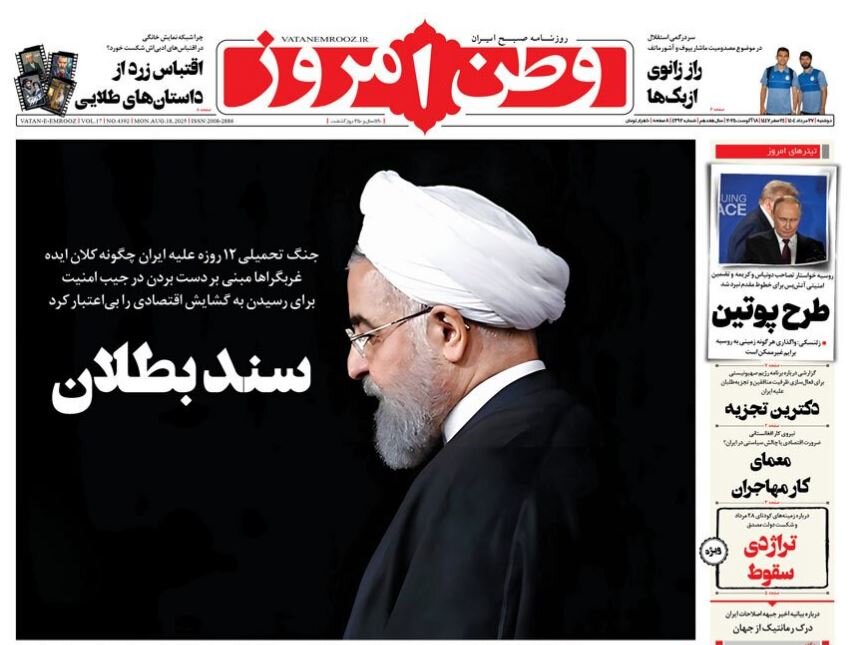
Tehran – In the article, Vatan et Emulz tackled China and Russia’s opposition to Europe’s move to activate the snapback mechanism against Iran, creating important political capabilities against the European move, opposition between China and Russia as two permanent members of the UN Security Council.
These two countries are not only politically and diplomatically aligned with Iran, but also propose a strong legal argument against Europe. China and Russia’s coordinated responses demonstrate the formation of a strong political front against this European movement. China has denounced the move as a diplomatic mistake, which leads to escalation of tensions, explicitly calling it illegal, and questioning Europe’s legitimacy for such a move. This consistency, rooted in the common strategic interests with Iran against both countries’ Western pressure, gives Tehran a great diplomatic weight and places Europe in a difficult position. The presence of two permanent members of the Security Council in this respect poses a serious challenge to unilateral action by Europe in terms of international legitimacy.
Fahhictegan: Trump Putin and his powerful impact on Eastern countries
In his analysis, Fahhictegan discusses the August 15 meeting with the US and the Russian President in Alaska, increasing pressure on both Iran and China if the US succeeds in ending the Russian-Cleine conflict. Two possible scenarios are envisioned. First, Washington could put a lot of pressure on Iran, settling the “Iranian file” and then pivot towards China. Alternatively, it could travel directly to China. In the short term, conflict with Iran will increase pressure on the Islamic Republic, but given the complexity of the region, Washington will soon encounter the depths of its challenges with Tehran. Thus, the Zionist actor hopes that the US will remain focused on the region, but Washington discovers that the costs of conflict will be excessive and urges them to seek an exit strategy. The US’s main purpose is to sow, pressure and gradually contain the divisions between Eastern countries. This ambition is recognized, and Eastern forces continue to cooperate to prevent the implementation of American policies.
Sobh-e-no: Lessons from the Alaska Conference
Sobh-e-no writes about the relationship between Iran and the Alaska Summit. Written: The key issues regarding this conference are its connection with Iran: lessons learned, potential benefits, and possible costs. The weakening of Europe in the face of Moscow during the Ukrainian War was the expansion of military cooperation between Iran and Russia, which led to increased pressure on Tehran. This is even going from triggering the 2022 riots, joining sanctions against Iran, and even moving into this broader context, from integrating with Israel and Washington in military action to trigger a snapback mechanism. However, recent developments in the South Caucasus and the 12-day war indicate that Russia is not intending to play a leading role for now. Its overall focus remains in Ukraine, with Iran forced to leave this struggle without any real friends or strategic partners, and protecting its own interests. There is also the risk that Moscow could use the “Iran card” to obtain further concessions in the Ukrainian conflict. After the Alaska meeting, former US President Trump hinted at the possibility of attacking Iran again. These events suggest that the Alaska Conference is holding multiple diplomatic lessons in Iran.
Arman-e-Emrooz: Why are Iran and we approach negotiations rather than war?
In the commentary, Ahman et Emuls argues there are indications that the US and Iran are taking steps towards negotiations rather than heading towards military conflict. It writes: Given the current situation, the analysis, coupled with a lot of evidence, shows the potential diplomatic breakthrough between the two countries. Despite many obstacles, the possibilities for dialogue are far greater than military conflict breakouts. There are many reasons why diplomacy has become an inevitable option. Powerful countries, particularly the trio of Europe, have repeatedly shown that they are ready to revive the nuclear agreement or mediate it to form new understandings. Pressure from powerful countries forced the United States to avoid military actions that could bind its allies. Meanwhile, Iran is facing deep economic problems. The situation has driven the Iranian government into negotiations to ease the pressure on sanctions. The fact that Iran and the United States recognize the devastating consequences of wars like the light of the dark light illuminates the path of diplomacy. This path is smoother than war and leads to dead ends.