
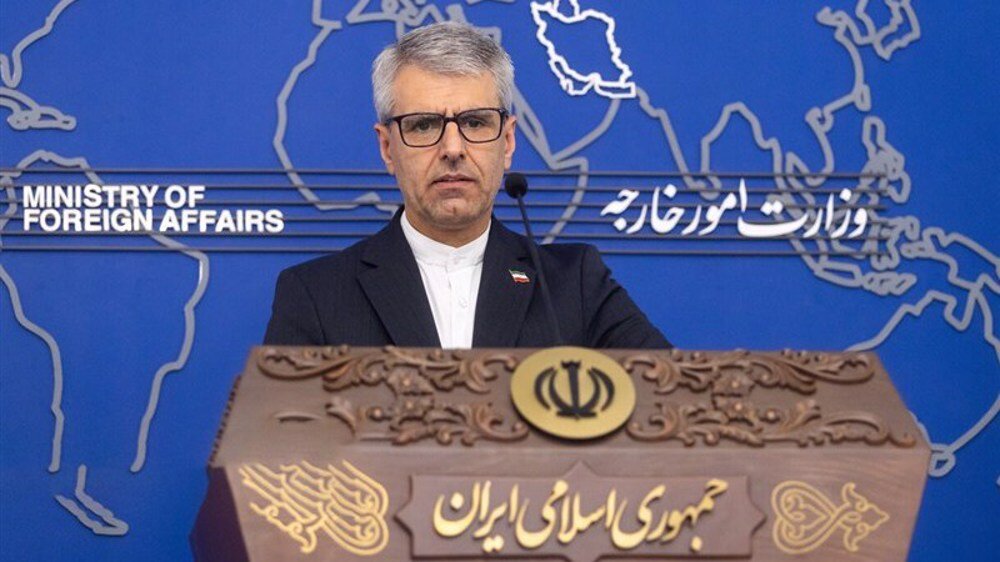
TEHRAN – Iran’s Foreign Ministry has rejected European efforts to activate the JCPOA snapback mechanism and called out illegal and illogical moves.
Speaking at a weekly press conference on Monday, Iran’s Foreign Ministry spokesman Esmaeil Baghaei stressed that the three European countries were unable to fulfill their obligations under the nuclear trade, warning that such actions represent a non-constructive approach that would serve Israel’s interests, rather than fostering dialogue in Iran’s nuclear programme.
The snapback mechanism, which is a provision within the 2015 Joint Comprehensive Action Plan (JCPOA), allows for a rapid recovery of UN sanctions if Iran is deemed “non-compliant” to nuclear deals.
Tehran believes this mechanism is illegal, especially after the 12-day war in June. Meanwhile, the UK, France and Germany (E3) coincided with the Israeli regime and the US, targeting Iran’s nuclear, military and civilian sites.
Iran challenged the legal validity of the UN Security Council’s snapback mechanism to revive sanctions and effectively abolish the 2015 nuclear deal.
Regarding the ongoing negotiations with European countries, he added: “Consultations continue, but no further discussion dates have been set.”
Iran denies rumors of closure of foreign embassy in Tehran
Baghaei dismissed reports that foreign embassies in Tehran were being closed, saying “None of the embassies reported to have been closed have actually been closed.”
He revealed that although some consular activities have declined since the war, all embassies remain fully operational.
“Attacks on Palestine’s civil infrastructure, Yemen constitutes war crimes.”
Baghaei condemned the ongoing violence in the region. “The Palestinian massacre continues and the Gaza people are still facing hunger. The international community opposes the forced movement of Gaza’s population, but the Zionist regime, supported by the US, continues to commit crimes.
Gaza’s Palestinian Health Ministry said Monday that the overall death toll since October 7, 2023 has risen to 62,004, causing 156,230 people to be injured. On March 18, 2025, when Israel breached its latest ceasefire, at least 10,460 people were killed and 44,189 were injured.
Commenting on Abraham’s agreement, Baghey warned: “The expansionist ambitions of the Zionist regime are more clear than ever. Netanyahu’s “great Israel” plan shows an unlimited regime.
Regarding the perception of European Palestine, he warned: “Awareness should not be in the form of deception. European countries must seriously support their commitment. A true recognition requires the establishment of a government in Palestine through a referendum that includes all residents, Imaslims, Christians and Jews.”
“Foreign intervention is not tolerated by Iran.”
In the South Caucasus, Baghey emphasized Iran’s sensitivity to foreign intervention. “We have explicitly communicated concerns about the existence and interference of foreign actors. We have explicitly communicated concerns about the existence and interference of foreign actors. Our partnership with the United States operates within Armenia’s jurisdiction, respecting the sovereignty and boundaries of the state, and de-creating the creation of blocks of communication routes and communication routes. Sovereignty.” He added: “We are closely monitoring development and will communicate concerns to local countries when necessary.”
In response to NATO forces entering through the Ararat border, Baguei said: “The presence of foreign troops, including the US and NATO forces, will hinder the region. Iran will closely monitor development and protect its borders.”
“Iran’s relationship with the IAEA continues.”
Baghaei has clarified its continued cooperation with Iran’s International Atomic Energy Agency (IAEA). “The relationship with the IAEA continues. Last week, the agency’s deputy visited Tehran to discuss new cooperative protocols. Vienna’s representatives remain in direct contact.”
Foreign Minister Kazem Galibabadi announced last week that Iran and the International Atomic Energy Agency agreed to continue consultations after consultations in Tehran, signaling the potential melting of relations after cooperation was suspended in June.
The breakthrough follows Tehran’s call for a fundamental restructuring of its involvement with the UN nuclear watchdog, citing the IAEA’s failure to fulfill its responsibility during the US-Israel attack on US-Israel civil nuclear sites in June.
IAEA Deputy Director Massimo Aparo, who led a delegation of international organizations and although no testing was conducted, both sides agreed to proceed with technical discussions. “It was decided to continue the consultation, taking into account the discussions held during the meeting,” Galibabadi said, emphasizing that future cooperation will depend on meaningful IAEA reforms.
At the latest conference, Iranian delegations strongly criticized the IAEA’s silence in response to recent attacks in response to nuclear facilities in Fordo, Isfahan and Natanz (US support and involvement).
The talks unanimously approved a law suspending IAEA cooperation following Iran’s June 25 parliamentary vote. The law requires future inspections to require express approval from Iran’s highest national security council and guarantees of the physical and technical security of nuclear facilities.
Congressional Speaker Mohammad Baqer Qalivaf accused the IAEA of becoming a “political tool” after accusing Iran of being a non-intensive violation just days before the Israeli regime attacks.