
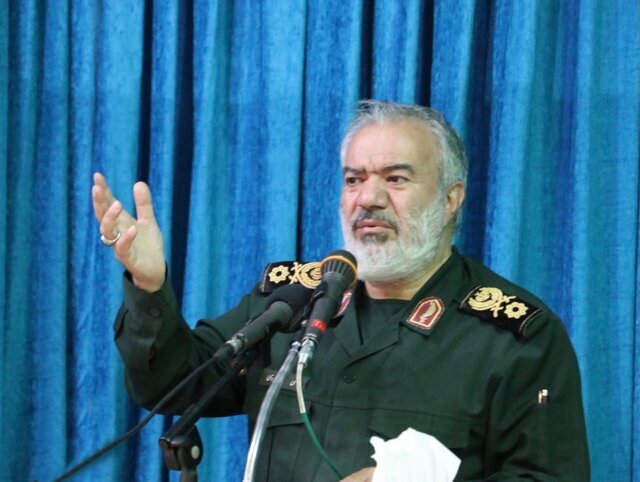
TEHRAN – The deputy commander of the Islamic Revolutionary Guard (IRGC) has declared Iran’s military preparations are much higher than they were two months before the war with Israel began.
Brigadier General Ali Fadabi said on Monday that increasing Iran’s defensive capabilities has been a constant mission for the IRGC since its establishment and is not subject to suspension. He said this ongoing effort has become most noticeable during a period of conflict, citing the eight-year war between Iran and Iraq, the Syrian conflict and, more recently, a 12-day conflict with Israel.
“We have the opportunity to continually strengthen our strength and capabilities, and people are actually seeing this outcome,” Fadabi said. “In the 12-day war, even what the whole world had hoped to stand up to Iran and defeat us, together, God was those who would otherwise have been defeated.”
He went on to emphasize that Iran’s preparations have grown considerably in the weeks since hostility began.
“We are proud to say, with God’s will, that our preparations today are much greater than they were two months before the war began,” declared Fadabi.
On June 13, Israel launched a wave of air strikes on Iran’s military, nuclear and security infrastructure. The war lasted for 12 days, killing at least 1,065 Iranians. This died primarily along with civilians, senior commanders and nuclear scientists. The United States has openly supported the Zionist regime from the start, and entered the war directly on June 22nd by surprise three nuclear sites that Israel had already targeted.
Iran responded with Operation True Promise III and launched 22 coordinated missile and drone attacks that devastated Israeli forces, intelligence, security and economic sites throughout the occupying territories. Analysts point out that Iran has caused serious damage but has deliberately refrained from deploying the most advanced and destructive weapons.
The June 24 ceasefire that Iran says was launched at the request of both Washington and Tel Aviv, with Iranian officials describing it as a “temporary suspension.”
The war exposed the unsustainable economics of US and Israel’s defense strategies. According to the Wall Street Journal, the US military fired more than 150 THAAD interceptors during the conflict. The naval destroyers fired 80 SM-3 missiles for up to $25 million each, with Israel spending hundreds of arrows 3, David’s slings and iron dome interceptors.
A report from the Washington-based American National Security Institute (JINSA) highlighted the disparity. The US military has launched 30 patriot missiles totaling $111 million to intercept only 14 Iranian missiles aimed at Al-Udaid Air Base in Qatar.
Replenishing these stockpiles is a major challenge. Lockheed Martin produces only about 100 THAAD interceptors per year. In other words, it can take three to eight years to recover from depleted reserves.
Israeli officials initially boasted an interception rate of 90-95%, but postwar ratings suggest that the actual success rate is rather low. Satellite radar images released weeks after Cerez Fire confirmed that Iranian missiles had hit at least five Israeli military sites.
According to Jinsa, 574 Iranian projectiles were launched, and 57 people struck a densely populated area, but 316 landed in the unmanned zone. Among the most important intrusions was a missile strike near Israeli military headquarters in Tel Aviv, which caused extensive damage and panic.
More importantly, Iran’s precision strike against Rehobot’s Wiseman Institute of Science on June 15th. Although widely portrayed as a civilian research centre, the institute plays a central role in Israel’s military industrial complex and secret nuclear programmes. The attack caused massive destruction, wiped out key research and revealed deep vulnerabilities at the heart of Israel’s strategic infrastructure.