
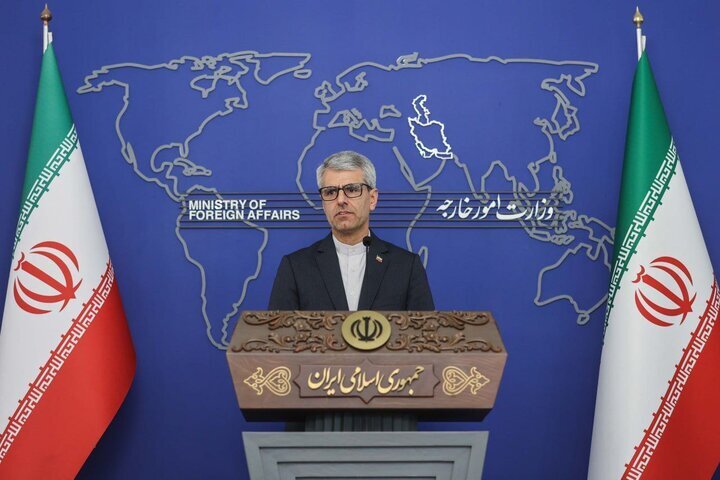
TEHRAN – Iranian Foreign Ministry spokesman Esmail Bhagihai has condemned Israel’s ongoing genocide in Gaza, noting the murder of five international journalists just a day ago.
“These crimes should not be unanswered,” he urged international organizations, such as the International Court of Justice and the International Criminal Court, to address the issue.
Baghey also mentioned the emergency summit held in Jeddah on the Palestine crisis, saying Iran has presented several proposals reflected in the final resolution. Among them was accused of the recent recognition that the Zionist Prime Minister would pursue the “Great Israel” project, which he said revealed his territorial ambitions for his neighboring countries.
The resolution called for the halt of arms sales to Israel and reconsideration of diplomatic relations, he added. “Following up at the United Nations and other agencies will be essential,” he emphasized.
“Iran and Russia are not limited to one sector.”
Addressing questions about Iran’s relationship with Moscow, Baghey emphasized that its relationship with Russia is “comprehensive” and covers multiple regions, including energy. He confirmed that natural gas cooperation is on the agenda and that there are details that the Ministry of Oil should pursue.
“The approach to Russia is not limited to one sector,” he said. “It reflects a broader strategy of regional and international engagement.”
Baghaei also pointed to the Shanghai Cooperation Organization (SCO) Summit to be held in China on August 31st. There, he will be attending for the first time since the Iranian president has joined the body.
“Snapback sanctions: national interest is our red line.”
Much of the briefing focused on Iran’s position on the so-called snapback mechanism under UN Security Council resolution 2231. He said Europe does not have the legal authority to trigger the return of UN sanctions on Iran.
“We’re not underestimating the outcome,” Baghey pointed out. “But we are ready to counter such abuse,” he said Tehran is coordinating closely with Russia and China to consider Moscow’s resolution on the issue.
“Our red line is in national interest,” he stressed, adding that negotiations with Europe are focused on lifting sanctions and protecting Iran’s rights under the nuclear deal.
“The Hezbollah Military Sovereign Lebanon Problem”
Asked about Hezbollah’s call for disarmament, Baghaei said the decision rests solely on Lebanon.
“Sovereign countries must decide their own path,” he said, adding that living with dignity in areas facing Israeli attacks requires “robust defensive capabilities.”
“The US has presented unprecedented double standards for Gaza.”
The spokesman harshly criticized Washington’s stance on Gaza, accusing others of making war crimes possible while lectured others on human rights. “International law was not under such brave assault,” he said. “Double standards are unprecedented.”
Regarding US terms for the negotiations, Baghaei reiterated that Tehran is not opposed to the dialogue, but never accepts threats or coercions. “It wasn’t Iran that betrayed diplomacy,” he said. “We are ready when it serves our national interests.”
“Ukraine’s actions will meet mutual measures.”
Baghaei condemned Ukrainian’s decision to cancel the bilateral agreement with Tehran, saying that Kiev acted on “false claims” about Iran’s involvement in the war. “This kind of unfair action will be met with mutual action,” he warned.
He also rejected reports in Western media that Iran was ready to accept “zero enrichment” and called them manufactured. British sanctions are “contradictory” with European calls to seek dialogue and violate international law, he added.
“IAEA pressure on Iran is unprecedented illegal”
Despite the tensions, Baghhai has reaffirmed its membership in Iran’s non-proliferation treaty (NPT) and technical discussions with the International Atomic Energy Agency (IAEA) are ongoing. He criticized Western pressure on the agency to inspect Iranian sites that have been attacked, calling it “unprecedented illegal.”
He also discussed the “3+3” form of regional cooperation with the South Caucasus and described it as an effective framework for addressing local issues.
“The sovereignty exchange between Iran and Africa is normal.”
Turning to Africa, Baghey rejected US criticism of South Africa’s defence ties with Iran, noting Tehran’s historical support for the anti-apartheid struggle.
“The exchange between sovereign states is normal,” he said. “What’s extraordinary is Washington’s interference.”
“Peaceful nuclear enrichment remains unnegotiable.”
Baghaei concluded by rejecting a report of US-backed proposals to the regional enrichment consortium, saying Iran is dealing with such ideas with caution. “Under the NPT, our right to peaceful enrichment is unnegotiable,” he said.
Looking back at the past year, he described it as a “difficult but defined period” for Iranian diplomacy. “The Foreign Ministry was on the forefront of defending Iran’s legitimacy during its 12-day defense,” he said. “Our policies are clear: we will protect our national interests, resist coercion and pursue as much constructive engagement as possible.”