
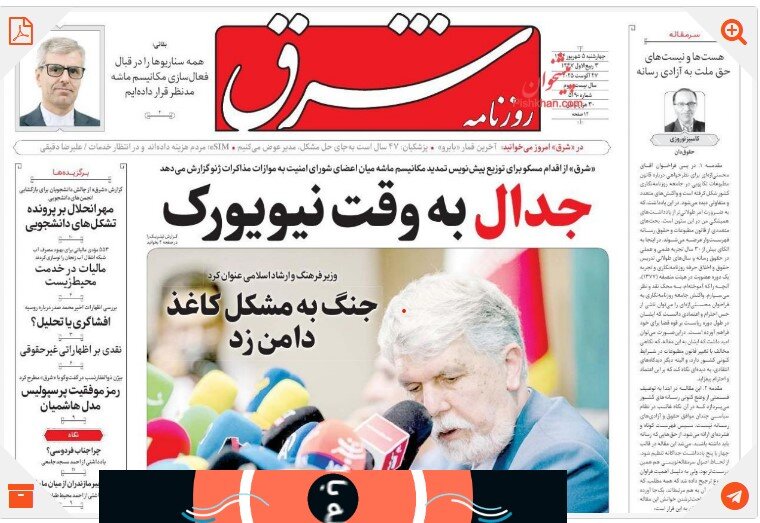
Tehran – Sharg analyzed the Geneva Conference between Iranian and European diplomats as E3 (UK, France, Germany) threatened to activate a snapback mechanism that would return all UN sanctions against Iran that were terminated under the 2015 nuclear deal called the JCPOA. It writes as follows: The second round of negotiations took place in a situation where the regional and international atmosphere was still under the shadow of the June attacks by the Zionist regime and the open support of the United States (12-day war).
This kind of atmosphere makes it more difficult to reach understanding naturally. However, Tehran emphasizes that the solution lies in dialogue. The parties appear to be carefully assessing the situation and preparing for the next phase. What is certain is that this round of consultation did not reach the endpoint or open a new path. In such circumstances, we can only say that diplomatic paths are still open, but their fate will depend on the will and choices of European parties, and of course, the political developments in the coming weeks. The release of the NO statement, the attention given by the parties to express their position, and the emphasis on giving all opportunities to diplomacy, suggesting that the lecture is at a sensitive and vulnerable stage.
Etemad: An opportunity to contain snapbacks
In an interview with European affairs expert Morteza Macki, Etemad looked into the possibility of a resumption of serious dialogue between Europe and Iran as Europeans threatened to invoke a snapback mechanism by the end of August. Makki said: Iran’s nuclear issue is now a serious challenge for the European government. Over the past few weeks, Israeli lobbies have also been active in Tel Aviv and Washington. We are asking that we do not miss an opportunity to promote the activation of snapback mechanisms. However, there are still questions among European governments about calling a snapback mechanism, as they know that if the JCPOA is thought effectively it will lose its role in Iran’s nuclear issue. As an influential player in the region, Iran is trying to prevent the revitalization of snapbacks in the remaining time, as the country’s current conditions cannot tolerate the return of Security Council sanctions. If Europeans start the process of sending letters to the Security Council to activate the snapback mechanism, Iran has a month’s time to propose an effective solution to prevent it. In the meantime, visiting our country’s president, Masoud Pezeshkian, to New York could be a great opportunity to prevent the revitalization of the snapback mechanism.
Khorasan: Negotiation table, postponement or activation scenario? !
Khorasan spoke with foreign policy analyst Rahman Ghahremanpour about new talks between three European countries: Iran, the UK, France and Germany, and the large European Union in Geneva. He said: New talks began in Geneva between Iran, three European countries and the European Union. Negotiations are presented by staff as new opportunities to diagrammatically map out courses of diplomatic relations between Tehran and the West. There are two main views on the future of snapback mechanisms. Some view it as a costly threat that should be postponed by diplomatic means. Others believe that postponements only increase costs and that the purpose should be clarified as soon as possible. As Europe continues to maintain its role in the nuclear file, it is in the interest of both Europeans and Iranians to extend or postpone the snapback mechanism. Deferrals are not the perfect solution, but they can reduce the strength of tension in the current situation.
Arman-E-Emrooz: Economic diplomacy is a victory card for the government
Arman-e-Emrooz argued that the success of economic diplomacy by incumbent governments is the result of several important factors. First, the strategic use of Iran’s geopolitical position as a route for ties between the East and West. Second, the establishment of mutually beneficial economic relationships that have gained the trust of foreign partners. Third, coordination between executive bodies, including the Ministry of Foreign Affairs and the Ministry of Economy, accelerated the implementation of the project. Fourth, the adoption of decisions in line with the FATF, which serves as a catalyst for trade facilitation. This integrated approach has made Iran a key player in the local economy. These results have had a widespread impact on Iran’s economy. Increases in non-oil exports to Arab and Eurasian countries have improved the trade balance. Foreign investments in particular from China have strengthened industrial infrastructure and created sustainable employment. The expansion of the transport corridor and the removal of FATF obstacles have led to increased foreign exchange revenues and made the Iranian economy more resilient to external pressures. These developments also strengthened public confidence in government policies.