
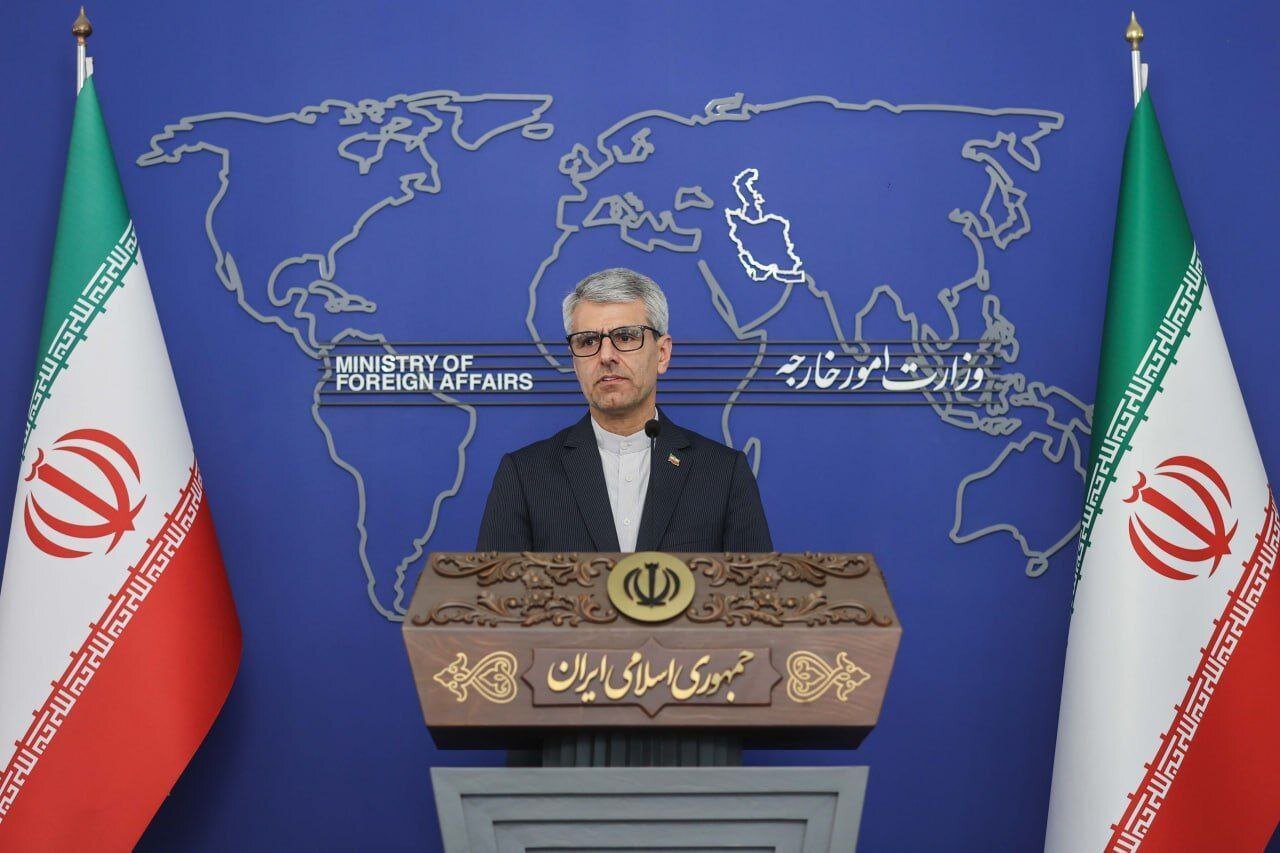
TEHRAN – Iran’s Foreign Ministry rejected claims that Tehran failed to meet its commitment under the 2015 nuclear trade (JCPOA).
At a press conference on Monday, Ministry of Foreign Affairs spokesman Esmaeil Baghaei said:
Baghaei highlighted multiple diplomatic developments over the past week in the region, particularly the participation of the Iranian president in the ongoing Shanghai summit.
“Israel attacks Yemen for blatant crimes.”
Bagaei expressed sadness to the Yemeni and the Palestinian people, and condemned the assassination of several ministers during Yemeni prime minister and Israeli military operations. “The law was a blatant crime and violated all the principles of international law,” he said, saying the attack coincided with the escalation of violence and mass murder in Gaza.
He described the humanitarian crisis and reported that nearly 2,500 Palestinians had died on the food line due to hunger and thirst. “Unfortunately, the UN has failed to take effective action to continue US support for Israel. However, international media and journalists have raised global awareness, with over 250 outlets refusing to print front pages yesterday in protest of the ongoing genocide.”
“We show the seriousness and lack of goodwill in negotiations.”
In response to recent remarks by Senator Marco Rubio about the in-person meeting with Iran, Baghhai said that such a condition revealed a severity and lack of goodwill. He recalled that the US unilaterally withdrawal from the JCPOA in 2018 and coordinated with Israel to carry out an attack on Iran during negotiations.
“The US Secretary of State’s approval of the snapback mechanism explains it in accordance with the presidential order, indicating from the beginning that the administration’s plan was to dismantle the JCPOA and impose illegal pressure on Iran,” Baghaei added.
Regarding initiating a snapback mechanism for the European trio (Germany, France, and the UK), he said: “When talking about the JCPOA, they have to ask which JCPOA they mean. They accuse Iran of not meeting its commitment, but parties who ignore the agreement cannot blame Iran.
He also criticised Europe’s current diplomatic role, saying:
“Tehran continues to be directly involved with the IAEA.”
Baghaei has confirmed that no International Atomic Energy Agency (IAEA) inspections have been conducted in Iran, except for the Bushehr reactor fuel load. He emphasized that Tehran continues to have direct involvement with the agency and is preparing a framework for future interactions in accordance with the guidance of the Congress and the National Security Council.
Regarding the recent statement from the Persian Gulf Cooperation Council on the Iranian Islands and Arash Fields, he said: “External claims are unacceptable and do not grant claimants any rights. Iran remains open to negotiations, but sovereignty does not compromise.”
“Participating at the Shanghai Summit is important for regional safety and economic cooperation.”
The spokesman emphasized his participation in the Shanghai Summit Tehran and called it “important” for regional security and economic cooperation. “This is our third full membership participation, and we have held multiple bilateral meetings, including our Chinese counterparts. The summit resolution addresses new challenges, condemns Israeli and the US aggression, and reaffirms UN resolution 2231,” he said.
He also noted strong ties between Iran and China under a 25-year cooperation agreement covering trade and energy. “Our partnership continues to be independent of external controversy. We are optimistic about strengthening relationships and expanding cooperation.”
“We are inconsistent and dishonest in Europe’s diplomacy towards Iran.”
Baghaei criticized European diplomacy against us and Iran, calling it consistent and dishonest. “You don’t have to be a diplomat to see contradictions. A threat is issued while insisting on your commitment to diplomacy. This reflects duplication and maliciousness,” he said.
He emphasized that European countries must act responsibly, review past negotiations and pursue an approach that is free and independent from us.
Regarding global governance, Bughai stated: “The Shanghai Cooperative Organization and BRICS play an important role in promoting multilateralism and North-South cooperation. China’s leadership is essential for unilateral conflict and improving regional stability.”
“Council decides on the push of snapbacks”
Finally, he highlighted the central role of Congress in decisions on snapback mechanisms. “The Congress is an important body in these deliberations. We will wait to see the final decision together with other decision-making bodies,” Baghhai said.
He reiterated Iran’s commitment to pursuing that right, including water allocations from the Hillmand River, stressing that public opinion and humanitarian concerns such as aid to Gaza remain priorities.