
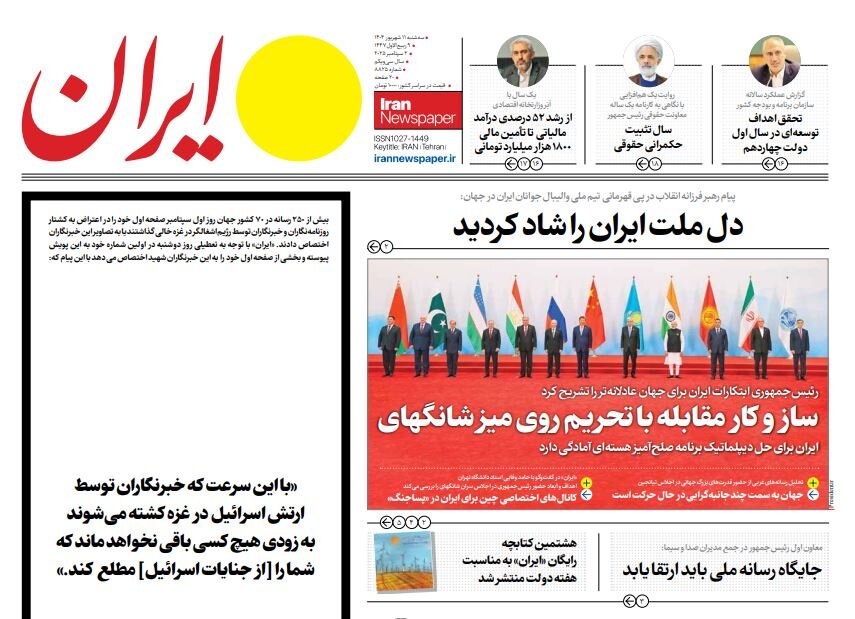
Tehran – In a memo, the Iranian newspaper spoke about the presence of President Masudo Pezeshkian at the Shanghai Cooperation Organization (SCO) Summit in Tianjin, and the presence of the President at the SCO Summit is more important in many respects than others.
The importance of this event is that while the Chinese president has hosted a considerable number of heads of state at the two-day summit, Pezeshkian reaffirms Iran’s position in the heads of state and the intensive programme of the sideline conference. This reminds me of the fact that Iran is an actor that cannot be ignored and that its presence in the international arena has considerable weight and fame. Perhaps the most prominent aspect of this trip is the president’s participation in the major international summit after the 12-day Iran-Israel War. The event takes place in a situation where some western and regional media are trying to present a weaker image of Iran. However, Iran’s active presence among prominent Eurasian leaders shows that Iran still has the capacity to influence regional and regional equations by redefine the power of the country. The move also reflects the stabilization of diplomatic stance and the relative stability of Iran’s foreign policy after the crisis.
Kayhan: Along with local power, it is important
Kayhan discussed Iran’s presence at the Shanghai Summit, seeking the views of Hooman Peymani, a local security issue expert. He said: The Shanghai Cooperative Organization was established primarily to counter the growing Western influence in Central Asia and Eurasia. Within this framework, the bloc’s Iranian membership has so far been more iconic than operational. However, the existence of Iran is useless and this membership could pave the way for a more prominent presence in the field of economic and security, especially in the context of the recent activation of snapback mechanisms (by the European troika against Iran). Even if the snapback mechanism returns (un) sanctions, the situation is different from the past. Today there is no global consensus on sanctions against Iran. Even US allies, many countries are under pressure from Washington’s policy. The face of Western sanctions between China and Russia itself has a very strong incentive to counter the mechanisms of snapback and reaffirm their position. Strong Shanghai members, such as Russia and China, may be more likely to support Iran outside the organization, as they view threats to Iran as a threat to themselves.
Khorasan: The importance of matching China’s interests
In the article, Khorasan discussed the importance of matching Iran’s interests with China. China’s current policy towards the current conflict between Iran and Israel focuses on “profit-oriented neutrality,” verbal opposition to attacks, ceasefires and humanitarian support, protection of energy and financial arteries, and rapid regulation of oil flows. This framework has a clear message. China is still a risk manager and will not become an actor on the battlefield. Although Beijing’s support for Tehran cannot be expected, at least in the current time frame, it should rather focus on matching China’s interests to regional stability in a more effective way. Additionally, using China’s mediation capabilities in the form of limited military security consultations could be a viable policy based on Iran’s national interests. If China’s interests outweigh the costs of supporting Iran, Beijing’s profit-oriented neutrality works in the favor of Tehran, without expecting Iran to stand as a wartime ally.
Ham Mihan: Snapback revitalization and impact on oil sales
In an interview with strategic energy management expert Masoud Hashemian, Ham Mihan examined the impact of snapback sanctions on oil sales in Iran. He said: Snapback has no impact on our oil sales at this time, and it has only psychological effects. The US and Israel are seeking consensus on Iran. Since the US withdraws from the JCPOA, Europeans have actually withdrawn from the JCPOA. Americans have tightened sanctions against us and tightened them up every day, and no longer have the H world and the usual trading system in all areas. However, national Iranian oil companies are always finding solutions, and essentially, sanctions have not affected Iran’s oil sales. Of course, it would have been better if these exchanges were implemented based on smooth international trade exchanges. But we know how to master this kind of sales and avoid sanctions. This also applies to petrochemical exports. However, based on snapbacks, it is unlikely that changes will occur in the commercial and transport systems of the petroleum and energy sector.