
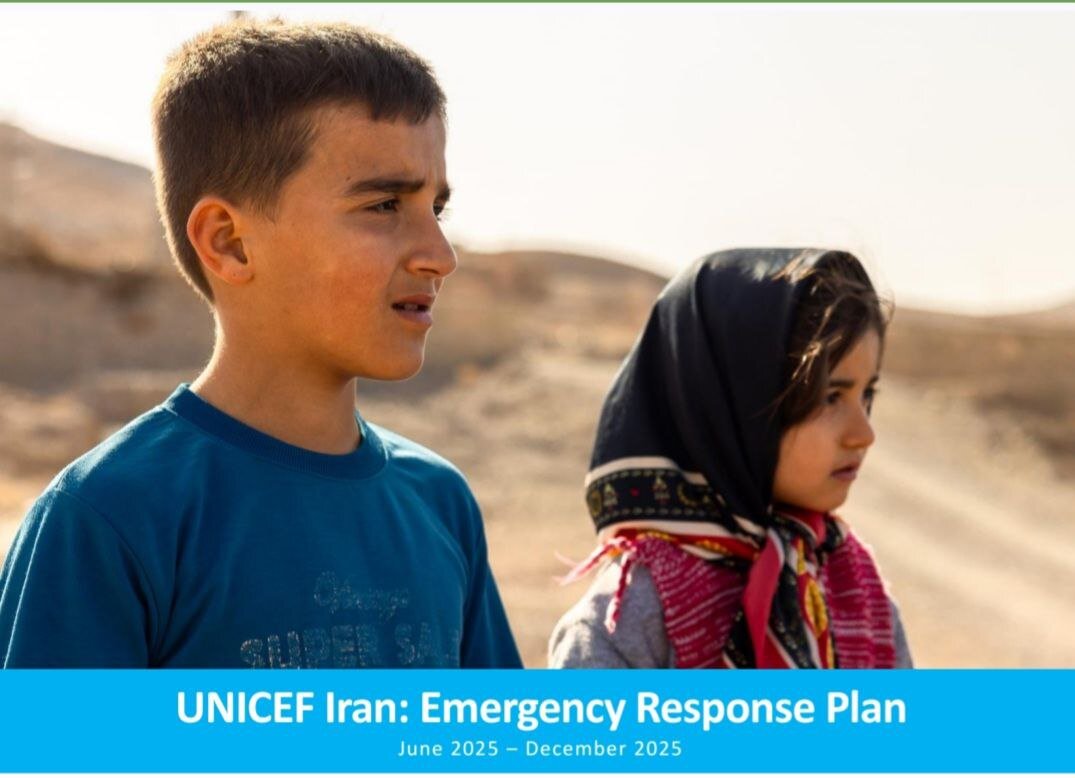
TEHRAN – The United Nations Children’s Fund (UNICEF) highlighted UNICEF’s strategic initiative, including providing effective support to children and their families in vulnerable circumstances, including partnerships with national implementation partners.
The document also provides details on the impact of war on children and families, focusing on areas that need immediate attention, such as mental health and service recovery.
Humanitarian situation
Tensions remain high throughout the region despite the ceasefire declared on June 24, 2025, 12 days after the war. The 12-day escalation caused serious humanitarian consequences, killing an estimated 1,100 people and injuring more than 4,935.
Private infrastructure, including housing and hospitals, has suffered extensive damage. Economic challenges, including inflation, unilateral sanctions and currency fluctuations, continue to affect the population in Iran’s vulnerable circumstances.
In response, the Islamic Republic government of Iran expanded its cash assistance and introduced a relief package
For the affected business. Financial support for households with damaged homes is also approved. Despite the rapid nationwide response, children, adolescents and vulnerable people continue to face barriers to access basic services. Approximately 40% of children and adolescents in affected areas need mental health and psychosocial support (MHPS).
Therefore, at the request of the Ministry of Health, Medical and Education (MOHME) and the Iranian Red Crescent Association (IRCS), UNICEF is complementing its national efforts by providing multiple sector responses to ensure timely and effective support for children and their families in vulnerable circumstances.
UNICEF’s response strategy
UNICEF’s response is consistent with children’s central commitment to humanitarian behavior, prioritizing comprehensive, prompt and accountable service delivery for children, adolescents and their families in vulnerable circumstances.
Multi-sector Mental Health and Psychosocial Support (MHPSS)
Goal: 1.5 million children, adolescents, caregivers, community members
• Supporting the provision of MHPSS services to children, caregivers and frontline workers, including procuring supplies for child-friendly spaces and Sahar teams
• Supporting MHPSS services to frontline workers, including viewers, caregivers and emergency kit procurement
• Supporting training school counselors and educational staff ahead of the new academic year
Service recovery and multi-sector integration
Goal: 1.4 million people including vulnerable children and caregivers
• Ensure continuous delivery and distribution of essential health supplies
Supports the recovery of cold chain capabilities to protect vaccine efficacy
•Providing dietary supplements to children in vulnerable situations under the age of 2
• Provide dietary supplements to pregnant and breastfeeding mothers in vulnerable circumstances
• Provide humanitarian cash transfers to affected individuals, including training service providers
Supporting education and access to services for children with disabilities
•Providing recreational and learning programs for affected children
Supports rehabilitation of affected schools
System resilience and emergency preparation
• Procurement of emergency response backpacks for mobile health teams
• Procurement of prefabricated classrooms as temporary learning spaces in preparation for the new academic year
Capacity building support for partners and frontline workers on principled humanitarian responses
Establish a rapid response mechanism (RRM)
Goal: 25,000 households (100,000 including 28,000 children)
• Procurement and prepositions of essential survival products for quick response
Risk Communication, Community Engagement, and Accountability (AAP) for affected groups
Goal: 4.7 million people reached with comprehensive, protective messaging and feedback mechanisms
•Perform rapid evaluations and social listening
Develop and disseminate life-saving information to the population groups in need
Strengthen comprehensive and responsive feedback mechanisms to promote transparency, accountability and community engagement
Funding requirements
UNICEF Iran’s humanitarian response is estimated at US$17 million. Approximately 65% are allocated to supply procurement, while the rest supports preparatory actions, coordination, rapid response mechanisms, risk communication and community engagement.
Planning, monitoring, assessment, AAP, and localization
Implementation Partners work closely with UNICEF to carry out and monitor activities through regular assessments, localized data collection and quality checks. Implementation partners play a central role in promoting feedback based on community input and adapting programs.
UNICEF continues to support improving our feedback system, particularly in terms of consistency and transparency. Localization remains an important pillar, with efforts underway to strengthen cooperation with national partners and embed UNICEF’s AAP principles in all aspects of the response.