
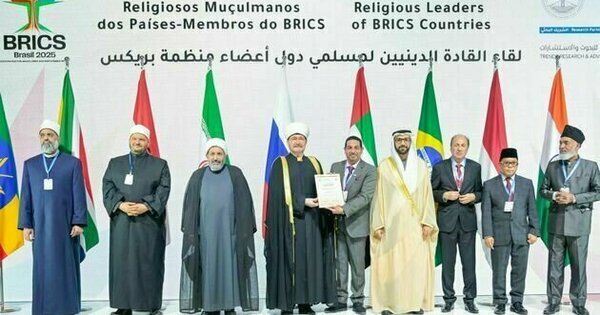
Tehran – The convening of the Brazilian-sponsored “Second-Time Meeting of Muslim Leaders in Brick Countries” is a turning point in the life of this forum, and beyond that, the pillar that strengthens the BRICS Union. Consultation and synergy with Muslim leaders within the BRICS framework on international crisis is not merely desirable, but an absolute necessity.
In fact, we cannot imagine the embodied model of governance and collective management in today’s world without considering cultural roots and dimensions. BRICS countries are fully aware and agree about the fundamental role of culture in shaping new global relations. Therefore, the conference of Muslim leaders from BRICS countries is not a formal gathering for discussion about the growing crisis in today’s world. We believe this process must lead to a comprehensive model of solidarity, cooperation and synergy. This can even lead to seemingly non-cultural relations within a sustainable framework. The decision of BRICS leaders in realizing this comprehensive model is indeed admirable.
Three important points within this context are worthy of attention.
First, at the second meeting of Muslim leaders of BRICS, the Islamic Republic of Iran was widely praised. Not only did its regime suffer the toughest blows only as a country that was recently attacked by Zionist enemies, it also dealt with a consistent position in the defense of the Palestinians. These stances played a very important role in shaping the attention and focus of BRICS members on the principles and proposals proposed by Iran. This setting first presented a comprehensive definition of the international community, and then highlighted the inherent existential threat posed by the Zionist regime and its supporters of humanity.
The conference revealed that BRICS and Shanghai cooperative organisations must engage in a struggle against oppression, human rights defense, and promoting religious coexistence at the heart of strategy, as two dynamic and emerging blocs where a huge rise in cultural, economic and political aspects have sparked rage and fear among the global security enemies of Washington and Tel Aviv. Praise God. It has become clear that an overview of such a comprehensive strategy has become a common concern among BRICS (and later Shanghai) members. The role of Islamic Republic in Iran as a pioneering force in confronting global oppression and hegemony is concrete and well understood by other members. Based on two valuable and practical components (cultural and geopolitics) that develop the strategic direction of BRICS, it strengthens collective cooperation and suppresses common threats across all dimensions.
Second, cultural issues involve essentially both input and output. In today’s world, collective cooperation forums and frameworks such as BRICS and Shanghai Cooperation Agency are areas that these cultural inputs reveal. New alliances like BRICS are not only opportunities to create economic and political balances in the modern world, but also a platform for the development of multiculturalism and expansion of the eastern culture. The deliberate silence, or rather, the obvious anger of hegemonic forces on the synergy of religious and cultural leaders within BRICS, is clear and conveys. Culture is neither a tool nor an abstract factor. This is the main driving force behind the collective life of BRICS and Shanghai members. Culture forms a fundamental framework and gives meaning and direction to both macro-level economic and political relations between members.
Third, special attention is required in the frameworks that must today define global relationships. We are at a fork where the world needs more empathy, synergy and peaceful coexistence than ever before. In these complex international situations, addressing issues such as interfaith coexistence amid escalating regional and global tensions is not only an ethical and humanitarian order, but also a strategic and business necessity. Therefore, we must start by creating a shared comprehensive explanation of what is happening in the international system and then by summarizing and operating the desired state based on this overall understanding. It is precisely a cultural and civilized perspective that brings together all these elements.
The synergy of religious leaders within BRICS is the possibility that they must be transformed into concrete reality. We have taken strong steps along this path. The consequences of such synergies over this strategic asset are the creation of global stability and sustainability, the repulsion of common threats within the BRICS framework, and the generation of opportunities that cannot be limited in scope.
Mohammad Medi Imanipur, head of Islamic Cultural Organizations