
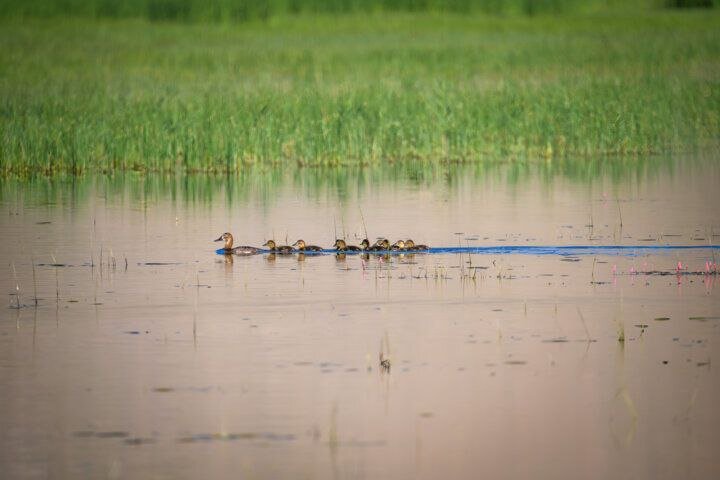
Tehran – Located in the precious wetlands and diverse habitats of the international migratory bird corridor, Chaharmahal Bakhtiari, it houses thousands of birds that choose this state as a winter shelter to escape the cold of Siberia.
Autumn approach, aqua herds and grey geese, gray cranes, fewer white geese, herons, white-headed ducks, various types of feathers, and curls begin to fly into the wetlands of Chogakahole, Ganderman and Soragan.
Unlike seasonal wetlands, these wetlands are covered in water all year round. Enough water, diverse vegetation, various species such as insects, mollusks, crustaceans, fish, reptiles, amphibians, environmental safety and tranquility, 24-hour protection by environmentalists, and online surveillance provided safe and stable habitat for the birds.
Some birds stay in the winter, while others rest for a while and pass through the marsh.
Gandmann Wetlands were registered as Iran’s 27th Internationally Important Wetlands in February. With its reaching 1,070 hectares, it is one of Iran’s top five bird watching sites and is the country’s most important permanent habitat for migratory birds.
The Choghakhor wetlands flowed to Hectorless in 1687 and are designated as a hunting restriction area. There are 47 species of birds, including migratory birds such as the Northern Pintail. The wetlands live more than 1% of the general Pintail population and endangered species such as white-headed ducks and Eastern Golden Eagles. Choghakhor Wetlands are also one of the most important habitats for native Zagros fish in Iran
Last year, 85 migratory species, including more than 300,000 birds, arrived in the wetlands and 25 species were kept here.
National Plans to Improve Wetland Conservation
In June, the Ministry of the Environment (DOE) and the Ministry of Agriculture signed a Memorandum of Understanding (MOU) to launch a national plan to empower communities to protect and promote sustainable use of wetlands.
The main purpose of the MOU is to turn wetland protection from a government initiative to an inclusive social responsibility by focusing on training, empowering and engaging in the community.
Wetlands are an important ecosystem and are known as the kidneys of the Earth. These ecosystems provide clean water, protect against flooding, restore underground aquifers, and maintain surface water flow during drying periods.
Iran’s geography is clear and full of diverse landscapes. The country has a variety of wetlands, of which 27 were listed in the International Ramsar Convention.
On December 10, 2024, DOE official Mehri Asna-Ashari said the Iranian wetland conservation project led to a 27.5% reduction in irrigation water consumption and an increase in agricultural produce by 22.5%.
“Currently, 49 wetlands, which cover about 22% of the total domestic wetlands, are preserved in the form of native ecosystem management partnerships,” the IRNA quotes Asna-Ashari as saying.
She made a statement at a meeting of the steering committee of the International Project for Iran’s Wetland Conservation.
mt/mg