
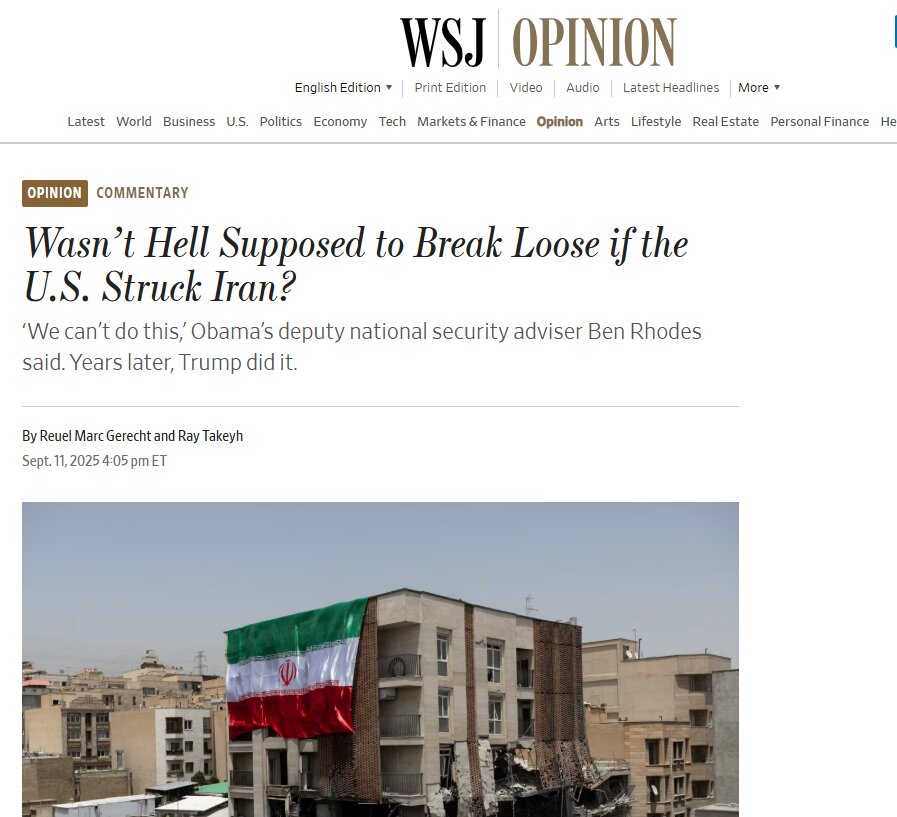
Tehran – In an article by Reuel Marc Gerecht and Ray Takeyh in the Wall Street Journal, long-standing assumptions argue that the US strike against Iran has sparked domestic support for the government and plunged the Middle East into a “eternal war.” However, it is not disproveable as they argue, and there are not just one reason, but multiple reasons to suggest that it is not.
The recent Israel-US campaign against Iran cannot compare it to full-scale professions in Iraq or Afghanistan. These invasions included tens of thousands of troops, extensive infrastructure targets, and ground combat. In contrast, the 12-day operation focused mostly on nuclear and strategic military facilities. In response, Iran fired drones and ballistic missiles that permeated the defenses of Israeli iron domes and other alliances. This argument breaks down when we recognize that Tehran calibrated the response to coincide with the limited extent of the strike. Precision attacks bring about precision responses rather than full-scale or “eternal war.”
Israel’s tight media control also obscures the scale of destruction achieved by Iran, such as suppressing footage of Haifa and Tel Aviv’s damage, and distorts the Western perception of the true strength of the conflict.
The Wall Street Journal claims that Tehran has failed to mess with its masses with meaningful displays of support and mourning. However, this assessment ignores a clear shift from street protests to digital and cultural solidarity. By limiting “mobilization” to street protests, WSJ overlooks wider engagement spanning hashtags and cultural performance.
During and after the 12 days of conflict, grassroots assistance erupted not only within Iran, but throughout the wider region. Iranian filmmakers, actors and singers (many of whom are based overseas) have posted unified videos and messages under various hashtags. The iconic peak attracted millions of viewers, when Iranian leaders invited famous admirals to play a slogan about Iran at the third Shia Imam ceremony. The event, coupled with a wide range of online campaigns, sparked generational enthusiasm, even among those critical of the government.
The Wall Street Journal argues that Tehran “turns inward and resorts to widespread oppression during and after the 12-day war.” But at that same time, Iran’s state broadcaster Ilib dedicated its prime time slot to debate that invited outspoken critics of the Islamic Republic. Many “opposition” within Iran were far from silence of objections and were free to challenge the official stories of social media and social media.
This article, in one way or another, urges US policymakers to implement further operations against Iran, assuming the horrifying Tehran. In reality, the 12-day halt of violent hostilities between Iran and Israel reflects strategic calculations rather than surrender.
By halting exercise manipulation, Tehran saves its core functions, purchases important breathing spaces, and shows inhibition in areas where escalation often produces more violence.
This pause highlights Iran’s confidence in weathering future conflicts without overstretching. Protect important military assets (missiles, drones, command structures) and book them at the moment. From this perspective, Iran intentionally adopted restraints to reconcile its stance on Israel and counteract the broader US presence in the Middle East.
And Tehran’s pivots to talks with the International Atomic Energy Agency, European intermediaries and even indirect channels to Washington represent more than just a concession. It embodies Iran’s belief that negotiations can further enhance bloodless nuclear energy knowledge. Diplomacy also provides a platform for gathering global opinions on new sanctions or military strikes, providing the ultimate shelter for peaceful conflict resolution and the most viable path for the West to impose restrictions without causing further conflict.
Long-standing sanctions have paradoxically sharpened Iran’s economic toolkit, rather than breaking that will and enforcing it in place of foreign imports. Tehran uses local currency arrangements to maintain crude exports, to grow its most prominent oil customers, especially China.
It also created a financial channel for sanctions, ranging from gold oil swaps to informal payment systems that blunt the impact of sanctions. Despite the economic challenges, these adaptations have repeatedly eased Iran against the pressure campaign. If UN sanctions are caused while painful, they are unlikely to force a complete surrender and could innovate new evasion tactics.
Iran’s response to rising Western pressure is to deepen its strategy with China and Russia, potentially restructuring the battlefield. This may unlock alternative financing and trade channels that further circumvent US control. Beijing’s continued friction with Washington over tariffs and technology transfers is a good encouragement for Chinese state-owned and private companies to expand their presence in Iran. At the same time, the Russian war in Ukraine has driven Moscow and Tehran more closely, both attempting to offset the expanded sanctions. Energy giants like Gazprom and Rosneft are poised to strengthen cooperation, and arms trade could surge in order to maintain military cooperation despite Western embargo.
This Sino-Russian axis also offers significant diplomatic dividends. In multilateral forums such as the United Nations and Shanghai Cooperation Agency, Beijing and Moscow have limited responsibility for routinely challenging or diluting Western sanctions resolutions, increasing the political costs of enforcement, and supporting Tehran. By leveraging these major power partnerships, Iran will turn the economic isolation of its attempts into a manageable challenge, presenting oil exports, attracting important foreign direct investments, and blunting the impact of future measures.