
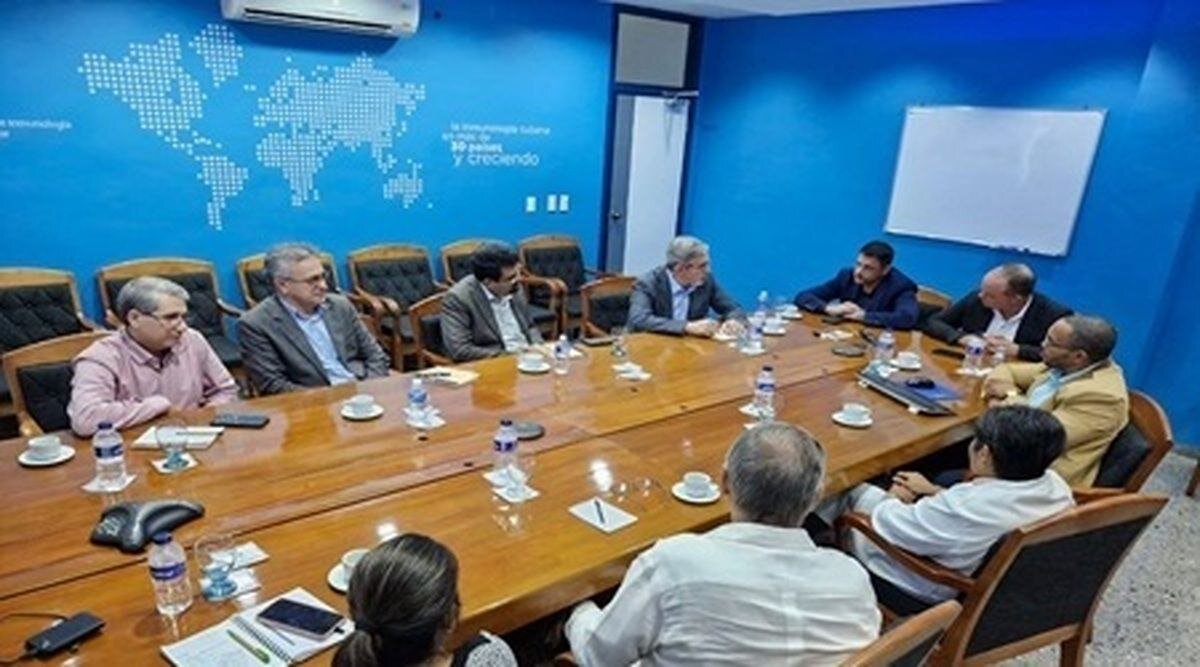
Tehran – Senior Advisor to the Minister of Health and Cuban Minister of Public Health Tania Margarita Cruz Hernandez discussed ways to expand medical and scientific ties between the two countries and take further action to increase vaccine production and cooperation in the biotech sector.
Wednesday’s meeting centers on reaching previously reached agreements between Iran and Cuba, promoting scientific and technical cooperation with the Pasteur Institute to transfer pneumococcal vaccine production technology from the Finlay vaccine. Officials also discussed their potential capabilities to manufacture vaccines.
Additionally, Jafarian has held meetings with other Cuban officials, such as Deputy Minister of Foreign Affairs, Deputy Minister of Foreign Trade and Investment, and the Principal and Director of the National Centre for Medical and Medical Devices (CECMED) of Cuba’s National Centre for Drugs and Medical Devices. Biocubafarma, the Centre for Molecular Immunology (CIM) in Cuba, and Hermanos Ameijeiras, the largest hospital in Cuba.
Medical relations between Iran and Cuba date back more than 30 years ago, with the first cooperation between the two countries beginning with the transfer of technology for the manufactured hepatitis B vaccine from Sigbu in Cuba to Iran’s Pasteur Institute.
In recent years, both countries have successfully developed a COVID-19 vaccine (Pastocobac), and the process of transferring pneumococcal vaccine technology is currently underway.
The Iran-Cuban Joint Committee is chaired by Iran’s Ministry of Health, Medical and Education, and the 19th meeting of the committee is expected to be held in Cuba in the near future.
Joint biotechnology, vaccine production project
In May, Cuba’s Tehran ambassador Jorge Fernando Nicholas discussed how to follow up joint projects on biotechnology and vaccine production projects, particularly during a meeting with Iran’s Minister of International Affairs, Alileza Biggrali.
The meeting was held on the sidelines of the Iran Expo 2025, the seventh exhibition of the Republic of Iran’s 7th export capacity, held at the International Permanent Fairgrounds in Tehran from April 28th to May 2nd.
The Cuban authorities’ delegation led by the ambassador also met representatives from the Pasteur Institute, the Food and Drug Agency, the Ministry of Foreign Affairs and the Trade Promotion Agency in Iran.
Referring to the successful experience of cooperation between Iran and Cuba, Biglari called these relationships a successful model of international scientific interaction.
Cuba is one of the Latin American countries and has the highest level of cooperation with Iran in a variety of areas, including the health sector, Jafarian said in January.
“Thanks to Cuba’s advanced technology, both countries benefit from joint health sector partnerships, including the onset of hepatitis and the Pastocovac vaccine.”
During the meeting, former Deputy International Health Minister Mohammad Hossein Niknam emphasized that following the agreement last decade, it will become more important, particularly in the economic and political sectors.
“So far, in addition to the main documents, seven documents related to the organization have been confirmed, four more have been reviewed. A list of joint projects for the health sector has also been created.”
During the meeting, representatives of stakeholder organizations and agencies presented opinions and considerations on their documents.
Participants also highlighted the importance of following up on the agreements reached by the private sector at the 2024 Havana International Exhibition.
Exchange of business delegations, developing financial models to meet the needs of the Cuban market, and opening credit lines for private sector activities were among other issues highlighted.
mt/mg