
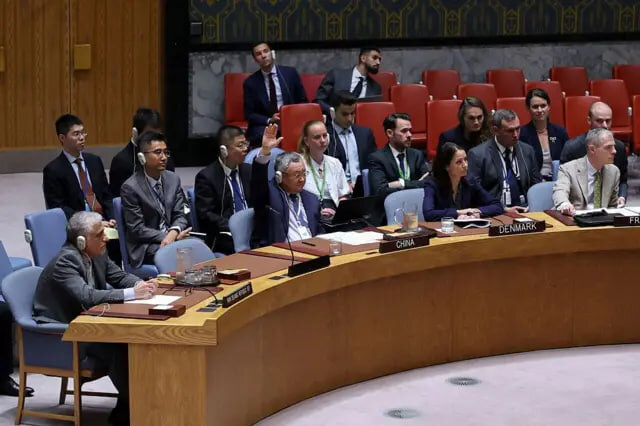
TEHRAN – After a controversial vote at the UN Security Council on Friday, senior Iranian officials opposed a decision to reimpose pre-JCPOA sanctions on the country, labeling it as “immoral and illegal” malicious acts that undermine international law and diplomacy.
The vote rejected a draft resolution by Russia and China that extended Iran’s sanctions relief for six months, thereby preventing the reconstruction or “snapback” of all previous UN sanctions. The so-called snapback mechanism was caused by the UK, France and Germany (E3) in late August, but despite being the original signatories of the JCPOA, the nuclear deal in 2015, which worked to dismantle during the diplomatic conflict over the issue during the recent months of diplomatic conflict.
Iranian President Masoon Pezeschkian, who met with New York’s UN Secretary-General Antonio Guterres, condemned the move as a direct result of American pressure and Europe’s surrender. “Despite Iran’s compliance and opposition from Russia and China, the implementation of snapback mechanisms and the reinstatement of sanctions is immoral and illegal,” Pezeshkian said. He urged the UN chief to use his authority to prevent this action, but he claimed that he rewarded American unilateralism and punished Iran’s compliance.
The president also contrasted the swift move to sanction Iran over the ongoing security council failure that prevented Iran from halting Israel’s ongoing genocide in Gaza. Pezeschkian said there are clear double standards for the application of justice by international organizations.
Iran’s Foreign Minister Abbas Aragchi was further pointed out in his remarks after the vote. Talking to the journalists, he filed a systematic lawsuit against E3 and the United States, putting the blame for the current crisis straight on their shoulders. “Today’s crisis is a direct result of the US withdrawal and Europe’s inaction. The US has betrayed diplomacy. E3 has filled it,” declared Araguchi.
He reminded the world that the International Atomic Energy Agency (IAEA) has issued 15 consecutive reports confirming full compliance with the 2015 Joint Comprehensive Action Plan (JCPOA). He detailed how Iran began to reduce its commitment only after the US illegally withdrawal from trade in 2018 and E3 did not respect its own financial commitments to Tehran.
Araguchi also highlighted the context of “state terrorism” – the US-Israel attack on Iran’s nuclear facility in June and the assassination of scientists, Iran endured without denunciation from his European counterparts. Despite this, Iran continues to act in good faith and recently said it had signed a new cooperation framework with the IAEA on September 9th.
“E3 cannot claim “significant non-performance” because it violated the transaction,” Araguchi argued, declaring that the snapback is “illegal, invalid and has no status.” He concluded with a warning. “The military attack has failed. The snapback will fail. The only solution is dialogue. Iran will not be under pressure. We will respond according to respect.”
Amid clear indications of Tehran’s dissatisfaction, the Iranian Foreign Ministry announced on Saturday that it had summoned ambassadors to Germany, France and the UK for consultation.
The JCPOA is a landmark contract reached in 2015 after years of negotiations, and saw Iran agree to strict restrictions on its nuclear program in exchange for lifting sanctions. The contract was unanimously approved by the UN Security Council in Resolution 2231.
The current crisis began in 2018 when the Trump administration unilaterally withdrew the US from the agreement and reimposed severe sanctions. E3 initially expressed regret, but ultimately failed to create a financial mechanism to protect legal trade with Iran from US penalties, effectively abolishing its own commitment. After waiting patiently for more than a year, Iran has begun a progressive and reversible reduction in the JCPOA obligations.
The “snapback” mechanism, which is a provision in Solution 2231, was designed to automatically reimpose sanctions if Iran is found to be in violation of the transaction. However, while the use of this mechanism in E3 is considered highly controversial, as it claims that the US has left the deal, Iran and other signatories argue that the European move is an abuse of a process aimed at killing the agreement forever.
Iran said it would abandon the deal it signed with the IAEA in Cairo and halt cooperation with the nuclear agency indefinitely once UN sanctions are returned. But lawmakers are calling for more measures, including leaving the Non-Proliferation (NPT) treaty.