
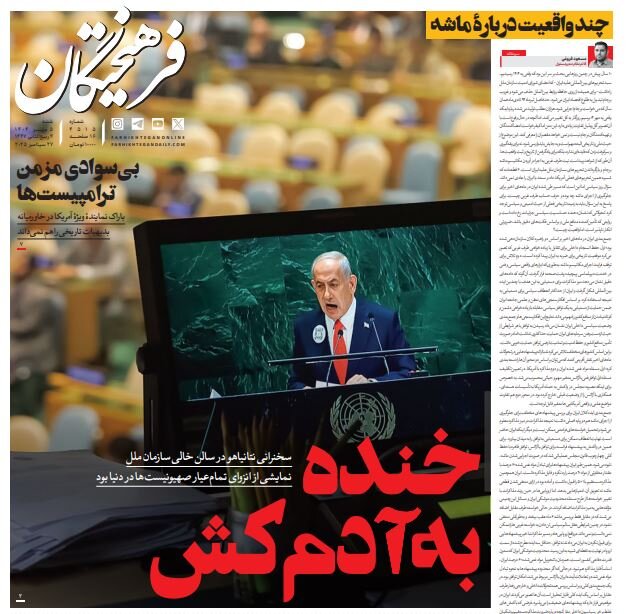
TEHRAN – In a memo, Fahhictegan addressed a statement from European authorities after China’s Russian solution to delay snapback sanctions against Iran failed at the UN Security Council.
It writes as follows: These statements illustrate a hypocritical game intended to condemn Iran for a failed negotiation. Europe proposed terms to Iran compliant Iran, but after implementing these terms, Europe and the US effectively brought negotiations to a deadlock by proposing new terms, including Iranian missiles and the impact of the region. In an interview with Israeli Channel 12, Macron argued that Iran’s proposal to stop the snapback was reasonable, but he refused to accept these proposals because “Araguchi’s words are not the words of the entire Iranian government.” These excuses showed that the European side had proposed terms from the start to avoid the agreement and buy more legitimacy in the media to activate snapbacks. Furthermore, such opposition announcements from Israeli channels shed more light on the background of such positions. The revitalization of snapbacks that led to the revival of international sanctions against Iran was designed from the start as a tool to put pressure on Iran. Europe and the US have sought to justify this mechanism by proposing an irrational situation and blaming Iran.
Hamshahri: The importance of nuclear power plants
Hamshahri writes: With the western Israeli axis in recent years trying to characterize Iran’s peaceful nuclear activities as a military program, Iran’s advance stage in nuclear power generation opens ways to alleviate electricity shortages. Western parties have tried to spend uranium enrichment for Iran in recent years, but enriched uranium has a variety of uses that have made the importance of continuing this process a strategic advantage. Today, it is clear to everyone that nuclear power plants have very long lifespans and many benefits, and the benefits cannot be ignored. This is while shortages in power generation and pollution caused by fossil fuel power plants have doubled the need for Iran’s nuclear power plants. Important measures have been taken in this area in recent years, both in the field of domestic and international cooperation, as well as issues that have become a strategic priorities for atomic energy organizations.
Ham Mihan: America’s goal in negotiations is to convince its public opinion.
In an interview with Hossein Beheshtipour, a senior international politics expert, Ham Mihan discussed Witkoff’s goals in negotiations with Iran, writing: Public opinion is extremely important to America. Especially when we hear that Iran has made a good offer, the American people think, and the US is not willing to negotiate with it. So he immediately says that we are willing to negotiate and that Iran needs to accept the negotiations directly and be willing to negotiate. This doesn’t mean he’s really looking for a solution, he’s trying to convince him that he’s not looking for war and conflict, and that he doesn’t want to show himself as an extraordinary person. Negotiations don’t necessarily lead to the outcome we want. Negotiations do not mean that our enemies definitely want to negotiate and reach an agreement. You can negotiate, but you cannot reach an agreement. In this situation, if the negotiation is the outcome itself, some people say, “It’s a fool to want to negotiate and don’t want to reach the outcome.” This means that you are a speaker and you are looking for a diplomatic solution, but you may not reach the desired outcome.
Javan: Rid lol and demonstration
Jawan wrote about Netanyahu’s speech at the UN General Assembly. It said: Netanyahu once again tried to justify the crimes of the Zionist forces in Gaza and attack Islamic countries as an action to fight terrorism. He also argued that Israel is carrying out these actions on behalf of the world, allowing other countries to live in peace and security. He even claimed that Tel Aviv is helping Gaza residents with humanitarian assistance, but Hamas is stealing them. This is an assertion filled with ridiculous laughs and laughter from the audience. As expected, political delegations left their seats and protests took place outside the headquarters of an organization that demonstrated global hatred towards Israel. Netanyahu holds his usual drawings, presenting Iran and the resistance groups as threats to world peace. This time he tried to ask questions, but with multiple choice responses that Iran and resistance groups in Gaza, Yemen and Lebanon are all threats to the international system that must be countered.